Rewiring Local Government for Citizen Engagement

Jason Lowther

The Institute of Local Government Studies (INLOGOV) has published a new report, Rewiring Local Government for Citizen Engagement, which sets out a compelling case for reimagining the relationship between local authorities and the communities they serve. At a time of structural reform, fiscal constraint and lower public trust, the report argues that citizen engagement must become fully embedded local governance, rather than a peripheral activity.

The report identifies three interrelated conditions that are essential for effective engagement. First, local authorities must convene inclusive democratic spaces that enable deliberation, dialogue and collective decision-making. These spaces, whether in the form of citizens’ assemblies, participatory budgeting or neighbourhood forums, can help to rebuild trust and foster more responsive policymaking.

Second, councils must invest in building community capacity. This involves supporting citizens, particularly those from groups whose views are often neglected, to participate meaningfully in public life. It also requires sustained investment in community infrastructure, such as local venues, networks and organisations, which provide the foundations for civic engagement.  The report recognises that 15 years of austerity since 2010 has significantly reduced the availability of community meeting places such as libraries, neighbourhood offices, youth and community centres, and cultural and leisure services.

Third, the report highlights the importance of co-producing public services. By involving service users in the design and delivery of services, councils can ensure that provision is more closely aligned with the lived experiences and priorities of local people. Co-production also fosters innovation and strengthens the legitimacy of public institutions.

The report draws on a wide body of academic research and practical experience, both in the UK and internationally. It shows that democratic innovations are already taking root in many councils, despite the challenges posed by austerity and institutional inertia. Examples include digital engagement platforms, youth-led initiatives, and the devolution of powers to neighbourhood and parish levels.

However, the report also acknowledges the barriers that councils need to address. Organisational cultures, limited resources, the need to develop new skills in officers and members, and legitimate concerns among elected members about the implications of participatory approaches can all inhibit progress. The report calls for leadership, reform and investment to embed engagement in the everyday practices of governance.

We pay particular attention on the vital role of councillors, who are well placed to act as facilitators and mediators between communities and institutions. Supporting councillors to develop these roles is essential if engagement is to be sustained and meaningful. The report also emphasises the need to engage young people and to make appropriate use of digital tools.

In conclusion, Rewiring Local Government for Citizen Engagement offers a clear and evidence-based framework for strengthening local democracy. It argues that by embedding citizen engagement in governance structures and practices, councils can foster trust, improve outcomes and build more inclusive and resilient communities.

We will be discussing our findings with councils, central government and related think tanks and sector organisations over coming months.

The full report is available here:

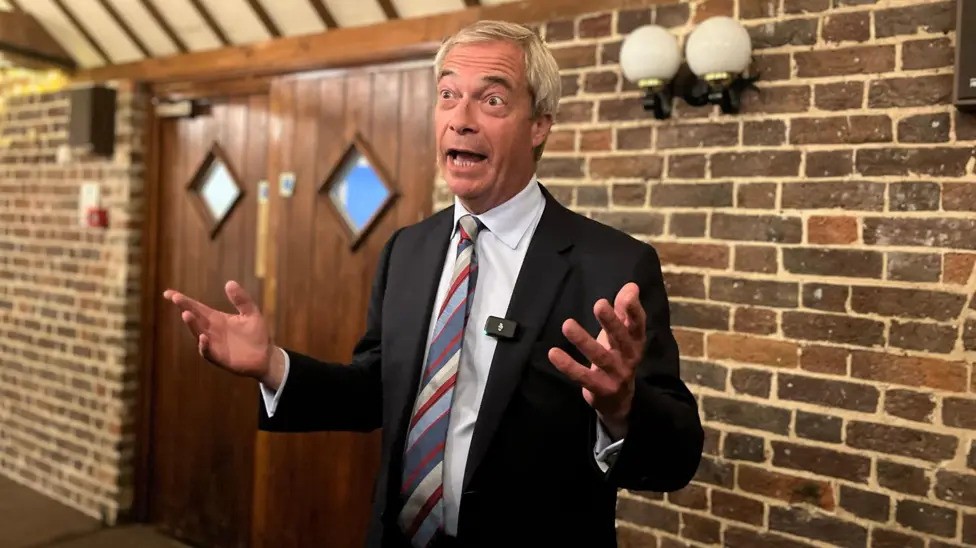
Win an election and implement your manifesto – that’s novel!

Image: Emily Sinclair/BBC https://www.bbc.co.uk/news/articles/c367lry5ypxo

Chris Game

First, a reader alert. What follows is in essence an only marginally revised column written for and hopefully published in this week’s Birmingham Post, to which for many years now I’ve been a regular contributor. Thanks, at least in part, to the “many years”, I’m permitted a wide scope of subject matter, but for obvious reasons local government in some form or other is what I tend to resort to most frequently – not least around local election season.

With the Post’s Thursday publication date, this is a mixed blessing, knowing that most readers interested in these matters would very likely have learned the results of the elections before they read one’s prognostications and predictions. What follows here, then, is my third column focused on this year’s local (County/Unitary Council) elections, which were, of course, limited to just 24 of England’s 317 local authorities (plus the Isles of Scilly) and precisely none in, never mind Birmingham, the whole metropolitan West Midlands.

Faced with the alternative option of ignoring the topic altogether, I decided to focus on the four West Midlands County Councils: three with biggish, if declining, Conservative majorities – Shropshire, Worcestershire and Warwickshire – plus STAFFORDSHIRE: Labour for decades, but Conservative since 2009, and, until the May council elections, with 55 Conservative councillors out of 62, almost as Tory as they come.

However … since last July, when the county’s parliamentary constituencies all went Labour, Nigel Farage’s Reform UK Party had been energetically hoping to build in Staffordshire on what statistically had been among its most promising performances. And indeed it did: Reform UK: 49 of the 62 County Council seats, leaving the previously controlling Conservatives with 10, and Labour, Greens and Independents 1 each. The Lib Dems, along with UKIP, the Workers Party of Britain and others, failed to score.

It typified results across the country. On what nationally was an exceptionally quiet election day, Reform UK increased its nation-wide base of just two councillors (both on Hampshire’s Havant Borough Council), to a relatively massive 677 (39% of the total seats contested) and gained majority control of no fewer than 10 of the 23 councils.

One can only speculate at some of the results that a fuller involvement of, say, the 130 unitary authorities, metropolitan districts and London boroughs might have produced. I concluded that Election Day column, though, not with any numerical predictions, but with Farage’s most publicised campaign observation/pledge: “We probably need a DOGE for every single county council in England”.

Which could have sounded a touch presumptuous from the Leader of a party who had approached that Election Day holding just two of the 1,700+ seats ‘up for grabs’ – but not from Farage.

I did wonder, though, what onlookers would make of that DOGE acronym (or, in some versions, D.O.G.E. – that’s how novel it is). Indeed, even Reform candidates, who probably knew at least that it stood for the love child of President Trump and the recently very departed Elon Musk’s Department Of Government Efficiency, trod carefully.

Created, they could possibly parrot, to “modernise information technology, maximise productivity and efficiency, and cut wasteful spending”, but did they have any real idea of how the function and office might work in a UK political context? Or did they possibly assume that, like so many campaign pledges, even if, rather incredibly, a DOGE majority did emerge, it would find itself, at least for the present, on the ‘too hard just now …. we’ve only just elected our Leader’ pile?

Certainly I, while having at least some idea of what county councils having an English DOGE might entail, would definitely NOT have predicted that, within just one month of those county elections, one of England’s biggest and traditionally most Conservative counties, KENT, would be preparing to face an ‘Elon Musk-style’ DOGE audit by a team of technical experts assembled specifically to analyse its £2.5 billion-plus budget spending and assess its financial efficiency.

Since the past weekend, the ‘Elon Musk-style’ bit will possibly have been played down, but not, seemingly, the ongoing implementation. With LANCASHIRE – £1.2 billion budget – already announced as next on the list, this just could prove insightful and potentially serious stuff.

Until May 1st, Kent County Council comprised 62 Conservatives, 12 Lib Dems, 4 Greens, 0 Reform UK.  Since then, it’s been 10 Conservatives, 6 Lib Dems, 5 Greens, and 49 Reform UK. If dramatic change is to be the agenda, Kent seemed an apt and attention-guaranteeing choice. 

By any measure, and almost whatever happens next, that – in my book, anyway – is an impressive achievement. There’s been, predictably enough, ‘Establishment’ outrage – “a superficial response to the deep problems of local government” … “initiating a review of local authority spending misunderstands the circumstances facing local authorities … All councils have been caught in an iron triangle of falling funding, rising demand, and legal obligations to deliver services. In that context every local authority has had to make difficult choices to cut services …” (Institute for Government).

On the other hand, win an election and implement your party manifesto! – a demonstration that turning out and voting in local elections, even in our exceedingly non-proportional electoral system – can produce policy action.

Or, rather, especially in our exceedingly non-proportional electoral system. Two of the new Combined Authority mayors (outside the West Midlands) were elected on under 30% of the votes cast, and obviously a much smaller percentage still of the registered electorate.

This follows the recent ditching of the Supplementary Vote in favour of ‘First-Past-The-Post’, where voters pick just one candidate, and the one with the most votes wins – even if, as this time in the West of England, that percentage was under a quarter of an already very modest turnout.

To me, anyway, it’s arguably even more important in these local/Mayoral elections than in parliamentary ones – for us, the elected Mayors, and democracy generally – that voters can indicate their first AND SECOND Mayoral preferences, thereby ensuring that, however low the turnout, the finally elected winner can claim the support of at least a genuine majority of voters.  Which means electoral reform – but that’s another column/blog.

Chris Game is an INLOGOV Associate, and Visiting Professor at Kwansei Gakuin University, Osaka, Japan.  He is joint-author (with Professor David Wilson) of the successive editions of Local Government in the United Kingdom, and a regular columnist for The Birmingham Post.

Transport issues are the most common concern raised in residents’ petitions in London local government

Richard Berry

The e-petitions system introduced by the UK Parliament has gained considerable attention in recent years. This is often when a noisy cause claims hundreds of thousands of signatures and forces its way onto the parliamentary agenda. At the time of writing, for instance, there are live petitions for suspending all immigration, rejoining the European Union, reducing the state pension age and changing the parliamentary electoral system.

One might question the feasibility of these suggestions. They may indicate high levels of popular support for an idea, however they call for major shifts in government policy, significant investment of public funds or far-reaching legislative change. Governments would ordinarily have determined their stance on such ideas without any further prompting from petitioners, even significant numbers of them.

In contrast, local government should be fertile ground for petitioners. The subjects of petitions submitted to councils are often hyper-local issues and, in theory at least, much more realistic in their ambitions.

Catherine Bochel and Hugh Bochel have studied the use of petitions in English local government and described the benefits to both local authorities and their residents. In summary, they have found petitions can provide access to politics for citizens without requiring a significant amount of resource. A well-run petitions system can come to decisions that are seen as fair by the petitioners, even if they do not get their desired outcomes, and can provide an educative function. For councils, a petitions system can be a means of receiving ideas and information, which may inform future policy development and service provision.

The London Assembly Research Unit has recently conducted research into how petitions are used in local government in London. We found that 28 of the 32 London boroughs (87.5%) offer an e-petitions platform on their websites. In a couple of boroughs these are only accessible to registered users of the site – that is, local residents with an online account with the council – but in most cases they were accessible to any visitor to the site.

Looking at the calendar year 2023, we were able to obtain data on the number of submitted petitions for 26 boroughs. There was significant variation, with Barnet Council receiving 45 petitions and some not receiving any. The average per borough across the year was 11 petitions.

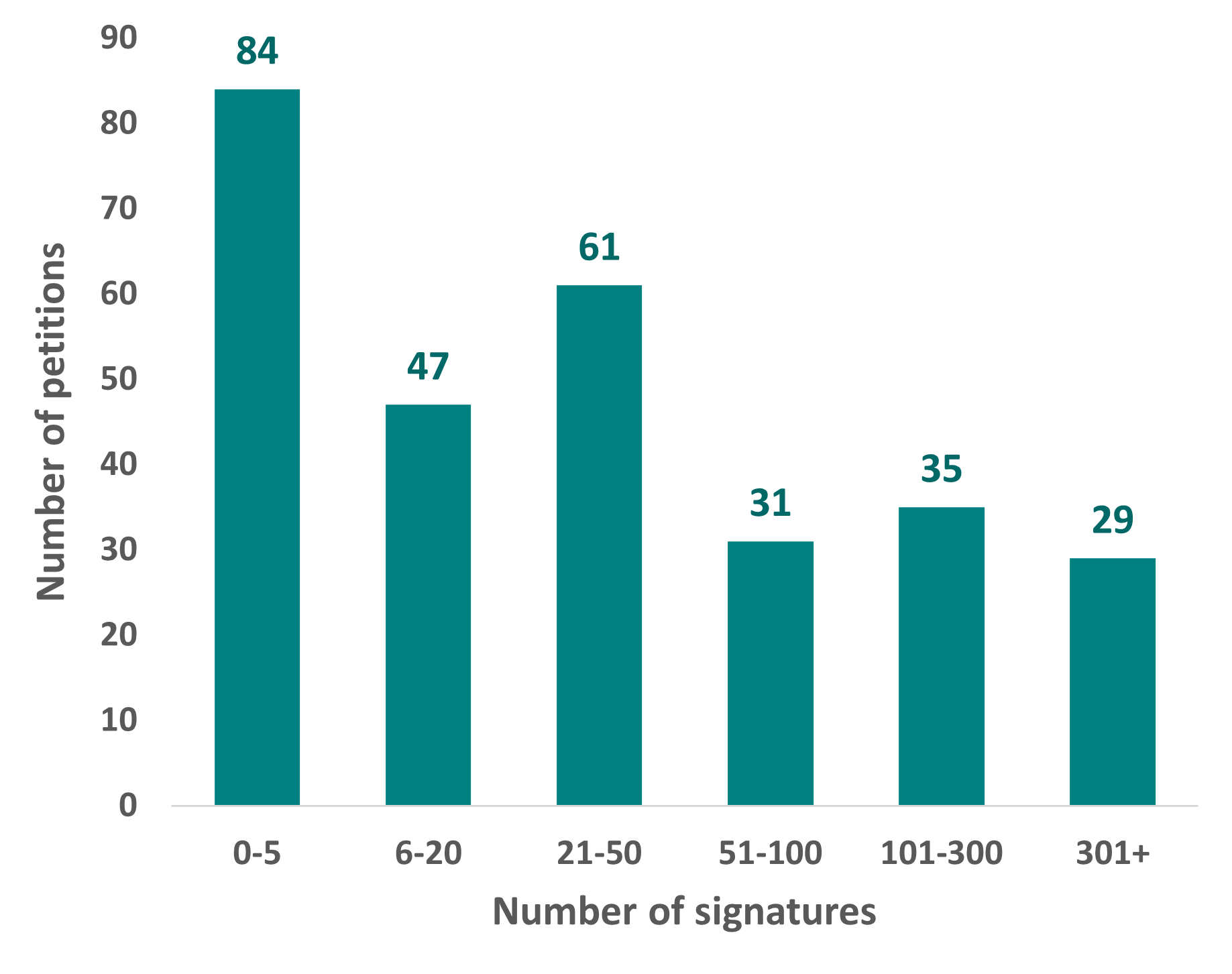
Chart 1 below presents information on the number of signatures received per petition. Most received relatively few signatures, with 26 being the median number of signatures. However, a few received very high numbers – 11 petitions across all boroughs received more than 1,000 signatures – bring the mean number of signatures per petition up to 187.

Chart 1: Number of signatures on e-petitions to London boroughs, 2023

Source: London Assembly Research Unit. Based on petitions data for 26 out of 32 boroughs

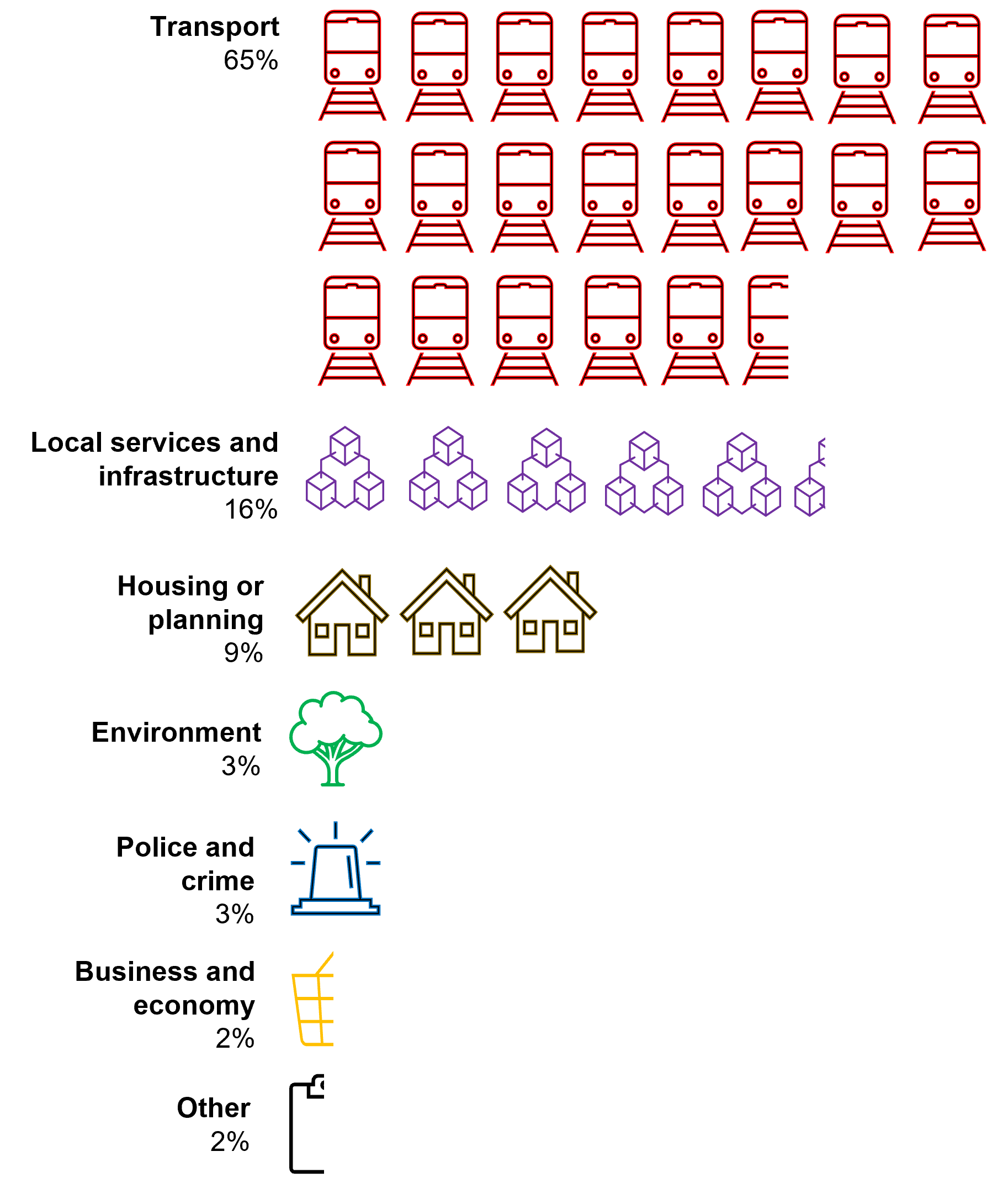
We also considered the topics of petitions submitted to boroughs. We found, somewhat surprisingly, that there was one dominant theme, transport, as shown in Chart 2.

In London, responsibility for most public transport and control of major roads is held by a city-wide strategic authority, Transport for London, overseen by the Mayor of London. Yet boroughs still control the majority of London’s roads, and we found this is where many petitions focused, as people sought changes to the streets where they live.

We see, for instance, that 71 residents of the London Borough of Ealing have called for the enforcement of the speed limit on one local road. 157 residents of the City of Westminster supported moving the location of an e-bike parking bay that had been blocking the pavement in one area. In the London Borough of Sutton, 52 residents signed a petition for the resurfacing one road in a state of disrepair.

Chart 2: Topic areas of e-petitions submitted to London boroughs, 2023

Source: London Assembly Research Unit. Based on petitions data for 26 out of 32 boroughs

The growth of online petitions systems has been the perhaps the most important development of recent times in this field. Another change that has coincided with the rise of e-petitions is that, from being the passive recipient of petitions generated externally, local authorities are now playing an active role in hosting the online platforms on which petitions are managed.

This was encouraged by the 2009 Local Democracy, Economic Development and Construction Act, which places a requirement on English local authorities to operate schemes for the handling of petitions from local residents. Although this requirement was repealed just two years later in the Localism Act 2011, systems had been introduced and in many cases have remained. In a very real sense, they are helping to facilitate campaigns focused on challenging councils’ own policies, which itself is a sign of a healthy democracy.

Richard Berry is the manager of the Research Unit at the London Assembly, which provides an impartial research and analysis service designed to inform Assembly scrutiny. The author would like to thank Kate First and William Weihermüller for conducting research cited in this article. All publications from the London Assembly Research Unit are available here.

Dusting down the cautious welcome: Initial reflections on the devolution white paper

Phil Swann

When I was director of strategy and communications at the LGA I was frequently criticised, by the late professor John Stewart among others, for issuing press releases “cautiously welcoming” one Blairite initiative or another.

The criticism was probably justified, but I would definitely have deployed that phrase in response to the government’s recently published devolution white paper.

There is undoubtedly a lot to welcome, not least the stated commitment to devolution, the additional powers for metro mayors, the revival of strategic planning, its reference to struggling small unitary councils and the focus on audit and standards.

There are, however, at least four reasons to be cautious.

First, every serious reformer of local government since George Goschen in the 1860s has argued that local government finance and structures should be reformed together. No government has ever had the political will or energy to do so. This government has also ducked the opportunity. As a result, this white paper will not fulfil its potential.

Second, the current mess and confusion in the structure of English local government is the result of incremental change. Just think of Peter Shore’s “organic change” and Michael Heseltine’s ill-fated Banham Commission. There is a real danger that this government will run out of restructuring energy or time. The contrast with Scotland and Wales, where local government was reorganised in one go, could not be starker.

Third, the effectiveness of the structures being proposed will depend on the quality of the relationships between mayors and councils, between councils and parishes and between ministers and mayors, councils and parishes. In England we are not good at relationships like these and there is precious little in the white paper to signal the trust, effort and imagination that will be needed to make these relationships work better than the previous ones did.

Finally, key to the revival of local government and effective devolution is a revival of citizen engagement in local politics and local governance. Word has it this will be addressed in a forthcoming white paper, but it should be central to this one.

So, a very cautious welcome it is.

Phil Swann is studying for a PhD on central-local government relations at INLOGOV.

Local Democracy in Crisis?

Peter Hetherington

Battered by fourteen years of austerity, is local government losing its once-proud standing and status? Probably. For a start, It’s no longer as ‘local’ as it should be. And it certainly isn’t ‘government’ as we once knew it.


These days, we sometimes tend to lump ‘democracy’ and ‘crisis’ together in a global context, forgetting that close to our doorsteps – in countless civic centres, town and county halls – there’s another crisis: restoring faith in local democracy, while sustaining councils literally facing insolvency.

At a hybrid event, organised by the Centre for Urban and Regional Studies at Newcastle University, we asked a simple question at the start: Do we need a new, positive direction for once-powerful towns and communities where meaningful democracy has disappeared as local government has withdrawn?

We attracted a great range of speakers putting, broadly, two cases: first for a new local government structure in England based on economic geography embracing combined authorities for big city areas alongside large county-wide single purpose unitary authorities, underpinned by a more equitable funding formula; and, secondly, for varying degrees of town and parish governance, sustained by participatory democracy, including citizens assemblies, with powers – parks, libraries, leisure facilities for instance – devolved from existing larger authorities. Often, such an asset transfer is born out of necessity because larger councils can’t afford to keep them anyway and parishes/towns can raise money through a council tax precept while sometimes creating stand-alone community interest companies.

The case for a genuine new ‘localism’ appeared strong. That’s because, currently, a continuing process of abolishing councils to create larger units with few, if any, local roots has created a sense of powerlessness, a collective loss of identity with little or no attachment to people and places. Fifty years’ ago England had almost 1200 councils, from the smallest urban/rural district to the largest city. “We were run by our own,” recalled the writer, broadcaster and ultimate polymath Melvyn Bragg, in his 2022 memoir ‘Back in the Day’. Born in Wigton, Cumbria, his small town had a rural district council (which I knew well): “We could challenge the elected councillors who made the decisions” Bragg continued. “They were not a separate cadre…they were just people you had been to school with…(approach) on the street…to whom you could write a personal letter knowing it would be read, considered, answered.”

No longer. His council disappeared in 1974. Today, after several rounds of ‘reorganisation’ under the dubious label of efficiency – although there’s little concrete evidence of cost saving – that number has been reduced to 317, with little if any public debate. A forthcoming devolution White Paper is expected to advocate more reorganisation and even fewer councils in a country where local authorities already cover much larger areas than in mainland Europe.

Against this background, it’s probably no surprise that Carnegie UK, in its recent ‘Life in the UK’ index, reports that a lack of trust in politics and government is undermining collective well being. Three-quarters of people, says Carnegie, feel they can’t influence decisions. Surely reconnecting them begins locally. But how local?

If the government’s approach so far is a broad definition of ‘taking back control’, could an over-arching contradiction be emerging? Will the apparent obsession with more all-purpose councils, the prospect of an all-unitary England – similar to the structure in Scotland and Wales – make people feel even more distant from power, disaffected? Carnegie insists that restoring faith in democracy should be the Government’s ‘mission of missions’.

If that’s one challenge, there’s another, interlinked: the crisis of financing local government, with 7 councils theoretically insolvent and many more heading that way; legally, they can’t go bust and have been forced to borrow the equivalent of pay-day loans on a mega-scale to stay afloat, adding to a debt mountain. Now Conservative-run Hampshire has said issuing a section 114 notice – prelude to technical insolvency – is “almost inevitable”, with a sting of others close behind. And as Prof Andy Pike, and Jack Shaw have outlined in their recent excellent, but chilling paper (‘The geography of local authority financial distress in England’) 96% of English councils won’t balance their books by 2026-27.

Of course, alongside that unparalleled financial crisis in local government, we’re also facing an alarming democratic challenge nationally with the lowest turnout ever recorded in the recent general election; almost half the electorate didn’t vote! Surely, the place to renew trust in the democratic process begins at the grass roots, perhaps reviving some of the 10,000 town and parish councils, some of which want to take over functions from larger authorities (some are obliging out of necessity). Could this – call it double devolution – provide one small way forward?

I’m aware there’s a danger that events, like the latest one at CURDS addressing the crisis in local democracy, can produce a combination of hand-wringing and hot air. But, hopefully, we concluded with a practical, positive outcome. As Professor Jane Willis, geographer and champion of community empowerment – now in Cornwall- noted: “It’s not all gloom and doom – there is good news.” In her county, communities are taking back control, again out of necessity – a really positive story and a lesson for elsewhere? Willis advocates a new social contract under a layered system of local government to “re-franchise” people.


In the meantime, the chair of the event urged those present to make their views known to MPs, and the government, as the forthcoming devolution White Paper foreshadows a pre-legislative consultation process. As Professor Andy Pike, of CURDS, noted in summing up, one leading question needed answering above all: “What is local government for, and how to fund it?”


All we know so far is that the White Paper, according to the Treasury, will include …“working with councils to move to simpler structures that make sense of their local area with efficiency savings from council reorganisation helping to meet the needs of local people…”. Contradictory or otherwise – will more larger councils “make sense” of local areas? – we must surely intensify a campaign for a genuine new ‘localism’, embracing places, communities, towns and some cities now without any form of local government. That doesn’t necessarily mean sidelining the case for a new – and/or revised – local government structure in England tied to a ‘needs’-based funding formula. The current one favours the richer parts of the country and penalises the poorest with the lowest tax bases.


But the time for national government to act is during the first year or so of a new administration. It assuredly won’t go down well with the ‘middle England’ target readership of – say – the Daily Mail. There’ll be howls of protest. But it must be a priority to bring a sense of fairness to a deeply unequal country and, equally importantly, deliver some hope to voters in the so-called ‘red wall’ seats who either returned to Labour at the last election or voted for an ascendant Reform. We live in a fragile democracy. Restoring faith in government, local and national, begins in community, neighbourhood parish and town. We need the Labour government to think big and act local. We haven’t much time.

Peter Hetherington is a British journalist. He writes regularly for The Guardian on land, communities, and regeneration.  He is also a vice-president, and past chair of the Town and Country Planning Association, former regional affairs and northern editor of The Guardian and the author of the 2015 book, Whose Land is Our Land? The use and abuse of Britain’s forgotten acres, and the 2021 book, Land Renewed: Reworking the Countryside.

The Little Black Book of the Populist Right

Jon Bloomfield

The spectre of the Populist Right haunts our politics: Farage and Trump, Orban and Le Pen. Why and how has this reactionary movement managed to redraw the political map from Warsaw via Workington to Wisconsin? Co-written with playwright David Edgar, our Little Black Book of the Populist Right is a crucial analysis of one of the greatest challenges of our time. Who votes for the 21st century demagogues eroding our politics – and why? What structural forces have aligned to enable their rise to power around the world?

In one short book, we provide a concise, accessible history and analysis of the Populist Right.

  • How the failures of globalisation – wealth inequality, outsourcing, the instability of global financial markets – and the retreat of social democratic parties from their traditional defence of ‘the labour interest’ and public services has left the space for cynical right-wing demagogues to exploit and come to power under the guise of “taking back control”.
  • How its ideology of national populism rewrote the right’s playbook, throwing up charismatic, often racist leaders, who appealed to new coalitions of abandoned voters.
  • How descendants of the interwar far right sanitised their parties, new anti-immigration movements emerged in Europe and the populist right invaded existing mainstream parties in Britain and America.

The book exposes the fallacies, flaws and fantasies of national populism. It tackles head-on the ideas of its main ideologues – the 4 Gs: Matthew Goodwin, David Goodhart, John Gray and Maurice Galsman. It then shows how progressives can fight back.

To halt the forward march of the populist right, we argue for a new paradigm, a progressive, bold vision of an alternative globalisation; a politics built on empathy and solidarity; new industrial and urban development strategies; and much, much more.

“Combines clear and concise analysis with a compelling case for action” Professor Jonathan Portes.

“A brilliant book” Neal Lawson, Director of Compass.

“Vital reading” Helena Kennedy KC

Available in all good bookshops £9.99 or on-line. Populist Right — Byline Books

Dr. Jon Bloomfield. Honorary Research Fellow, Institute of Local Government Studies, University of Birmingham.