Renewing Democratic Leadership

Jason Lowther and Sonia Bussu

Legislative Theatre with West Midlands Combined Authority

As local government in England undergoes significant restructuring, with fewer councils serving larger and more diverse populations, the role of councillors is under pressure. At the same time, democratic innovations, such as citizens’ assemblies, or creative methods of participation, such as legislative theatre and digital engagement, are gaining traction. These innovations offer new ways to engage communities and strengthen democratic legitimacy.  But how do they fit with the role of elected councillors?

Recent research and practice suggest that councillors can play a crucial role in facilitating inclusive and impactful citizen participation.

Politicians’ Views on Participation

Across the UK and Europe, many elected representatives have expressed support for citizen participation in policymaking. They see it as a way to build trust, improve decision quality, acknowledge a wider range of perspectives and knowledge, engage citizens more deeply in political life, and potentially identify novel solutions to politically difficult issues. However, research by Kersting shows that this support is often conditional. Councillors tend to favour participatory instruments that reinforce their representative role, such as advisory boards or structured consultations. They are more sceptical of online platforms and randomly selected citizen assemblies (so-called minipublics), which they worry may not be genuinely representative of their electorate and may lack the capacity to understand complex issues.

Werner and Marien’s comparative experiments in Sweden and the Netherlands provide further insight. Their work shows that participatory processes consistently increase perceptions of fairness. This matters because fairness perceptions are closely linked to trust, policy compliance, and perceived legitimacy. Importantly, these effects are not limited to winners (who support the outcome of the exercise); even those who lose in participatory decisions tend to view the process more positively than in purely representative settings.

These findings highlight a tension. While democratic innovations can enhance legitimacy, councillors often feel uncertain about their role within them. Without open discussion, clear support, and integration, these processes risk bypassing councillors altogether.

Reimagining the Role of Councillors

Inlogov’s 21st Century Councillor research offers a compelling framework for renewing councillors’ roles. It describes councillors as hybrid connectors who build relationships both online and offline, multi-level diplomats who navigate partnerships across governance layers, and system stewards who shape democratic innovation and institutional change.

To fulfil these roles, councillors need support. This includes help to understand democratic innovations and any potential concerns.  They need understanding of key areas such as facilitation skills and digital engagement, confidence in narrative-building around democratic innovation, access to mentoring from peers with experience of these approaches, opportunity to explore difficult scenarios, and chance to reflect on their practice. Councils must also empower community members to scrutinise participatory outputs, and help councillors to navigate tensions between citizen input, officer advice, and party lines.

The Camden Model: Embedding Participation

Camden Council offers a practical example of how participatory processes can be embedded within representative governance. The council has institutionalised citizens’ assemblies as regular tools for major policy development, including planning, climate change, and health and social care. Assemblies are commissioned by council boards, which commit to formally responding to recommendations. In the case of the 2019 Climate Assembly, all 17 proposals were endorsed and integrated into Camden’s Climate Action Plan, with the citizen’s assembly referenced throughout the document.

This approach demonstrates how local government can lead participatory processes, ensuring they are not just consultative exercises but integral to policy development. However, several recommendations from the Camden climate assembly extended beyond the council’s jurisdiction, highlighting the structural limitations of local deliberative processes in addressing systemic issues like the climate. Councillors could have played a stronger bridging role, helping to clarify expectations and ensure that recommendations were grounded in the council’s remit. Stronger involvement from elected representatives might have thus enhanced democratic accountability.

Inclusive youth engagement in policymaking in the West Midlands

There is much more to learn and do to make democratic innovations more inclusive and effective, supporting participation from historically marginalised groups, which tend to ignore invitations to participate in citizen assemblies or formal consultation exercises.

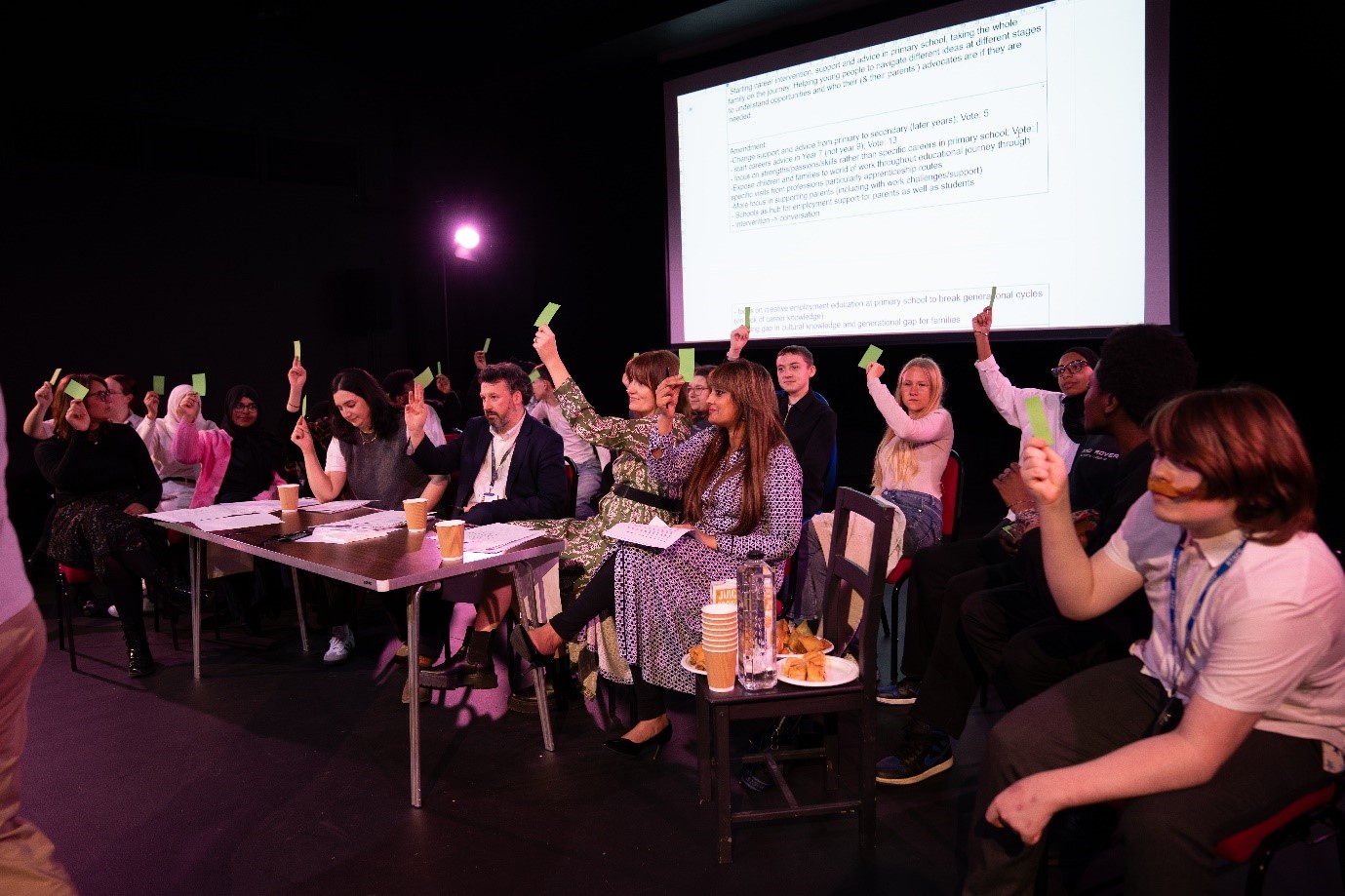
A recent example of inclusive approaches comes from the West Midlands, where the INSPIRE project, led by the University of Birmingham, used legislative theatre to engage young people in shaping youth employment policy. Legislative theatre is a method developed by Augusto Boal that uses performance to explore lived experience, test policy interventions, and co-create solutions. It involves watching a play co-created by the participants on real issues and based on their lived experience. During the event, an audience of community members and policymakers become spect-actors, acting out alternative scenarios, proposing policy changes, and voting on them in a public forum.

The University of Birmingham partnered with the Young Combined Authority and Youth Focus West Midlands to recruit a diverse group of 15 young people (14-17 years old) who, under the guidance of legislative theatre practitioners, developed a play about barriers to work experience and youth employment. Through performances and structured dialogue with policymakers, they co-created six policy proposals. These include reforms to careers advice, work experience, and employer accountability.

Crucially, policymakers were invited to participate not just as observers but as co-creators and champions. Their involvement can help bridge the gap between lived experience and institutional action, demonstrating how local government can play a central role in democratic innovation for social change.

Councillors as Democratic Innovators

Democratic innovations in Camden and the West Midlands are two examples of how local government can promote democratic renewal. Councillors can and should play more central roles in these processes, beyond party politics, to facilitate and nurture dialogue between citizens and institutions, ensuring follow-through on recommendations, and using committee structures to embed participatory outputs.

Rather than seeing participation as a threat, councillors can embrace it as a tool to strengthen their representative role and reconnect with communities. They are uniquely positioned to bridge the gap between citizen voice and institutional action. This requires a shift in mindset and practice.

Dr Jason Lowther is Director of Inlogov (the Institute of Local Government Studies) at the University of Birmingham, and was Assistant Director (Strategy) at Birmingham City Council from 2004 to 2018.  His research focuses on the use of evidence in public policy and central intervention in local government.

Dr Sonia Bussu is an Associate Professor at the University of Birmingham Department of Public Administration and Policy where she studies and teaches public policy. Her main research interests are participatory governance and democratic innovations, and creative and arts-based methods for research and public engagement. 

This article was first published in the Municipal Journal, 25th September 2025, available online here: https://www.themj.co.uk/renewing-democratic-leadership

Picture credit: Inspire Legislative Theatre, March 2025 – photo by Bucuria Maria Polodeanu – Insta: @reelmasterproduction

Politicians’ conceptions of fairness

Clive Stevens

“You won’t find many of them”, people quip when I tell them the title of my PhD; and my riposte, “that’s why I asked councillors”. And I was right; interviews with 17 councillors across four parties have revealed over 2,000 examples. Conceptions include: equality, proportionality, equity, fair opportunity, market fairness, fair administrative process and more. These conceptions were collected during the semi-structured interviews based on four carefully crafted vignettes (case studies). Thematic coding assisted their allocation into eight broad types (Realms) along with sub-categories like reciprocity, merit and efficiency. Sometimes the councillor denied they were talking about fairness, but they were; a simple reframing, usually changing a point of view, clarified the analysis, for example, council efficiency can be reframed as value for money and thus fairness to the taxpayer.

My PhD can be likened to an exploration. With me, the explorer, finding snippets of theory from various academic sources each describing a type of fairness and sometimes disagreeing with another. Thus equipped, I ventured into the jungle, Bristol City Council, and witnessed, watched and registered actual conceptions coming from actual politicians. I returned relatively unscathed and after analysis discovered much that agreed with theory but also much else. I now have a clear report to deliver about the eight, strange, fairness-beasts that rule their Realms and what happens when they mix.

Combinations

The findings map out the Realms more accurately and show that in certain circumstances a combination of Realms can elicit quite strong responses. For example, in one vignette, six councillors wanted to request a breach of council-house regulations to allow a tenant to sublet her flat. Reasons varied, but many were drawn to the description of her disadvantage, escaping an abusive relationship, and were impressed that despite all her problems she had not only sought work but actually landed a job. “Respect” and “this is the type of person we should be helping” were two of many responses. However, an equal number of councillors were totally unimpressed and thought she should be served notice as per the tenancy. 

Another vignette, about a large donation to the Children in Care Service, offered councillors three policy options. Eight wanted to make policy changes; and every one of those changes was based on making the choices fairer.

Fair Process or Outcome?

With this more reliable set of fairness definitions, the data can be analysed in many ways. For example, there is debate about whether fairness in Local Government should be about fair process or fair outcome, some arguing one way and some the other. I recall a council officer telling me that if a decision follows fair process from a fairly formulated policy, then it must be right whatever the outcome. But is that fair?

This data lets me measure the number of conceptions of fair process and the number of conceptions of fair outcome; there was little difference whether the councillors were male or female, new or experienced, and from different parties. But it did change and dramatically, if the councillor was or recently had been in a cabinet or committee chair position compared with backbench councillors. The latter group were much more interested in fairness of outcome. This is a finding from a qualitative study, so not definitive, but I’ve already had a number of conversations saying “that’s not surprising” each with suggested reasons. Perhaps a more rigorous study could be done.

Party Dogma?

Another question I’m asked is about the influence of parties. The interviews were conducted singly and confidentially; I hope I reached the councillors’ true views. One vignette asked them to come to a conclusion and vote based on their values, and then asked whether their vote might change if it were whipped. Many said they might change out of loyalty. Loyalty, like fairness, is a moral value and clearly quite powerful.

Wicked Problems

One of many potential uses is in understanding intractable “wicked” problems. These are made more wicked if there are value differences between the stakeholders. Fairness is a human value, so perhaps an understanding of fairness could assist in some small way to make headway with such problems that seem nowadays to be popping up everywhere.

What next?

I have just entered the final year; out of the jungle but not quite out of the woods, yet; there’s a lot of writing up to do, and then I’d like to use the findings and meet up with people interested in better understanding other councillors’ or parties’ values.

An ex-councillor in Bristol and author of the book on Local Government, After the Revolution, Clive followed up on politicians’ conceptions of fairness. He is now his final year of a PhD at the University of Bristol, interviews complete and writing it up. His personal blog site is: https://sageandonion.substack.com/

Openness of council finances is key for a functioning democracy

Matty Edwards, Research For Action

Local authorities are under immense pressure to find savings whenever they can. After more than a decade of austerity, the collective deficit in the sector is expected to reach £9.3bn by next financial year. Local authority finances have also become increasingly speculative, as budgets are prepared on the basis of unpredictable grant allocations and single-year financial settlements, sometimes without audited accounts. Pressures to find new sources of income through commercial investments and private sector partnerships have also increased the complexity of council funding.

This creates a challenge: scrutiny of local government finance is more important than ever. Yet even with the best intentions, local authorities struggle to produce open and accessible financial information. 

In a research collaboration between Research for Action and the University of Sussex, we set out to explore how financial information — such as council budgets and accounts — could be made more accessible to the public. Our research found that even experienced researchers, accountants and councillors struggle to find and understand local authority financial information.

We spoke to 26 people from the local government sector over three months this spring to examine barriers to making local authority financial information accessible to councillors and the wider public. Interviewees included councillors from a range of authorities, council officers, academics, accountants, journalists and key sector bodies like CIPFA. 

Our key findings were a lack of standard reporting requirements, strained council capacity after years of austerity and a fragmented data landscape with no standard formats for publishing financial information. These barriers make it difficult to understand a single council’s finances and make comparisons across the sector, hindering effective scrutiny by councillors and journalists, and democratic participation by the public. 

Some interviewees argued that accessibility was less of a priority in the face of a mounting crisis in local authority finances, but in our view, openness is not a luxury. It is key to effective local democracy. 

How to improve open up council finances

Based on our findings, we set out a series of recommendations for greater transparency and openness. 

The government should introduce new data standards for local government to improve accessibility, potentially via a Local Government Finance Act. This should include making financial information machine readable where possible and using accessible file formats. An easy win in this area would be to create a single repository for all local government financial information.

Local audit reforms are also an important piece of the puzzle. The new Local Audit Office (LAO) should be made responsible for local government financial data, including making it publicly available with tools to enable comparison and oversight. A more ambitious idea for the new LAO could be to create a traffic light warning system for the financial health of local authorities based on indicators that are timely and easy to understand, taking inspiration from Japan

Council accounts were highlighted as a particularly technical and opaque part of local government finance. That’s why councils should be mandated to attach a narrative report to their annual accounts, as previously recommended by the Redmond Review.

We think that the Local Government Data Explorer, recently scrapped, should be replaced with a data visualisation that is genuinely accessible and interactive, perhaps taking inspiration from a dashboard created by academics in Ireland. There should also be funding for local open data platforms, because there have been isolated examples of successes, such as the Data Mill North. 

The other part of the problem is that councillors often don’t have the knowledge and skills to properly scrutinise the complicated world of local government finance. That’s why we’re calling for greater support and training for councillors to enable better financial scrutiny, as well as public resources to improve literacy around local government.

While the sector faces great upheaval in the next few years through local government reorganisation and English Devolution, these reforms also present an opportunity to improve transparency – whether that’s at unitary or combined authority level. 

We believe that greater openness will ultimately facilitate better public participation and healthier local democracies.

Matty Edwards is a freelance journalist based in Bristol who also works for Research For Action, a cooperative team of researchers that in recent years has investigated PFI, LOBO loans, the local audit crisis and scrutiny in local government.

Cyclopean ‘local’ government and the end of local democracy?

Chris Game

As with another quite recent blog of mine, it’s important to start with the alert that most of its style, structure and content stem directly from its having been written in the first instance not for an academic readership, but as a column for probably this week’s Birmingham Post. There are a few additions and subtractions, plus, barring a dramatically uncharacteristic Lowtherian intervention, one guaranteeable difference: the title.

At the time of writing this intro I don’t know for certain what the Post editor’s choice of words and punctuation will be – except that it won’t comprise nine words, including three longish ones. Space and layout, you understand. It will, however – because regular authors do have at least some bargaining ‘say’ – open with that key word that many/most Post readers will barely recognise.

To summarise the whole thing: here in Britain we already have, and in England, following last December’s devolution White Paper, are about to develop still further, a scale of ‘local’ government that makes a complete mockery of the term ‘local’; and the present Government, with no noticeable public consultation, is embarked on increasing that non-local size still further – to truly Cyclopean dimensions.

And, as I sought to explain to the Post editor, by introducing this concept, rarely if ever used in modern political debate, both the Post and I will become – well, you never know – possibly a little bit famous. Here’s the reasoning.

First, ‘Cyclopean’, used in the context of local government.  Ancient Greek, pretty obviously, it originally described an architectural style in which the walls, towers and other fortifications of ancient cities like Mycenae (a 70-odd mile day trip SW of Athens) were constructed from massive limestone boulders – of the scale shown in the accompanying illustration – fitted extremely closely together without apparently having been substantially reshaped and without use of mortar or cement. 

So preternaturally impressive were these city constructions – the hilltop Mycenae was perhaps the most famous, but there were numerous others – that the myth developed that they must have been built by the Cyclopes, a race of superhuman giants in Greek mythology, and the only humans physically capable of creating such constructions. Hence ‘Cyclopean’ – to describe the assumed method and scale of a city’s governmental architecture, not the size of its residential population.

Somehow, though, towards the latter end of the 3,500 intervening years, the UK has developed, to an almost unique degree, its own interpretation of ‘Cyclopean local government’. Yes, there are loads of large buildings – Birmingham’s Council House and Central Library for starters, the Octagon, etc. – but there’s no Cyclopean mystery about what holds them together. Put crudely, it’s the concrete and steel, not some mystical manpower.

The UK’s, and particularly England’s, modern-day local government and its latest structural ‘reform’ have become almost entirely about scale. Instead of referring to the governance of, or provision of services for, a particular local community and its unique character, England’s ‘Cyclopean local government’ currently comprises just over 300 ‘local’ authorities, with populations averaging 180,000 – which is hardly our (or anyone’s) ‘everyday’ usage and understanding of that term ‘local’.

And yes, averaging. Which, of course, would make Birmingham’s 1.2 million population ‘super-Cyclopean’ – and the West Midlands Combined Authority’s 4 million ‘Mega-Cyclopean’. Or ‘hyper-Cyclopean’, which I personally slightly prefer, suggesting something beyond the bounds of reason, or control. We’ll return to that.

Some quick comparisons or contrasts: average size of German and Italian municipalities is around 7,500, Spain’s 5,700, and France, albeit as exceptional in its way as the UK, 1,900. Yes, slightly under one-hundredth the size of our average, and, by chance, roughly the same as our smallest, the Isles of Scilly, arguably our one ‘municipality’ that wouldn’t make a mockery of the term ‘autorité locale’.

The rest of the world, or first-time observers, find our scale figures as extraordinary as the Ancient Greeks found Mycenae. They are naturally curious as to how we do anything purporting to be genuinely ‘local’ government on such a manifestly non-local scale, and, above all, why.  Good questions, but not for a local newspaper column. Indeed, not for the likes of us mere citizens and voters either, because no one’s bothering to ask us.

The major redesign of England’s local government is currently in the hands of Angela Rayner – Deputy Prime Minister + (in any spare time) Secretary of State for Housing, Communities and Local Government.  An early action was to cancel – arguably “legally risky”, if not unconstitutionally (see Google– ‘Cancellation of 2025 English local elections’) – nine May 2025 county and unitary council elections, she/someone in the Government having decided that these bodies had had their day and there would be no room for them in her new, but still undefined, single-tier England.

Rightly describing the UK as the “most centralised” country in Europe (https://www.bbc.co.uk/news/articles/cn0xz4938z9o), Rayner’s apparent plan is to end central government’s micro-management by making ours, by a distance, the least localised – most Cyclopean – ‘local government’ certainly in Europe, if not the world (500,000 minimum), and, it would appear, without a great deal of consultation.

The ’plan’, in summary, represents the biggest and most transformative upheaval of English local government in my adult lifetime (sorry, you’ll have to work it out!), rushed/bullied through Parliament and local government itself with absolutely minimal consultation and consequential analysis. In short, modern-day Cyclopean local government.

Chris Game is an INLOGOV Associate, and Visiting Professor at Kwansei Gakuin University, Osaka, Japan.  He is joint-author (with Professor David Wilson) of the successive editions of Local Government in the United Kingdom, and a regular columnist for The Birmingham Post.

Picture credit: https://stock.adobe.com/uk/images/odysseus-und-seine-gefahrten-fluchten-vor-dem-zyklopen-polyphem/608942497

Unsuccessful Political Parties. Exploring and Combining Party Death and Party Failure

Julien van Ostaaijen and Sander Jennissen

‘I am fed up. It was interesting, fascinating, and frustrating. As a small faction it is difficult to be on top of everything and I noticed that I became less focused’. This is how one of many Dutch councillors explains why his party will stop having representatives after the election.

Participating in elections and having representatives elected is one of the main characteristics of political parties. However, political parties can be unsuccessful. They can stop having representatives elected. In the Netherlands, every four years, at least 15% of all Dutch local political parties lose all their representatives. What can happen to parties losing all representatives and what happened to the Dutch parties?

Figure 1: An oversight of unsuccessful parties: party death and party failure

In our article, we separate five possible reasons for political parties losing all representatives (Figure 1). In our framework, the first category is that of party death. In this category, the political party ceases to function as an independent, autonomous organisation. This category encompasses dissolution death (the party organisation no longer exists), merger death (the party has merged with another party), and absorption death (the party has been taken over by another party). The second category is that of party failure. In this category, the political party still functions as an independent, autonomous party organisation and is thus not ‘dead’. However, for other reasons, it no longer has elected representatives. This can be because of a mobilization failure (the party has ‘failed’ to present candidates for (re-)election and thus temporarily withdrawn from the election process) or electoral failure (the party participated in the election but failed to have any representatives elected).

In the Netherlands, we found 129 local political parties that had representative elected in the local elections of 2014, but no longer in 2018 (and most also not in the elections of 2022). Using several data sources, including election results, party websites and media reports, we analysed what had happened to these parties (Figure 2).

Figure 2: Results for local parties with no elected representatives in 2018

Our data show that about three-quarters of all the parties that ceased to have elected representatives after the 2018 local elections had effectively ‘died’, meaning that they ceased to exist as an autonomous organisation. However, most of the parties placed in this category had merged with other parties and therefore continued as part of a new party organisation. This pattern is closely connected to a trend in Dutch local political practice: between 2014 and 2022 the number of Dutch municipalities decreased by about 15% and many local party mergers took place in municipalities that were amalgamating around the same time. The remaining quarter of local parties with no representatives experienced party failure, meaning that they either did not gain sufficient votes to elect a representative, or decided to temporarily not participate in elections. It is noteworthy that the vast majority of these parties can be considered effectively dissolved four years later, in 2022, supporting the view that party failures, consisting of electoral and mobilization failures, are a prelude to party death. Nevertheless, the posited causal relationship should be further investigated.

Regarding our theoretical framework, we would urge to keep separating party death from party failure. In the literature, there are many different definitions and overlaps between concepts. Party death refers to the end of the party organisation. Party failure relates to not participating in the elections or not winning enough votes to elect a representative.

Looking forward, we believe that our framework provides greater clarity for analysing the final stages of political parties at both local and national levels. The five subcategories encompass the different ways in which parties are unsuccessful, i.e. have no elected representatives from one election to the next. The model can identify the circumstances that explain why this is the case. In the Dutch case this was largely due to municipal mergers and therefore party mergers. Applying the model in different countries with different systems will most likely lead to different results. Applying the model to national politics will also be a further test of its relevance.

Find our full article here: https://research.tilburguniversity.edu/en/publications/reasons-political-parties-lose-their-representatives-combining-pa

Julien van Ostaaijen is a professor of Law & Safety at Avans University of Applied Sciences and an assistant professor in Public Administration at Tilburg University. His research interests include local institutions and parties, the relationship between society and politics, local safety, and good governance and countervailing power.

Rewiring Local Government for Citizen Engagement

Jason Lowther

The Institute of Local Government Studies (INLOGOV) has published a new report, Rewiring Local Government for Citizen Engagement, which sets out a compelling case for reimagining the relationship between local authorities and the communities they serve. At a time of structural reform, fiscal constraint and lower public trust, the report argues that citizen engagement must become fully embedded local governance, rather than a peripheral activity.

The report identifies three interrelated conditions that are essential for effective engagement. First, local authorities must convene inclusive democratic spaces that enable deliberation, dialogue and collective decision-making. These spaces, whether in the form of citizens’ assemblies, participatory budgeting or neighbourhood forums, can help to rebuild trust and foster more responsive policymaking.

Second, councils must invest in building community capacity. This involves supporting citizens, particularly those from groups whose views are often neglected, to participate meaningfully in public life. It also requires sustained investment in community infrastructure, such as local venues, networks and organisations, which provide the foundations for civic engagement.  The report recognises that 15 years of austerity since 2010 has significantly reduced the availability of community meeting places such as libraries, neighbourhood offices, youth and community centres, and cultural and leisure services.

Third, the report highlights the importance of co-producing public services. By involving service users in the design and delivery of services, councils can ensure that provision is more closely aligned with the lived experiences and priorities of local people. Co-production also fosters innovation and strengthens the legitimacy of public institutions.

The report draws on a wide body of academic research and practical experience, both in the UK and internationally. It shows that democratic innovations are already taking root in many councils, despite the challenges posed by austerity and institutional inertia. Examples include digital engagement platforms, youth-led initiatives, and the devolution of powers to neighbourhood and parish levels.

However, the report also acknowledges the barriers that councils need to address. Organisational cultures, limited resources, the need to develop new skills in officers and members, and legitimate concerns among elected members about the implications of participatory approaches can all inhibit progress. The report calls for leadership, reform and investment to embed engagement in the everyday practices of governance.

We pay particular attention on the vital role of councillors, who are well placed to act as facilitators and mediators between communities and institutions. Supporting councillors to develop these roles is essential if engagement is to be sustained and meaningful. The report also emphasises the need to engage young people and to make appropriate use of digital tools.

In conclusion, Rewiring Local Government for Citizen Engagement offers a clear and evidence-based framework for strengthening local democracy. It argues that by embedding citizen engagement in governance structures and practices, councils can foster trust, improve outcomes and build more inclusive and resilient communities.

We will be discussing our findings with councils, central government and related think tanks and sector organisations over coming months.

The full report is available here: