The French local elections – and a quiet revolution?

Chris Game

This Sunday, March 23, the French will be voting in their local/municipal elections, an occasion about as different from our forthcoming local elections on May 22 as it’s possible to be. There’ll be two rounds of voting – run-off ballots next Sunday, if required – party lists with alternating male and female candidates, proportional representation, winners’ bonuses, required voter identity proof, transparent ballot boxes, no postal voting, a nearly 70% turnout, and not one directly elected maire (mayor). Above all, though, it will actually feel local.

France has 36,682 communes with an average population of 1,780, a median population of around 400, and all will be elected, en bloc, for six-year terms. That’s it. Big numbers, but not, I’d suggest, greater complexity. England, the only part of Great Britain with local elections this year, has just 325 lower-tier and unitary councils, with an average population of 163,000 – yet it takes two semi-colons just to summarise in a single sentence who’s entitled to do what on May 22.

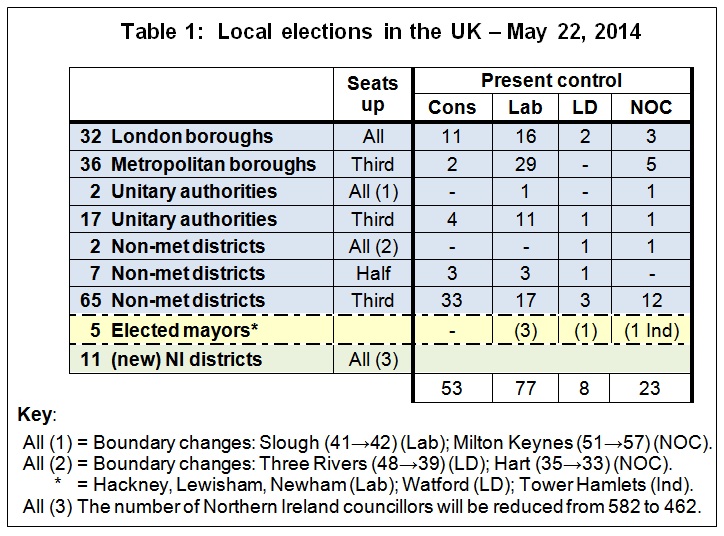
Depending on where we live, some of us will be electing, in addition to members of the European Parliament, all councillors in 32 London boroughs, and in two unitaries and two non-metropolitan districts where there have been boundary reviews and resulting changes in council size; plus one-third of the councillors in 36 metropolitan boroughs, in 17 (of 56) unitaries, in 68 (of 201) non-metropolitan districts, and half of those in a further 7 non-metropolitan districts; plus 5 elected mayors. And we wonder why bewildered residents sometimes ring somewhere called the Institute of Local Government Studies wanting to know if they’ve got a local vote this year.

Actually, I lied a little about the straightforwardness of what I should have called the French systems – plural. With so many very small communes, the French split their municipalities into two electoral groups, the dividing line now being a population of 1,000, and roughly 20% of the total, rather than the previous 3,500.  Smaller communes will elect their 9- to 15-member councils by a single-district, multi-member plurality (first-past-the-post) system, with voters able to choose either a whole party list or candidates from more than one list. In larger communes the voter’s choice is restricted to complete party lists and seats are allocated through a proportional system, but one distorted by a 50% ‘winner’s bonus’. To ensure a working majority, the list with most votes is awarded half of the seats, with the remainder distributed proportionally among all of the lists including the winning list. In both systems the election can take up to two rounds.

The parallel existence of the two different systems offers a ready-made research design, but electoral reformers arguing that proportional systems stimulate turnout have received at best only modest support from such studies. Local turnout in both systems is consistently between 65 and 70%, confirming the phenomenon regularly found in cross-national surveys: that, to the French more than most – and certainly more than us – local politics really does matter.

In fact, the larger/smaller commune division has had a more decisive impact on attempts to redress women’s under-representation in French politics through the kinds of gender quotas that, as Catherine Durose and colleagues noted recently, are still being resisted by the Conservative and Liberal Democrat parties here in Britain.

In 2000, to quite widespread surprise, France became the first country to introduce an electoral gender parity law. Parties were required to present an equal number of female and male candidates on their lists for all elections conducted by systems of proportional representation – i.e. for the European Parliament, most national Senate seats, regions and larger municipalities, but not, significantly, the National Assembly.

Though the law referred to female candidates, its immediate impact on those actually elected was considerable. In 2001 women councillors in municipalities with more than 3,500 residents rose from 26% to 48%, and the number of women Senators in parity seats quadrupled.  Since then, electoral law has been tinkered with, some loopholes exploited by the parties have been closed, and, by the 2012 elections, the numbers of women National Assembly members had gradually risen to 27% (5% ahead of the UK), albeit thanks largely to that year’s sweeping Socialist victory. Furthermore, unlike his predecessor, Nicolas Sarkozy, President François Hollande honoured his pledge to have an equal number of women and men in both the cabinet and government.

His pledge, however, had a kick in the tail: “… which is not to say that they will have the same responsibilities” – and Hollande honoured that part too. All top ministries apart from Justice went to men, and Martine Aubry, ministerial author of the 35-hour working week law (‘la loi Aubry’) and his defeated challenger for the Socialist Party nomination, was passed over as Prime Minister for a personal friend.

If, as suggested, local politics matters more in France than in many European countries, then the most important political figure in most French citizens’ lives is the executive maire/mayor of their commune. Communes may be small, but those who attempt to equate them to our parish and town councils need to remember that they are responsible, individually or jointly, for elementary school buildings and equipment, youth services, recreation and sports facilities, tourism, local urban policy and planning, water sanitation and distribution, waste management, roads and public transport, public and social housing, police, traffic and parking.

One might expect, and many suppose, the French mayoralty to be a directly elected office – but it’s not. Mayors are formally elected by their fellow councillors, although, with the various parties’ candidates for mayor heading their respective candidate lists and having already selected their proposed adjoints (equivalent to committee chairs), many municipal elections give every appearance of being what in reality they are: virtual direct mayoral elections. However, with indirect elections not covered by the parity law, there are, in contrast to the pattern of councillor representation, proportionally more women mayors of smaller communes, proportionally fewer of larger ones, and just one in the 12 largest cities – Martine Aubry in Lille.

That, however, is about to change dramatically – and I’ve no journalistic excuse for taking so long to get to what will undoubtedly be the topic of Monday morning’s headlines. But, so hyper-personalised and sickeningly sexist has the media coverage of the Paris mayoral contest become that I promised myself I’d write at least 800 words exceedingly unsensational stuff about these local elections before I mentioned it – which, if you’ve read this far, you’ll realise I’ve easily managed. And, bad news, the unsensational stuff will continue for at least another paragraph.

Like all French mayors, the mayor of Paris is also indirectly elected – though in this case by 163 of the councillors elected to the councils in the 20 arrondissements (districts) into which Paris is divided. The real battle, therefore, faced by the Conservative challenger – though you’d never guess it – is to win not a city-wide personal popularity contest ‘to become the new face of Paris’, but enough seats in the arrondissements in which the Socialist Party of the President and the current city mayor holds today a majority of the mayoralties.

The strong probability is that that battle will be decided in a run-off ballot next Sunday between the Socialist Party’s Anne Hidalgo, Spanish-born two-term deputy to the retiring mayor, Bertrand Delanoë, and Nathalie Kosciusko-Morizet, widely (and thankfully) known as NKM, of the Conservative opposition party, the Union for a Popular Movement (UPM), who was a minister in the Sarkozy government, spokesperson during his re-election campaign, and is mayor of the southern Parisian suburb of Longjumeau. Given the unpopularity of President Hollande and his government, the UPM could well regain most or even all of the party’s 2008 municipal losses, but still fall short of the biggest prize of all.

game 2

There are several other candidates, representing parties from the Left Front and the Ecologist/Green Party across to the Centrist Alliance and the National Front, but they go almost entirely unmentioned. There is some serious coverage of the principal candidates’ policies, but the enduring images (literally) of this campaign seem more likely to be those of ‘the Heiress vs the Harpist’.

game 1

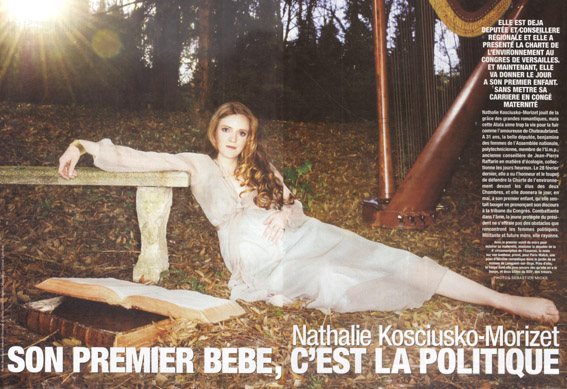
Hidalgo, of course, is the Heiress – ‘la dauphine’ to and protégée of Delanoë, and whose TV latex puppet on France’s version of Spitting Image is usually depicted trailing behind or agreeing with his.  The ‘aristocratic, Botticelli-haired’ NKM had the misjudgement to pose for a Paris Match photo spread, pregnant, nymph-like and with an abandoned harp in the middle of a forest, apparently proclaiming that ‘My first baby is politics’.

Despite such coverage, and whatever the outcome, an effectively all-female contest for such a major office – and one traditionally seen as a springboard to the Presidency – does constitute a sizable step in the hitherto fairly quiet revolution in the role of women in French politics, and one that should contribute to greater female representation in both national and government. An even bigger step, though, as observed by former Justice Minister and early mayoral candidate, Rachida Dati, will be when journalists stop talking altogether about candidates’ gender, and concentrate on their competence and experience.

game

Chris Game is a Visiting Lecturer at INLOGOV interested in the politics of local government; local elections, electoral reform and other electoral behaviour; party politics; political leadership and management; member-officer relations; central-local relations; use of consumer and opinion research in local government; the modernisation agenda and the implementation of executive local government.

The Political Colour of an English Parliament

Chris Game

One of the closing questions put to Professor Eastwood following his recent Distinguished Lecture on The British State: Past, Present and Future concerned the place, if any, of an English Parliament in the kind of future federal or quasi-federal Britain about which the lecture had speculated. Pressure of time permitted only a brief answer, but one reason proffered for what I took to be Professor Eastwood’s instinctive scepticism concerning such an institution was that it would be likely to have “a permanent Conservative majority”.

Even here in the Midlands, which could lay claim to be its most obvious location, a separate English Parliament has hardly captured the popular imagination as being the answer to Britain’s unfinished devolution project.  Much preferred, certainly within the present Government, would be ‘English votes for English laws’ – English MPs having the final say on purely English legislation – which has the considerable advantage that it wouldn’t itself require legislation, simply a change in the Standing Orders of the Commons.  Some suspect that an English Parliament would undermine the Union almost as seriously as Scottish independence. Still, that’s no reason not to consider what politically an English Parliament might look like, if there were one.

I’ll take the most improbable scenario first. If a devolved English Parliament were to comprise all the 533 English constituency MPs elected at the 2010 General Election, the Conservatives, even with their 39.5% of the English vote, would indeed have an overall majority – with 297 seats to Labour’s 191 (from 28% of the vote) and the Liberal Democrats’ 43 ( from 24%). It’s even further from proportional representation than was the actual Westminster result, thereby avoiding the need for any coalition negotiations. That, however, with great respect to the Vice Chancellor, is about as far as a permanent Conservative majority goes. In 1997, 2001 and 2005 Labour would have had very comfortable overall majorities of 127, 117 and 43 respectively.

It is, though, politically inconceivable that a new, devolved English Parliament would contain anything approaching the present number of English MPs – which would put it amongst the dozen largest national lower chambers in the world. For illustrative purposes, therefore, I will use a 180-seat chamber, loosely modelled on the Scottish Parliament and Welsh Assembly, as proposed in a 2011 policy paper by The Wilberforce Society. Obviously, if that two-thirds cut in membership were the only change posited, then the same results in recent General Elections would produce the same outcomes: overall, if numerically smaller, majorities for the Conservatives in 2010 and for Labour previously. But it wouldn’t be the only change.

Like the Scottish and Welsh devolved bodies, a devolved English Parliament would almost certainly be elected by some system of Proportional Representation (PR) – not least to reduce the prospect of any one party being able to obtain an overall majority on the basis of a minority vote. The Wilberforce Society’s model uses the Scottish and Welsh Additional Member System (AMS), in which each elector has two votes: a constituency vote and a party vote. 120 of the 180 MDEPs (Members of the Devolved English Parliament) would be elected from single-member constituencies, and the remaining 60 additional or ‘top-up’ members from regional party lists, in such a way as to make the Parliament’s final membership as proportionally reflective as possible of the party votes cast.

It needs to be remembered that PR isn’t itself an electoral system, but simply the broad aim of many different systems, some more perfectly arithmetically proportional than others. The German system, used to elect the Bundestag, is almost perfectly proportional, having exactly equal numbers of constituency and top-up members.  The Scottish Parliament and Welsh Assembly systems aren’t, with only 43% and 33% of top-up members respectively, which partly explains how the Scottish National Party, despite having only 44% of the party vote in 2011, achieved 69 of the 129 Parliamentary seats and an overall majority.

It would be possible, therefore, for a single party – say the Conservatives – to win an overall majority even in an English Parliament elected by a supposedly proportional electoral system like AMS. It would also be possible to prevent it: simply by adopting the German, rather than the Scottish, variant.

game

Chris Game is a Visiting Lecturer at INLOGOV interested in the politics of local government; local elections, electoral reform and other electoral behaviour; party politics; political leadership and management; member-officer relations; central-local relations; use of consumer and opinion research in local government; the modernisation agenda and the implementation of executive local government.

The Coalition’s mishandling of recall: worse than Baldrick’s war poem

Chris Game

Seeking an arresting phrase to convey the protracted abjectness of the events described in this blog, my first thought was Education Secretary Michael Gove’s  ‘misbegotten shambles’ – his accusatory summary of how certain historians and popular TV programmes like Blackadder have depicted the First World War.

Then I realised Captain Blackadder himself does the job even better in the final ‘Goodbyeee’ episode that probably riles Gove most. Appraising Private Baldrick’s second most famous war poem – not ‘Boom, boom’, but ‘Hear the words I sing, war’s a horrid thing’ – the Captain opines: “Well, it started badly, tailed off a little in the middle, and the less said about the end, the better. But, apart from that, excellent.”  A neat encapsulation, I’d suggest, of the sad story of the Coalition Government’s pledge to give electors the power through petition and election to recall/remove MPs and other public officials before the end of their term of office.

The less said about the pathetic end probably is for the better, but there has to be something. It looked to have arrived when it was widely reported last month that David Cameron and presumably his elections adviser, Lynton Crosbie, had decided that – with two incumbent Tory MPs already deselected and Culture Secretary, Maria Miller, apparently about to escape any significant punishment for claiming over £90,000 in allowances for a second home for her parents – it was time to kill the whole expenses-prompted recall issue by dropping the anyway ineffectual Bill from May’s Queen’s Speech.

This week the PM appeared to have completed a double U-turn, with the announcement that the recall Bill had not been recalled – well, not permanently anyway – and that it may well, or perhaps not, feature in the Queen’s Speech; but, either way, it owed nothing whatever to the Lib Dems.

It’s one more of the Coalition’s lengthening list of political reforms – an elected House of Lords, a smaller House of Commons and reformed electoral system, a House Business Committee, even the promised funding of 200 all-postal open primaries that I blogged about recently – whose actual or seriously contemplated abandonment must, if it were possible, have increased still further public cynicism towards the whole parliamentary system.

Whatever its immediate future, though, MPs’ recall is really only the secondary concern of this blog. My main moan here is the Coalition’s total neglect of the ‘other public officials’ strand – that should by now be in place and applying to at least directly elected mayors and Police and Crime Commissioners, both of which offices would, in my view, have proved more attractive to a suspicious electorate, had a recall provision been part of the package.

Recall, like referendums, citizens’ initiatives and petitions, is an instrument of direct democracy for holding directly elected politicians to account. Put simply, ‘fully participatory recall’ means that the voters who elect someone to public office have the right, between scheduled elections and for any reason, to initiate and vote for their removal. It sounds a laudable principle – possibly even meriting a Blackadder ‘excellent’ – but not just a principle, for that’s essentially how it operates in, for example, around 30 American states, some German Länder, Japan, Switzerland, and British Columbia.

Necessarily, it generates public interest. Take last November’s recall of Mayor Deedy Slaughter (female, if you were wondering) by voters in the smallish Louisiana town of Port Allen. The Mayor had upset residents by, among other allegations, hiring her brother-in-law as chief-of-staff and de facto policy boss, attempting to fire the Chief Finance Officer without City Council approval, and charging to taxpayers her Washington trip for President Obama’s Inauguration. A recall petition was launched, and signed by well over the required one-third of registered voters; 57% of the 63% turnout in the ensuing election voted for recall, and the Mayor was ousted from office by the same people who had voted her in.

It’s undeniably democracy, but clearly the very idea scares the pants off many of our MPs, who, even in the wreckage of their collective expenses scandal, were never going to vote for that much of it. Nor, more seriously, despite what some idealistic reformers imagined, was there ever any real chance of their being asked to. For, like Baldrick’s poem, our very approach to recall started badly, in two distinct ways: one unfortunate but understandable, the other just depressing.

The unfortunate one, assuming at least some of those involved wanted the thing to work, was not taking advantage of the fact that the politicians whose accountability the recall procedure is best suited to secure are those exercising personal executive powers – like the elected mayors and Police and Crime Commissioners (PCCs) being promoted in other sections of the Coalition Agreement, both, as it happens, also the subject of recent INLOGOV blogs.

Both these imported posts would always have been hard to sell to a disengaged and disenchanted electorate – even supposing the Government had bothered to mount serious information campaigns. But, judging from my own limited involvement with both issues, I feel some of people’s genuine worries about the accountability and removability of these new powerful office holders could have been mollified by the existence of credible and participatory recall mechanisms.

Given how the whole concern with recall had arisen out of the 2009 parliamentary expenses scandal, it was inevitable that recall of MPs would get legislative priority. But it would not have been difficult to publicise the Government’s intention that elected mayors and PCCs would be subject to similar recall accountability – as opposed to tucking it away on page 9 of a Localism Bill impact assessment.

Certainly it would not have been difficult, having opted to legislate for MPs’ recall first, to make a better fist of it. Indeed, as we’ll see below, the Commons Political and Constitutional Reform Committee’s view was that it would have been preferable to have produced nothing at all. That’s how depressing it was.

Much was made at the time of all three main parties’ 2010 manifestos supporting a right of recall; much less of the accompanying qualifications. For Labour it would apply only to MPs found responsible for financial misconduct (undefined); for the Conservatives and Liberal Democrats, it would be for proven “serious wrongdoing” (undefined).

From the outset, therefore, it was clear it would offer at most ‘mixed recall’, with voters’ involvement having to be triggered by someone else defining and proving the misconduct, wrongdoing, or whatever. And the ‘someone elses’, of course, would be the accused’s fellow MPs. The intended purpose of recall – empowering voters to hold MPs to account – would be turned virtually upside down. Yes, recall is a serious business and there should be safeguards, but not a parliamentary filter.

Apart from promising “early legislation”, the Coalition Agreement simply tidied up the manifesto pledges. Public confidence in our shamed parliamentarians was to be restored through what might be termed ‘late-in-the-day participatory recall’, “allowing voters to force a by-election where an MP is found to have engaged in serious wrongdoing and having had a petition calling for a by-election signed by 10% of his or her constituents.” (p.27).

The bad start was followed by the ‘tailing off a little in the middle’, or the draft Bill. Its many deficiencies included seeing recall as an instrument of discipline rather than democracy, and ‘serious wrongdoing’, without ever attempting to define it, as more concerned with prison sentences than abuse of position, breach of parliamentary privilege, nepotism, racism, cheating, lying and indolence. Its chief virtue was to offer a target for pre-legislative scrutiny, some of which was pleasingly robust, like that of the Commons P&CR Committee (p.3).

“Under the Government’s proposals, constituents themselves would not be able to initiate a recall petition. The circumstances that would trigger a petition – if an MP received a custodial sentence of 12 months or less, or if the Commons resolved that there [had been] ‘serious wrongdoing’ – are so narrow that petitions would seldom, if ever, take place.

“We are not convinced these proposals will increase public confidence in politics. Indeed, we fear that the restricted form of recall proposed could even reduce confidence by creating expectations that are not fulfilled.”

So misconceived and irredeemable was the Bill considered by some genuine reformers, like the Commons Committee, that they almost welcomed last month’s anticipated demise. As would I, were it not for my concern that any prospects of proper participatory recall for elected mayors, councillors, and Police and Crime Commissioners would have been even further postponed too.

game

Chris Game is a Visiting Lecturer at INLOGOV interested in the politics of local government; local elections, electoral reform and other electoral behaviour; party politics; political leadership and management; member-officer relations; central-local relations; use of consumer and opinion research in local government; the modernisation agenda and the implementation of executive local government.

Devolution’s biggest hurdle: Whitehall’s culture of contempt

Chris Game

Labour published its draft 2015 local government manifesto recently. Entitled Labour and localism: perspectives on a new English deal, the core of the deal is a radical new approach to the financing of local government:

“ … too much power is hoarded in Whitehall.  That’s why we need a fundamental shift from the centre to the local – communities, towns, cities and counties – which gives more power to people and to the elected politicians we already have.” (p.4)

Sounds good, doesn’t it, but also perhaps faintly familiar? Compare and contrast, as they say, with this:

“Over the last forty years, governments of all colours have been guilty of weakening local government. Bureaucratic control has replaced democratic accountability. Hoarding of power by distant politicians and unaccountable officials in Whitehall has damaged society by eroding trust.

“We believe if you decentralise power, you get better results and better value for money. So the plans in this manifesto represent an unprecedented redistribution of power and control from the central to the local, from politicians and the bureaucracy to individuals, families and neighbourhoods.”

The comparison, I think you’ll agree, shows that they’re pretty similar – lots of Whitehall hoarding being supplanted by earth-moving shifts of power to localities. The contrast is that the second quote comes from the Conservatives’ manifesto in 2010 – p.73, to be precise.

Which means, of course, that the ‘unprecedented redistribution’ must already be well underway. Evidence on the ground, however, suggests otherwise.  I doubt, for instance, if Somerset Levels residents, whose ground is currently flooded, reckon they’ve seen much redistribution – of power, that is, not water. They’ve discovered the hard way that, even if their elected local drainage boards manage to persuade the unelected Environment Agency that dredging and other flood defence work is necessary, what actually happens is determined by the Agency’s funding from the Department for Environment, and ultimately by benefit-to-cost rules imposed by the Treasury.

That’s how things work, in our most hypercentralised of governmental systems. As Yes, Minister taught us back in the 1980s and, as that Conservative manifesto acknowledged, Whitehall bureaucracy trumps local democracy every time.

Regarding local government, it’s hard to know whether the politicians who signed up to that 2010 decentralisation pledge, or the Ministers subsequently responsible for implementing it, ever really believed in it – other than as a vote-winning slogan. Communities and Local Government Secretary, Eric Pickles, self-admittedly didn’t. His brand of what he calls ‘muscular localism’ involves effectively setting councils’ tax and spending levels and telling them how often they should empty our refuse bins.

Cities Minister, Greg Clark, at least tries to walk the localisation walk, with his City Deals policy of stimulating city-driven economic growth through negotiated packages of powers and discretions. However, doubling until recently as Financial Secretary to the Treasury, few knew better than Clark where the serious power in Britain resides, irrespective of the party in government.  It’s in Whitehall departments and ultimately in the quaintly addressed Unit 1, Horse Guards Road, aka Her Majesty’s Treasury – between them a far more formidable obstacle to a genuine English devolution deal than any temporary bunch of Ministers.

Were any confirmation needed, it’s come in spades recently, in the Institute for Government’s fascinating study, Achieving Political Decentralisation, of how and why opposition parties so good at making commitments to devolve power have as governments found it so hard to implement them. Tom Gash and his IfG colleagues identify from their case studies a pleasingly neat, if depressing, ten obstacles to reform that anyone seeking to decentralise power must navigate.

At Number 1 – where else could it be? – is Resistance from national government, the essence of which is “the fact that ministers and civil servants simply do not trust sub-national government to competently exercise additional powers and … constantly worry that they will “do something barmy” (p.20). It almost beggars belief, doesn’t it? The civil service folks who brought us the NHS IT programme, the Child Support Agency, the West coast rail franchising fiasco, non-flying Chinook helicopters, and mothballed aircraft carriers sit around worrying about other people’s sanity and competence!

Unfortunately, there’s a serious point here, although – certainly on this platform – I’m inclined to put it less genteely than the IfG. Whitehall departments’ resistance to devolution doesn’t stem just from it being their powers and budgets that parties, when in opposition, want to devolve. Much worse, the beneficiaries would be a collection of local councils and politicians that senior civil servants generally regard in much the way that Mr Banks, prior to being saved by Mary Poppins, viewed his children: with an unconcealed mixture of disdain and distrust.

For the alliteratively inclined, it amounts to a culture of centralist contempt, and is naturally seen most obviously in the big things: local government’s huge dependence on central funding, the centre’s stranglehold on councils’ housebuilding, planning, and indeed their total budgets. If you actually work in local government, though, it’s possibly the smaller things – the almost daily drip, drip of petty insult, distrust, denigration and condescension – that really get you down. Let me illustrate with a couple of examples from last week’s drips – one trivial but irritating, one non-trivial and infuriating.

First, we have a typical illustration of how our Communities Secretary, when aggrieved, resorts to the role of Victorian paterfamilias and takes it out on his local authority children. Thwarted by Cabinet colleagues from reducing the council tax referendum trigger from an increase of 2% to 1.5 or even 1%, Pickles immediately put before Parliament alternative proposals he claimed would protect ‘hard-working families’ from their greedy councils: requiring them to publish, as a matter of record, each councillor’s individual vote on any council tax changes.

The Minister had discovered that most councils’ budget votes last year, whether to freeze or increase their council tax, were by a show of hands, with just the totals or results recorded in the Minutes. He disingenuously implies that this represents something underhand, although, as a onetime council leader, he knows full well that this is how most council votes are taken – a ‘named vote’ being taken only if called for by a specified number of councillors.

Taking Labour-controlled Birmingham as an example, there were in fact three named votes at last February’s Council budget meeting, on amendments proposed by the minority Conservative and Lib Dem parties. Named votes were called for, and the amendments were comfortably defeated by Labour’s 71 councillors voting en bloc – precisely as they would have done in support of the main motions to approve the Council’s Business Plan, Budget and Council Tax Requirement.

And that’s the point. In most council votes, as in Parliament, councillors vote with their party, and when one party has a clear overall majority, a named vote serves little purpose and wastes time. If Pickles wants to argue that the annual setting of the level of council tax is uniquely important, that’s fine. But to pretend that recorded votes will enhance local accountability and keep tax rates down is a deception of his hard-working families, as well as confirmation that he feels it entirely appropriate for a Cabinet Minister to dictate in detail how elected local governments conduct their business.

My second case is an archetypal central government gaffe – an example of what happens when you legislate from the centre without adequate consultation or scrutiny. This time it was the Bedroom Tax (or Spare Room Subsidy) – last April’s controversial change by the Department for Work and Pensions (DWP) that cut the housing benefit of those living in a council or housing association property deemed to have one or more spare bedrooms. The legislation should have exempted working-age tenants who had been living at the same address and entitled to claim housing benefit continuously since 1 January 1996. Basic as it seems, it didn’t – meaning that estimated tens of thousands of tenants are entitled to refunds of around £640 for 40 weeks of undue reductions.

To ordinary citizens, expecting perhaps at least a hint of humility, the DWP’s response to councils might seem extraordinary, and even for those of us only too familiar with the ways of central government, it was a minor classic. First, they disputed all local government and housing professionals’ estimates of the numbers. Their methodology calculated that “very few” households – maybe 5,000 – were affected.

Second, no, they wouldn’t disclose their methodology, even to the Local Government Association. Third, while the DWP would of course close the loophole, councils could pay for the department’s unfortunate slip-up by footing the bill for identifying, locating and refunding the relevant claimants. And you thought maybe I was exaggerating, talking of a centralist culture of contempt?

game

Chris Game is a Visiting Lecturer at INLOGOV interested in the politics of local government; local elections, electoral reform and other electoral behaviour; party politics; political leadership and management; member-officer relations; central-local relations; use of consumer and opinion research in local government; the modernisation agenda and the implementation of executive local government.

Directly elected mayors in England: leading local government?

John Fenwick and Howard Elcock

The first directly-elected executive mayors in England took office more than a decade ago. Drawing inspiration from European and American experience, the directly elected mayor appealed to New Labour and Conservative policy-makers alike, offering an apparent solution to perceived problems of weak local leadership and bureaucratic stagnation. The heroic image of urban leaders from the world’s great cities was implicit in this depiction of the elected mayor, a new figure in English (and potentially Welsh) local government who would have decisive executive authority gained from direct popular mandate.

It didn’t work out like this. Under legislation enacted in 2000, the first local referendums largely rejected the mayoral option. In 2012 the coalition government initiated 10 further mayoral referendums in selected English cities but in only one – Bristol – was there popular assent for establishing the office of mayor. Overall, there is no evidence of widespread public support, yet the prospect of more mayors – with enhanced powers – remains firmly on the policy agenda. Why?

Drawing from a decade of research by the authors, this article considers reasons for the persistence of the mayoral experiment, its broad support across political parties and the importance of specific local factors in the few areas where mayors actually exist. It finds little evidence of public enthusiasm. It suggests that the relationship of mayoral leadership to place remains problematic. Analytically the article uses the authors’ leadership grid to link the governmental, governance and allegiance roles of mayors to the problematic nature of local leadership. The article also finds that although further legislation in 2007 – under which it became possible to establish a mayoral system through simple council resolution rather than referendum – potentially facilitated expansion of the mayoral system, this rapid expansion has not occurred. Indeed, two areas which previously adopted the office of mayor subsequently reversed their decision. Thus, in 2014, there are (excluding the London mayor, a different job with different powers) only 15 directly elected mayors in England. This is interesting and curious: not only in political terms but also in terms of local leadership and the long-standing search for an effective core executive. What is going on?

A full version of this article – Elected Mayors: Leading Locally? – is published in Local Government Studies. The article is open access until the end of February 2014.

John-Fenwick

John Fenwick is Professor of Leadership and Public Management at Newcastle Business School, Northumbria University. He is author of Managing Local Government (1995), numerous articles on local governance and public policy, and co-editor of Public Management in the Postmodern Era (2010). His current research includes local leadership and the elected mayor; the third sector in local service provision; and critical approaches to management development and organisational behaviour.

DSCF5376_Elcock_small

Howard Elcock is Professor (emeritus) at Northumbria University. He is author of Administrative Justice (1969), Portrait of a Decision: the Council of Four and the Treaty of Versailles (1972), Local Government (three editions 1984–1994) and Political Leadership (2001). His current research includes political leadership and elected mayors; local democracy; and the ethics of government.

The prospects for a dramatically more representative Parliament post 2015 are bleak

Catherine Durose, Liz Richardson, Ryan Combs, Francesca Gains and Christina Eason

Whilst the likely outcome of the next election maybe still far too close to call, one feature of the next Parliament is very predictable.  The 2015 Parliament is likely to remain as deeply unrepresentative of the make-up of the UK population as the current legislature.  Although the 2010 Parliament showed some improvements in diversity, while women represent 51% of the UK population they formed just 22% of MPs; and although the ethnic minority population is 8% the number of ethnic minority MPs is half that at 4%.  Representation by other underrepresented groups: for example people with disabilities or openly LGBT is also less than would be reflective of the makeup of society more generally although this is harder to count.

This poor representation is despite all three main party leaders stating their support for efforts to improve the diversity of representation in Parliament in evidence given at a specially convened Speakers Conference before the last election.  While Lord Hurd has argued recently that greater diversity in political representation is a ludicrously radical demand, the Conference argued that improved diversity would support better policy making as MPs would draw on a wider range of experiences, and could act to enhance the legitimacy of Parliament and encourage greater political engagement.

Our research for the Equalities and Human Rights Commission, conducted just after the election in 2010, set out to explore the barriers to representation from underrepresented groups and to examine the pathways to politics taken by successful politicians from those groups protected by the Equalities Act to see what lessons could be learned.  We gathered primary qualitative data from a purposive sample of 62 national politicians and candidates, some who had been successful, and some who had not managed to achieve selection and/or elected office.  We also heard from around 20 lobby groups for under-represented groups within and outside political parties, and other stakeholder organisations.

In some cases shocking examples of sexist and racist attitudes were reported.  One black candidate was asked whether she was ‘one of them happy-clappy churchgoers’. One candidate recounted the experience of a local party member ‘hitting me on the bottom and asking me what a nice girl like me is doing in the Labour Party.’  A female ethnic minority candidate expressed her perception of the “double whammy” of discrimination she faced.  This also ran the risk of reducing support for diverse candidates.  In one example, other women in a candidate’s party assumed that she would get support from ethnic minorities in the party, but the other minority members were: “reluctant to support me because I am female and they are all men”.  Other attitudes towards women were less overtly expressed but still exclusionary. Women in politics perceived themselves as facing heightened expectations to justify their presence in a way that men did not. Yet, women were not taken seriously or seen to have the gravitas of male politicians.

While possibly horrifying, these might be familiar complaints about lingering outmoded common-or-garden prejudice.  However, beyond this, our analysis, published in Parliamentary Affairs, identified a systemic and institutional problem with local party ‘selectorates’.  A key issue mentioned by those we spoke to was the critical veto role played by the local selectorates, the local party activists who are responsible for selecting candidates.   Women and ethnic minorities reported facing ‘selector hostility’ struggling to secure the nomination for winnable seats as local party elites look for so-called ‘archetypal’ candidates.  The archetypal candidate reflects selectors’ own characteristics, but more importantly, those of previously successful candidates.  It is partly based on assumptions about electoral risk, and who different parts of the electorate will be prepared to vote for.  Candidates and sitting politicians saw this attitude reflected in the suggestions put to them to ‘have a go’ in ‘unwinnable’ seats. Analysis by Maria Sobolewska at the University of Manchester  has shown that, pre 2010, the Liberal Democrats selected the overwhelming proportion of their minority candidates in highly ethnic diverse seats, most of which were unwinnable and the Conservatives selected more than half of their minority candidates into hopeless seats.  The Labour Party selected the highest proportion of ethnic minority candidates for safe and winnable seats.

In our research, we argue that where candidates from under-represented groups have been successful, this is often because they were ‘acceptably different’ and shared particular ‘pathways’ into national politics which mitigated against the perceived electoral disadvantages of being from an underrepresented or  minority group.  One younger, male, ethnic minority politician highlighted how other aspects of his identity were able to make his ethnicity ‘acceptable ‘I think my age and colour ticked certain boxes and ex-military, public school boy ticked others’.  For women, this could take the form of being ‘one of the boys’, as explained by one respondent: “It’s how you fit in so they don’t think you’re a girl […] Once one of my colleagues described me as one of the boys, I think he meant it as a compliment but I’m not sure that it is.”  Such candidates are also likely to follow a pathway into politics which emphasises university education and a ‘politics facilitating’ or an increasingly  prominent ‘professional politics’ route.  Many of the new female or ethnic minority MPs elected in 2010 had experience in national politics as advisers, or lobbyists.  Of the 27 ethnic minority MPs, at least ten have legal backgrounds (37%).

Whilst this new type of pathway into politics can help to overcome selector hostility if candidates are filtered both through local selectorates and through professional pathways, then a key policy question in increasing diversity in representation becomes how to open up politics.  One of our interviewees said “When I was trying to become a Parliamentary candidate I was asked on more than one occasion what my qualifications were and they meant academic qualifications. One woman even said it was a real shame because one of the other candidates was a lawyer and another one had a PhD and although I seemed like a really nice woman I wasn’t really [of] their calibre”.

Although the Labour Party is persisting with the unpopular but effective policy of making 50% of its target seats selected from all women shortlists, this willingness for the party elites and the party machinery to work with local selectorates to overcome selector hostility is not found elsewhere.  Although David Cameron is clearly committed to wider diversity, Conservative members are deeply resistant to either interference from the national party or equality measures, as highlighted by recent media reports, and supported by other research by Sarah Childs and Paul Webb. And the Liberal Democrats are also struggling to take any positive measures, with the ongoing furore over sexual harassment claims still making headlines.

Without tougher efforts by all parties to address their own openness, attitudes and ‘selectorates’, the portents for the 2015 Parliament being radically more representative than 2010 do not look good.

This blog first appeared on Democratic Audit, http://www.democraticaudit.com/?p=2540 27 January 2014

durose

Dr Catherine Durose is Senior Lecturer and Director of Research in the Institute of Local Government Studies at the University of Birmingham and works with the Public Services Academy.

cihardson

Dr Liz Richardson is a Senior Lecturer in Politics at the University of Manchester, and a Visiting Fellow in the Centre for Analysis of Social Exclusion (CASE) at  London School of Economics and Political Science (LSE).  Her previous roles include Co-ordinator of LSE Housing at the LSE. Liz is co-editor of the journal, Local Government Studies.  She is also a Director of a community charity, the National Communities Resource Centre.

ryan-combs-150x150

Ryan Combs is a Research Associate at Centre for Primary Care, Institute of Population Health at the University of Manchester.

gains

Francesca Gains is a Professor of Public Policy at the University of Manchester. Before entering academia she worked in local government and the probation service, and has both government funded and Parliamentary research experience. Her research agenda explores the relationship between political management arrangements and policy outcomes.

Christina Eason has a PhD from the University of Manchester’s School of Social Sciences and has research interests in British politics, gender, women, representation, and institutions.