The fact that governments face an array of challenges is a well-rehearsed argument. City governments across the globe are tackling a myriad of social, economic and environmental issues, from trying to reduce homelessness, improving health and wellbeing, or increasing educational attainment. In parallel, philanthropic foundations’ accumulated wealth and knowledge means they are increasingly welcomed as a government partner in addressing social needs. So why do philanthropic foundations engage with city governments?
The UK Association of Charitable Foundations defines philanthropic foundations as “charities with private, independent, sustainable income that supports individuals and/or organisations” (Pharoah and Walker, 2019, p. 1). In 2015, there were over 10,000 charitable foundations based in the UK and some of these are engaging with city governments.
In the U.S. context, philanthropic foundations have a long history of interacting with the government (Zunz, 2012) They have traditionally funded physical structures like libraries and opera houses, and in recent years, foundations have increasingly working directly with governments to tackle issues as diverse as climate change (Madénian and Van Nest, 2023), gun control, and poverty reduction (Barber, 2014; Nijman, 2009; Moir et al., 2014). Yet, there has been little exploration of this phenomenon in the English context.
Based upon the case study analysis of three contrasting English cities, Bristol, Manchester, and Newcastle, I drew upon qualitative interviews and policy reports to understand the interconnections between foundations and city governments.
Why do city governments and foundations collaborate
Philanthropic foundations can be a capacity-building partner of city government, providing direct funding and non-financial resources to help city governments solve problems. Philanthropic foundations provide city governments with direct funding and non-financial resources, including data, research, events, and other outputs, such as toolkits.
Foundations are motivated to improve public services, develop new approaches to problem-solving, advocate on policy issues, and fill funding gaps left by austerity. Foundations select city governments based on personal rapport and perceived ease of working.
City governments are motivated to engage with foundations to access resources, for foundations to help amplify the voice of city governments, and because foundations are perceived as less bureaucratic and more trustworthy funders.
Barriers to city government and foundation collaborations
Foundation engagement with city governments is inconsistent. This study found that certain city governments (in this case, Manchester and Bristol) had more partnerships with foundations. The reason is that foundations often will not work with city governments when the city government’s priorities are unclear, if they are hard to engage, or when there is a perceived slow pace of change in city hall.
On the part of city governments, a scarcity of resources can prevent them from seeking foundation resources. With the impacts of austerity still lingering, it may have been surmised that austerity could prompt cities to seek foundation support, instead, this study has found that a lack of internal capacity can prevent the city government from seeking foundation involvement.
Implications for policy and practice
City governments interacting with foundations in England is a relatively nascent and under-explored phenomenon. As well as few academic studies, there is often an opaqueness in the nature of these collaborations. A lack of transparency can hinder scrutiny, which is problematic if city governments and their partners are to be held to account. Going forward, a key facet of city government engagement with foundations should be a commitment to transparency in the nature of the collaboration and an openness to sharing evidence of the impacts of the interactions on the outcomes that the foundation and city governments are trying to achieve.
Areas for future research
As a relatively underexplored topic, more research could usefully explore foundation engagement with city governments across England on a larger scale, particularly to understand the implications for accountability. Futuremore, future research could usefully explore whether philanthropic foundations prioritise collaborating with city governments over different types of organisations, such as charities, and if so, whether this is because city governments enable potentially larger degrees of policy influence than more “marginal” political institutions, such as NGOs or community groups.
To find out more about the research, please contact Dr Ruth Puttick, [email protected]
Dr Ruth Puttick runs a research consultancy and is a Senior Research Fellow at the Institute for Innovation and Public Purpose (IIPP) at University College London. She has over 15 years of practical research experience in the public and private sectors advising on public sector reform, innovation and impact. She served as a Senior Policy Advisor in the UK Government’s Open Innovation Team, and before that, she worked at Tony Blair Associates, a global management consultancy, helping establish the policy and research team in the government advisory practice. Prior to that, she spent six years at Nesta, the UK’s innovation agency. Ruth is on X.com @rputtick and can be contacted at www.ruthputtick.com
This is the first of two blogs resulting from this year’s INLOGOV undergraduate summer intern project, which examined how councils can boost wellbeing amid austerity. This first article summarises some of the key literature, the second article (next week) will explore practice examples.
In a period characterised by fiscal austerity, local governments confront major hurdles in providing basic services while working with tight resources. Spending cuts have far-reaching consequences for communities, frequently having a negative impact on the public’s well-being and standard of living. In response to these issues, community initiatives have arisen as viable mechanisms for minimising the harmful effects of austerity policies whilst also promoting community belonging in neighbourhoods. This paper will begin with a literature review surrounding the topic, examining studies that have demonstrated the impact of community initiatives.
This article starts with a literature review examining the potential for community initiatives to achieve wellbeing outcomes, emphasising how councils may successfully collaborate with communities to reduce the negative effects of budget cuts in an age of permanent austerity. Since the 2008 global financial crisis, several nations have undertaken austerity measures that have considerably impacted local government finances and services (Lowndes and McCaughie, 2013). This ‘age of austerity’ has caused councils to reassess their approach to providing public services and ensuring community well-being (Hastings et al., 2015). In response to the spending, councils can and, on occasion, have turned to community initiatives as a possible way to preserve or improve wellness within the community.
Research consistently demonstrates that community-led initiatives can effectively address service gaps resulting from austerity measures while enhancing local decision-making practices and overall community well-being. Crisp et al. (2016) believe that community-led alternatives can assist in addressing service gaps caused by funding reduction. Their research of community-based organisations in the UK revealed that these projects might assist in areas such as employment, training and social care. Evans (2008) and Fletcher-Etherington (2010) also draw attention to the advantages of community-led initiatives, particularly highlighting enhanced decision-making procedures. Building on this concept, Fung and Wright (2003) provide further empirical support through their examination of participatory governance cases. Their research demonstrates that including the community in the decision-making process can result in more successful and fair policy results, which are more likely to improve the community’s general well-being.
Community initiatives are vital for improving public health outcomes, with research consistently showing their positive impact on physical and mental well-being. There is a strong link between community initiatives, social capital, and health outcomes, as revealed in various studies. For example, Kawachi and Berkman’s (2000) research provides compelling evidence that social connections, cultivated through community efforts, are associated with better physical and mental health. This link between community involvement and health is further explored in specific contexts, such as mental health initiatives. Knifton et al. (2010) investigated community-based mental health programs in Scotland and found that they have the potential to reduce stigma, increase social support, and improve access to mental health services. Moreover, South (2015) offers a comprehensive guide to community-centred approaches to health and well-being, emphasising the crucial role of local government and the NHS in supporting these initiatives. South’s research underscores the importance of integrating community-led approaches into broader health and social care strategies, highlighting how such integration can lead to more effective and sustainable health outcomes for the community. Strong partnerships between the council and the community, along with insights from studies like Kawachi and Berkman (2000) and Knifton et al. (2010), are crucial in this process. These studies underscore the value of community-centred approaches in improving public health and suggest that policymakers and health professionals should prioritise integrating community initiatives into mainstream health and social care strategies to promote positive well-being outcomes.
Community initiatives provide significant economic and environmental benefits, offering viable solutions for councils to improve well-being within financial constraints. Imbroscio (2013) has found in many cases that locally-driven community initiatives can create more sustainable and equitable economic outcomes compared to top-down approaches. Krasny and Tidball (2009) examined community-based environmental initiatives. They discovered that these programs not only benefited local ecosystems but also promoted social learning and community resilience. These findings are consistent with a growing global trend in communities engaging in environmental stewardship (Bennett, 2018). Examples include community-based conservation and locally managed marine areas, which have emerged in sectors such as fisheries, forestry, and water management (Berkes, 2004). This shift recognises that community initiatives can address environmental concerns while also building social connections and, therefore, well-being.
Asset-Based Community Development (ABCD) has emerged as a transformative approach to community well-being initiatives, emphasising the inherent strengths and resources within communities. McKnight and Kretzmann (2005), pioneers of the ABCD approach, argue that sustainable community development must start with recognising the capacities, skills, and assets of local residents and their associations. Their work emphasises the importance of mapping community assets as a starting point for development initiatives. The methodology is driven by community members and focuses on harnessing the inherent strengths and assets of individuals, associations, and communities to promote social change (Mathie, 2003). ABCD represents a shift from traditional deficit-based approaches to community development. Instead of focusing on needs and shortcomings, ABCD emphasises the existing strengths and resources within a community. This approach is based on the principle that every community, regardless of its challenges, possesses a wealth of assets that can be mobilised to address local issues and enhance overall well-being. The effectiveness of ABCD relies on several key mechanisms. Harrison (2019) highlights the importance of building strong, trusting relationships within the community as a fundamental aspect of this approach. These relationships form the foundation for cooperation and collective action, which are essential for the success of community initiatives. Additionally, Harrison emphasises the role of reciprocity and accountability among community members in sustaining engagement and ensuring that initiatives are both community-driven and beneficial. While ABCD is fundamentally community-driven, the role of local authorities in supporting and facilitating this approach is crucial for its success.
Local authorities play a pivotal role in nurturing and sustaining ABCD initiatives through strategic support and facilitation. Forrester et al. (2018) identify several key strategies local authorities can employ. These include participating in appreciative inquiry, which is asking positive, strength-based questions to identify and build on community successes. Local authorities can also build social capital by developing networks of connections, which are critical for community resilience and well-being. Furthermore, sponsoring local economic initiatives can assist in establishing long-term economic prospects while improving general community well-being. ABCD emphasises empowerment. According to García (2020), empowering people in the community to identify their own assets and skills can help local authorities to establish long-term community initiatives. This empowerment boosts self-efficacy and gives community members a stronger sense of ownership and duty. ABCD’s success depends greatly on a supportive and trustworthy atmosphere. Harrison et al. (2019) observe that when community members feel supported and trusted, they are more likely to actively participate and contribute to the success of community efforts. ABCD offers a promising approach to community development by focusing on the positive aspects of communities rather than their deficiencies. This strengths-based approach can lead to more sustainable and impactful outcomes. However, it is important to recognise that the success of the ABCD relies heavily on the presence of a supportive environment and the active involvement of local authorities. Local authorities must adopt a facilitative role, providing necessary support and resources and allowing community members to lead (Forrester et al., 2018). ABCD represents a paradigm shift in community development, offering a promising framework for sustainable well-being outcomes when effectively supported by local authorities and embraced by community members.
Alice has recently graduated from the University of Birmingham with a first class degree in Policy, Politics and Economics. She was awarded the Jane Slowey bursary in her final year for her research on the Homes for Ukraine scheme. Alice is currently seeking further opportunities and can be contacted at [email protected]
References
Berkes, F. (2004) Rethinking community-based conservation. ConservationBiology, 18(3), 621–630. doi:10.1111/j.1523-1739.2004.
Forrester, G., Kurth, J., Vincent, P., & Oliver, M. (2018) Schools as community assets: an exploration of the merits of an Asset-Based Community Development (ABCD) approach. Educational Review, 72(4), 443–458. doi:10.1080/00131911.2018.1529655.
Fung, A. and Wright, E.O. (2003) Deepening democracy: Institutional innovations in empowered participatory governance. Verso.
García, I. (2020) “Chapter 4 Asset-Based Community Development (ABCD): core principles”. In Research Handbook on Community Development. Cheltenham, UK: Edward Elgar Publishing. doi:10.4337/9781788118477.00010.
Harrison, R., Blickem, C., Lamb, J., Kirk, S., and Vassilev, I. (2019) ‘Asset-Based Community Development: Narratives, Practice, and Conditions of Possibility—A Qualitative Study With Community Practitioners’ Sage Open, 9(1). doi:10.1177/2158244018823081.
Hastings, A., Bailey, N., Gannon, M., Besemer, K., and Bramley, G. (2015) ‘Coping with the Cuts? The Management of the Worst Financial Settlement in Living Memory’. Local Government Studies, 41(4), 601–621. doi:10.1080/03003930.2015.1036987.
Henderson, C., Evans-Lacko, S. and Thornicroft, G. (2013) ‘Mental Illness Stigma, Help Seeking, and Public Health Programs’. American Journal of Public Health, 103(5), 777-780. doi:10.2105/AJPH.2012.301056.
Imbroscio, D. (2013) ‘From Redistribution to Ownership: Toward an Alternative Urban Policy for America’s Cities’. Urban Affairs Review, 49(6), 787-820. doi:10.1177/1078087413495362.
Kawachi, I. and Berkman, L. (2000) ‘Social cohesion, social capital, and health’. Social epidemiology, 174(7), 290-319.
Knifton, L., Gervais, M., Newbigging, K., Mirza, N., Quinn, N., Wilson, N., and Hunkins-Hutchison, E. (2010) ‘Community conversation: addressing mental health stigma with ethnic minority communities’. Social psychiatry and psychiatric epidemiology, 45, 497-504.
Kretzmann, J. P. and McKnight, J. (2005) Discovering community power: A guide to mobilising local assets and your organisation’s capacity. Evanston, IL: Asset-Based Community Development Institute, School of Education and Social Policy, Northwestern University.
Lowndes, V. and McCaughie, K. (2013) ‘Weathering the perfect storm? Austerity and institutional resilience in local government’. Policy and Politics, 41(4), 533-549.
The commons refer to those cultural and material resources collectively managed by the community and represent an alternative to both the state and the market. Recent literature emphasises the capacity of the commons’ prefigurative politics to develop alternative institutions to neoliberal regimes and/or deliberative and collective forms of resource management. The grassroots movements managing the commons often take an oppositional stance to the state, but they might also depend on its resources. By the same token, the state has an interest in supporting assets and services managed as commons, which offer flexibility and efficiency, while encouraging citizen participation in local politics.
Within political contexts sympathetic to progressive socio-economic projects, such as new municipalism in Barcelona, formalised alliances between the local state and the commons started to emerge, facilitating the development of novel policy instruments that respond better to the demands of the commons and open opportunities for more participatory policymaking. So-called public-common partnerships are long-term agreements based on cooperation between state actors and the commons members. In our paper, we wanted to understand better the relational work behind these partnerships and the role of boundary spanners that build bridges between two worlds, such as the state and the commons, which are often quite distant in terms of visions of local democracy and the language to articulate such visions. We take the case of the Citizen Asset Programme (CAP) in Barcelona to explore the relationships between public officials and commons members, highlighting how these collaborations shape governance practices and can help foster a collaborative culture within public administration.
CAP was approved in 2016 and aims to create the institutional framework to recognise and support commons-managed municipal assets in the city. Based on qualitative analysis of interviews with public officials and commons members involved in the partnership, as well as official documents, we drew out insights on the relational dynamics that facilitated the creation of two policy instruments under CAP: The Community Balance Metrics and the Social Return on Investment of Can Batlló. The first one is a set of indicators to evaluate the performance of community-managed assets considering their transformative potential and including dimensions of internal democracy, care, inclusion, and environmental sustainability. The second helps to measure the value of activities and volunteer work carried out in the community centre of Can Batlló.
Through a series of vignettes depicting the different state and commons actors involved, we examined how they forged alliances and employed creative thinking to manage conflicts, resistance, and scepticism from both the local administration and the grassroots movements. Public officials from the Active Democracy Department were able to build trust among commons representatives by recognising their needs and potential. They explained the workings of public administration in a clear language. They created spaces of open-ended dialogue between grassroots movements and different departments to facilitate the development of policy instruments, measures and indicators that valued the commons’ innovative work, while still coherent with existing legal requirements. For instance, a working commission was set up involving members of Can Batlló, the Legal and the Heritage Department, as well as representatives of the District administration. This public-commons partnership developed a comprehensive agreement to regulate asset transfers, which fully recognises the social and economic value of the commons.
By the same token, the commons members played a crucial role in communicating to grassroots movements the work of the Active Democracy officials and build mutual trust. On the one hand, they helped the commons understand feasibility issues of their demands; on the other they pressed the public administration for greater transparency and creative interpretation of existing regulatory framework to strengthen democratic values underpinning asset transfer agreements.
Two cooperatives supported these partnerships as consultants. They contributed knowledge of innovative public policies from across the world. They also facilitated knowledge sharing to encourage cooperation between commons members and state institutions, for instance by inviting grassroots groups from other parts of the world to share their experience of working with the state.
The work of these public-commons partnerships is gradually reshaping the administrative culture and fostering more transparent and democratic working practices within the public administration. An example is the joint work to develop the Community Balance Metrics, which helps evaluate the performance of the commons using indicators agreed upon by both local public administration and the commons. However, these processes face a number of challenges, as they clash with established working routines and performance evaluations of public administrators that hardly ever value participatory work. Existing literature suggests that despite the introduction and encouragement of new practices, there is a tendency to revert to traditional policymaking methods when faced with unexpected problems. When boundary spanners that had supported the partnership exit the process, they can leave a vacuum that is hard to fill and that can jeopardise the partnership. In Barcelona, ongoing discussion between Can Batlló members and the City Council on who is responsible for funding the refurbishment of one of Can Batlló’s building is causing friction within the partnership and some of the work has stalled.
Inevitably this collaborative work is hard to sustain, but in the face of multiple and overlapping crises facing local government, these public-commons partnerships are also beginning to open safe space to experiment and do things differently.
Picture credit: Victoria Sánchez.
Sonia is an Associate Professor in INLOGOV. Her main research interests are participatory governance and democratic innovations, and creative and arts-based methods for research and public engagement. She led on projects on youth participation to influence mental health policy and services, coproduction of research on health and social care integration, models of local governance, and leadership styles within collaborative governance.
Marina is a researcher at Autonomous University of Barcelona (UAB). She holds a PhD in Public Policy from UAB and a M.A. in Sociology from Columbia University (New York). She has been a visiting scholar at CUNY Graduate Center (New York) and at INLOGOV, University of Birmingham. Her research interests include community assets transfer, democratisation of public administration, community development and public-common partnerships.
Dr Marina Pera from Autonomous University of Barcelona is presenting a critical analysis of the asset transfer policies in Barcelona at our next INLOGOV seminar, which starts at noon on Thursday 30th November at our Edgbaston campus.
Marina will examine opportunities and risks raised by citizen management of municipal assets, taking a community empowerment perspective.
Barcelona is a city with a long tradition of neighbourhood associations, community and cultural centres run by citizens. Since the 1970s, in response to citizens’ demands, a number of municipal assets have been transferred to local non-profit organisations with economic support from the City Council.
The transfer of these assets was decentralised to the administrative districts, which in some cases led to practices of co-option and clientelism. In 2015, the Bases de gestió cívica (civic management legal basis) was collaboratively designed and approved: a local regulation that standardises the allotment of assets, increasing transparency on asset transfers. However, the Bases of gestió cívica did not solve some of the challenges that had emerged from the collaboration between the local state and community actors. One of the main challenges was the insufficient adaptation of regulations and administrative procedures to the idiosyncrasies of grassroots organisations with low levels of professionalisation. These place a huge burden on these community groups, who had to invest time and resources in bureaucratic procedures, hindering their original mission and accelerating their de-politicisation.
In 2016, with the rise of a progressive government in the city of Barcelona, an ambitious policy was approved, the Citizen Assets Programme (CAP). This policy aimed to recognise, support, and consolidate urban commons: spaces and facilities rooted in the community that were apt to be transferred to non-profit organisations in order to be managed democratically. The CAP thus aimed to empower the community and promote citizen participation. This policy entailed greater transparency and legitimacy surrounding the process of asset transfer and the accountability of grassroots and non-profit groups. However, the Citizen Assets Programme has been facing a number of challenges in terms of legal issues, resistance by public officials and scepticism by non-profit organisations.
Despite the difficulties involved in the implementation of the Citizen Assets Programme, it has presented an opportunity for collaboration between the City Council and the commons. The efforts to create an environment of trust and mutual learning among public officials and community groups has allowed the development of innovative administrative instruments that recognise the transformative work of the commons, through innovative public-commons partnerships. This seminar therefore aims to analyse alternative forms of asset management beyond public direct and outsourcing management, engaging in current debates on collaborative culture in public administration, the dismantling of the welfare state and community empowerment.
Seminar details
The re-arranged seminar will run 4-5pm on Thursday 7th December at the University of Birmingham Edgbaston campus in Muirhead room G15.
Further information, link to attend and registration can be found at the eventbrite.
Our world is experiencing multiple pressing crises; political elites’ inability or unwillingness to address them has contributed to diminishing trust in representative institutions. Democratic Innovations and participatory governance processes engaging citizens directly in politics and policymaking have been hailed as an antidote to elected representatives’ plummeting legitimacy. But they have also attracted much criticism, as they give much power to commissioning organisations, who design the process and choose who to invite, while there is limited follow-up on citizens’ recommendations.
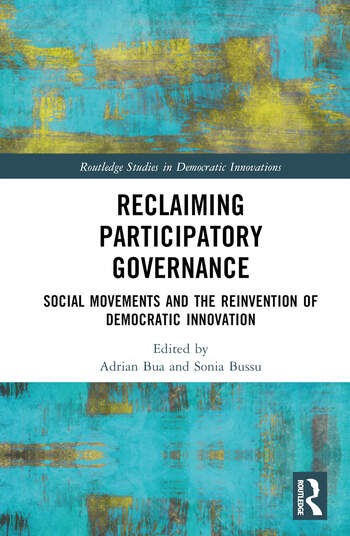
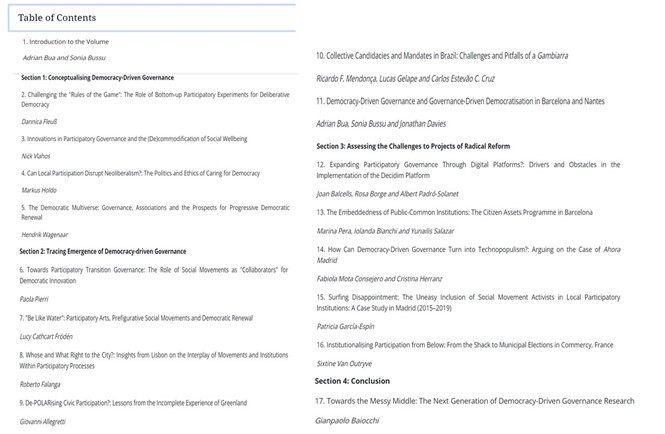
Reclaiming Participatory Governance, a volume I co-edited with Adrian Bua for Routledge’s Democratic Innovations series, provides an analysis of how social and grassroots movements are reclaiming and reinventing democratic innovations to strengthen the impact of citizen participation for social change. The book is articulated into three main sections to provide 1) theoretical and 2) empirical analyses of these processes, and to reflect on 3) challenges to the implementation of radical projects of social transformation. Through 17 chapters covering a range of cases, the volume captures the growing synergy between social movements’ mobilisations, the commons and participatory deliberative democracy, exploring how grassroots democratic action is mobilising to foster alternative forms of participatory politics and economics.
Throughout the book we apply democracy-driven governance as an analytical framework. We initially developed this concept to describe how social movements and grassroots groups who mobilised across Spain against austerity politics in the early 2010s used the deliberative and participatory toolbox, first to build movement parties’ platforms and later, after winning elections in many major cities, to transform local state institutions. Democracy-driven governance captures these social-movements-led forms of democratic innovations that aim to widen the scope of participatory governance from political institutions to the economy and wider society.
It is a counterpoint to Mark Warren’s governance-driven democratisation which refers to democratic innovations mostly initiated by public agencies, particularly at the local level. Governance-driven democratisation responds to specific policy issues and what Warren calls “pluralised ungovernability” (2014, 49). This refers to situations of high complexity that administrators are caught in as they navigate, on the one hand, dispersion of governing capacity, and on the other hand, high interdependence. The potential of Warren’s governance-driven democratisation resides in its pragmatic, problem-solving orientation, addressing problems of political leadership and public administration. However, by decoupling politics and economics and failing to attend to socio-economic factors, the practice of governance-driven democratisation has been quite tokenistic, falling short of making substantive positive change to the lives of citizens, in a context of widening inequalities.
Both governance-driven democratisation and democracy-driven governance exist in a dynamic relationship, which shouldn’t be understood as a mere bottom-up v. top-down heuristic. They both attempt to foster participatory governance or to include citizens in the work of public administration through “routinised participation”. They also interact with other participatory spaces, such as oppositional politics (protests) and the commons, where citizens create their everyday democracy by managing public goods through their own democratic decision-making rules and with limited interactions with state institutions.
The contributions to the volume look at how democracy-driven governance emerges across different socio-political and geographical contexts, and how it develops and navigates (or fails to) the constraints of day-to-day politics and public administration. Firstly, we wanted to test the analytical power of democracy-driven governance. By applying these concepts to a range of diverse cases, the chapters help flesh out the empirical characteristics of different forms of participatory governance. Secondly, we were interested in assessing how democracy-driven governance’s aspirations to social justice fare when applied to the real world. Can it strengthen the politics of the commons by making it visible and linking it to state institutions, as in the case of civic management and community-wealth building in Barcelona, or collective electoral mandates in Brazil? Can it facilitate processes of decommodification to help re-embed the economy in democracy and the wider society? Are these new approaches to politics and policymaking sustainable in the face of existing legal, business and public administration constraints?
The contributions trace practical challenges, from participation fatigue and activists’ disappointment with the slow pace of administrative work, to bureaucrats’ resistance or the challenges of reconciling democratic innovations, where citizens can participate as individuals, with assembly democracy, which strengthens organised civil society. One important aspect of democracy-driven governance concerns the digital commons, and the digital sphere will increasingly be the new battleground against the expansion of algorithmic capitalism.
The book provides many insights on the contested space to advance democracy, showing how social movements and citizen participation continue to play a crucial role in furthering the cause of critical theory: to challenge incumbency and demonstrate the possibility of other worlds.
The book launch is on 7th June 2023, at the University of Birmingham and on Zoom – register here.
Sonia Bussu is associate professor of Public Policy at INLOGOV. Her main research interests are participatory governance and participatory action research. Over the years, she has led research and published on participatory and deliberative processes, community engagement, coproduction of public services, and participatory research ethics.
With under 700 days to the next UK general election, political parties are busy developing their manifesto documents. In February, Labour leader Keir Starmer made a major speech laying out his “five missions for a better Britain”. How do these five missions relate to local government? And is the turn to “mission driven” government likely to work?
The five missions vary in their level of specificity and challenge. Securing “the highest sustained growth in the G7, with good jobs and productivity growth in every part of the country…” is a little vague but likely to be difficult, especially given we are currently ranked 6 out of 7 in terms of output per worker. Mission #2, “make Britain a clean energy superpower”, accelerating the move to zero-carbon electricity from 2035 to 2030, is specific but very challenging. Mission #3, reform of health and social care and reducing health inequalities, will require a re-focus from secondary (hospital) care to social care and addressing the social determinants of health. Mission #4 is about community safety, and likely to involve more community policing. Finally, mission #5 is to “break down the barriers to opportunity at every stage” through reform to the childcare and education systems.
Local government potentially has important roles in each of the five missions. Local education, skills and economic development functions will be critical to improving productivity. On energy, Net Zero requires at least a doubling of electricity generation by 2050, from decarbonised sources. Decarbonisation strategies need to be place-based, taking account of the geography, building types, energy infrastructure, energy demand, resources and urban growth plans. We’ve recently argued here for the key roles of councils in this area.
Turning to health and care services, local government clearly has leading roles – including ensuring place-based planning to address the social and behavioural causes of health inequalities. Analysis by the Liverpool and Lancaster Universities Collaboration for Public Health Research in 2021 concluded: “investment across the whole of local government is needed to level up health including investment in housing, children’s, leisure, cultural, environmental, and planning services”. Similarly community safety, child care and education are areas where local government could be enabled to have much greater positive impact.
Perhaps as important as the specific “missions” is the approach to governing which the party is proposing. Labour’s document characterises this as a move from top-down, target-led, short-term, siloed approaches, to government which is more “agile, empowering and catalytic”, working across the public and private sectors, and civil society. This, it argues, requires organising government around a shared vision, focusing on real world outcomes, concentrating on ends with flexibility and innovation concerning means, devolving decision making from Westminster, increasing accountability including central and local data transparency, and adopting long-term preventative approaches including greater financial certainty for local areas.
In some ways the idea of mission-driven government echoes the 1990s thinking of Ted Gaebler and David Osborne’s book “reinventing government”, which argued for a more entrepreneurial approach to the delivery of government. Their work pointed to entrepreneurial companies setting overall missions and goals, and then leaving managers to figure out how best to deliver these – for example, by providing an overall budget for a service rather than detailed line-by-line budgets which disappear if not spent by year end. The focus on managers rather than considering the perspective of politicians is one of the problems identified in subsequent evaluations of the reinventing government model, together with difficulties in sustaining the approach.
Mission-driven policies addressing ‘grand challenges’ of society are increasingly common, for example in the UN Sustainable Development Goals and various EU policies. Mazzucato et al recently argued that addressing such challenges requires strategic thinking about: the desired direction of travel, the structure and capacity of public sector organisations, the way in which policy is assessed, and the incentive structure for the private, public (and I would add community) sectors. Labour’s paper makes a start (albeit at a very high level) on thinking through these areas. The litmus test, though, will be in developing the detail and how far this engages with local areas.
Over the next few months, we will be contributing to the debate on the upcoming party manifestos with some research-informed thoughts on a variety of local government related policy areas. If you would like to be involved in developing these, please get in touch.
Jason Lowther is the Director of INLOGOV. His research focuses on public service reform and the use of “evidence” by public agencies. Previously he worked with West Midlands Combined Authority, led Birmingham City Council’s corporate strategy function, worked for the Audit Commission as national value for money lead, for HSBC in credit and risk management, and for the Metropolitan Police as an internal management consultant. He tweets as @jasonlowther








 INLOGOV Blog