Intervention 3.0: Designing a Responsive Model for Local Government Support in England

Jason Lowther / Paul Joyce / Philip Whiteman

The arrival of the new UK government looks set to result in a new policy on central government’s intervention powers in local authorities, the third generation of such policies this century.  This article suggests some key lessons from earlier models. 

Intervention 1.0 was facilitated by Best Value legislation that an “authority must make arrangements to secure continuous improvement in the way in which its functions are exercised, having regard to a combination of economy, efficiency and effectiveness” (Local Government Act 1999).  This remains the basis of statutory interventions today.  But the context could not be more different. 

The Blair government commissioned an extensive set of national performance indicators, developed independently by the Audit Commission with a common definition and quality assured through local audits.  The “District Auditor” role maintained in depth contextualised knowledge of each local council, and could identify and flag significant governance or performance issues at an early stage.  As well as diagnosing problems, the Audit Commission’s national studies provided evidence-based recommendations to help improve local services’ economy, efficiency and effectiveness.

The strengths of this model were the comprehensive nature of the evaluation, its collective and mutually supportive use of expert agencies to provide an evidence base, and the sanctions that went with it including transparent public reporting.  Inlogov produced a series of reports diagnosing and explaining the causes of poor performance, analysing recovery planning and strategies for organisational recovery, evaluating various policy instruments for recovery (such as lead officials) and identifying the key developmental mechanisms for recovery. 

Our reports clearly demonstrated that the context for poor performance determines effective mechanisms for recovery: one size definitely does not fit all.  The causes of failure are varied, such as ineffective leadership arrangements and inadequacies in the operating culture. 

Improvement mechanisms need to address issues of cognition, capability and capacity.  Cognition is the council’s awareness and understanding of their performance trajectory, which is often resilient to changes in political control.  Capability concerns the construction and institutionalisation of a change-oriented vision by council leaders.  Finally, capacity is the ability to deliver the required vision and change. The required change mechanisms are both internal (such as leadership change) and external (for example, peer mentors, expert advisors, and funding). 

Intervention 2.0

The arrival of the Coalition government in 2010 brought rapid changes to intervention.  The Audit Commission was summarily discarded, publicly justified by claimed savings of £50m.  In reality, recent research by the Audit Reform Lab at the University of Sheffield suggests that English audits have higher costs and greater delays than in Wales or Scotland (where centralised oversight arrangements were maintained). 

From 2010 to 2020, central government intervention was relatively rare with formal interventions in only four councils.  However, from 2021 this situation changed substantially with interventions in eight councils in three years (none of these councils were controlled by the ruling national party).  In the same three years, there were statutory best value notices in a further nine councils.

It’s fair to describe this phase of intervention as less structured and evidence-based, without robust national data or independent routine inspection of councils.    

There has been limited evaluation of Intervention 2.0 to date.  Our early research findings based on three case studies suggest a five-stage model of intervention: (i) crisis revelation, (ii) delegitimisation, (iii) imposed reforms, (iv) capacity building, (v) restoration or reorganisation.  We conclude that under localism interventions were not merely administrative responses to failure but were deeply political acts that reshaped the legitimacy and capacity of local governance. The Commissioners, acting as technocratic agents of central government, connected central and local government, and had the effect of buffering the political tensions of intervention, while leading a process in which managerial competence rather than local democracy steered intervention.

Where next for intervention?

The raft of interventions related to section 114 notices, the establishment of the new Local Government Outcomes Framework and local audit reform including the Local Audit Office indicate a new phase of intervention and open opportunities to develop a more systematic and evidence-based approach.  More thought is needed on how this should work in future, including the role of peer reviews and inter-council support arrangements.  The centralisation of intervention power and the dominance of technocratic intervention needs to evolve to suit devolution and to provide greater support for local democracy. This could build on the new audit arrangements through a “district auditor” type overview of governance.

The acid test of reforms should be that while central government would still be able to intervene when councils were failing, the intervention process would minimise the suspension of local democracy, do as little damage as possible to the public’s trust in their local council, and foster good local democratic political leadership.

This article first appeared in the Municipal Journal on 16 October 2025 titled “How not to damage democracy”. It is available here: https://www.themj.co.uk/damage-democracy

Dr Jason Lowther is director of INLOGOV (the Institute of Local Government Studies) at the University of Birmingham.  Prof Paul Joyce is an Associate at INLOGOV.  Dr Philip Whiteman is a lecturer on public policy and administration at INLOGOV.

Politicians’ conceptions of fairness

Clive Stevens

“You won’t find many of them”, people quip when I tell them the title of my PhD; and my riposte, “that’s why I asked councillors”. And I was right; interviews with 17 councillors across four parties have revealed over 2,000 examples. Conceptions include: equality, proportionality, equity, fair opportunity, market fairness, fair administrative process and more. These conceptions were collected during the semi-structured interviews based on four carefully crafted vignettes (case studies). Thematic coding assisted their allocation into eight broad types (Realms) along with sub-categories like reciprocity, merit and efficiency. Sometimes the councillor denied they were talking about fairness, but they were; a simple reframing, usually changing a point of view, clarified the analysis, for example, council efficiency can be reframed as value for money and thus fairness to the taxpayer.

My PhD can be likened to an exploration. With me, the explorer, finding snippets of theory from various academic sources each describing a type of fairness and sometimes disagreeing with another. Thus equipped, I ventured into the jungle, Bristol City Council, and witnessed, watched and registered actual conceptions coming from actual politicians. I returned relatively unscathed and after analysis discovered much that agreed with theory but also much else. I now have a clear report to deliver about the eight, strange, fairness-beasts that rule their Realms and what happens when they mix.

Combinations

The findings map out the Realms more accurately and show that in certain circumstances a combination of Realms can elicit quite strong responses. For example, in one vignette, six councillors wanted to request a breach of council-house regulations to allow a tenant to sublet her flat. Reasons varied, but many were drawn to the description of her disadvantage, escaping an abusive relationship, and were impressed that despite all her problems she had not only sought work but actually landed a job. “Respect” and “this is the type of person we should be helping” were two of many responses. However, an equal number of councillors were totally unimpressed and thought she should be served notice as per the tenancy. 

Another vignette, about a large donation to the Children in Care Service, offered councillors three policy options. Eight wanted to make policy changes; and every one of those changes was based on making the choices fairer.

Fair Process or Outcome?

With this more reliable set of fairness definitions, the data can be analysed in many ways. For example, there is debate about whether fairness in Local Government should be about fair process or fair outcome, some arguing one way and some the other. I recall a council officer telling me that if a decision follows fair process from a fairly formulated policy, then it must be right whatever the outcome. But is that fair?

This data lets me measure the number of conceptions of fair process and the number of conceptions of fair outcome; there was little difference whether the councillors were male or female, new or experienced, and from different parties. But it did change and dramatically, if the councillor was or recently had been in a cabinet or committee chair position compared with backbench councillors. The latter group were much more interested in fairness of outcome. This is a finding from a qualitative study, so not definitive, but I’ve already had a number of conversations saying “that’s not surprising” each with suggested reasons. Perhaps a more rigorous study could be done.

Party Dogma?

Another question I’m asked is about the influence of parties. The interviews were conducted singly and confidentially; I hope I reached the councillors’ true views. One vignette asked them to come to a conclusion and vote based on their values, and then asked whether their vote might change if it were whipped. Many said they might change out of loyalty. Loyalty, like fairness, is a moral value and clearly quite powerful.

Wicked Problems

One of many potential uses is in understanding intractable “wicked” problems. These are made more wicked if there are value differences between the stakeholders. Fairness is a human value, so perhaps an understanding of fairness could assist in some small way to make headway with such problems that seem nowadays to be popping up everywhere.

What next?

I have just entered the final year; out of the jungle but not quite out of the woods, yet; there’s a lot of writing up to do, and then I’d like to use the findings and meet up with people interested in better understanding other councillors’ or parties’ values.

An ex-councillor in Bristol and author of the book on Local Government, After the Revolution, Clive followed up on politicians’ conceptions of fairness. He is now his final year of a PhD at the University of Bristol, interviews complete and writing it up. His personal blog site is: https://sageandonion.substack.com/

LGOF: CPA-lite or Daily Mail target practice?  

Jason Lowther

In July, then Local Government Minister Jim McMahon announced a new Local Government Outcomes Framework (LGOF), which (he said) “forms an integral part of this Government’s reforms to ensure we have a sector which is fit, legal and decent”.  These reforms are already pretty extensive, including LG reorganisation, devolution, community engagement, member standards and funding arrangements.

The LGOF framework, the Minister hoped, “will help to put the right checks and balances in place to ensure value for the taxpayer and results for citizens to whom councils are ultimately responsible”.  Given the removal of most systematic monitoring of local performance and outcomes in England with the demise of the Audit Commission a decade ago, is this a new dawn for helpful local insights and intelligent central steering, or the raw material for a crude league table that obscures more than it illuminates?

History shows the difficulty of designing and using performance measures effectively.  Whilst the logic of measuring what matters to inform management (and political) decision making is clear, and there are many examples of successful applications, there are enough examples of failures and unintended negative consequences to encourage caution. 

The immediate precursor to LGOF was a set of measures developed by the ill-fated Office of Local Government (OFLOG).  These were immediately manipulated by the Times newspaper into a league table, labelling Nottingham as the worst council.  The fact that this took place during the pre-election period only made the impact more negative, leading to a stinging letter from the LGA to the then Secretary of State, Michael Gove.  OFLOG was in some ways set up to fail.  Sited inside the Ministry, its political independence was immediately open to challenge.  And reconciling providing local authorities with better data at the same time as acting as an accountability mechanism to central government was always going to be tricky. 

The health service experience of performance measures and targets presents mixed evidence.  It appears that four-hour A&E waiting times targets were associated with reduced mortality, but at the same time there were examples of departments admitting patients near to the time limit at the expense of others more in need of urgent care, a few examples of blatant misrepresentation of figures, and some bizarre holding of patients in ambulances and redefinition of corridors as wards.

Key lessons from these examples include the importance of having a clear focus for the LGOF and the adoption of a broad ‘exploratory’ approach to presenting the performance measures.   As the Institute for Government argued for OFLOG, a key contribution could be making data more consistently available, comparable and usable – and hence supporting evidence-based policy making through the deliberative use of robust evidence.

The LGOF data needs to be presented in ways that enable and encourage exploration and questioning, rather than simplistic league tables which ignore the inherent differences between different councils in terms of population, geography, deprivation, funding, etc.  It therefore needs exhibit what I call the three Cs: to be comparable across councils, contextualised to reflect local circumstances, and citizen-focussed (accessible to lay people).

There are many positive features of the new framework, including its attempt to look at missions and outcomes (rather than just council outputs).  Interested parties had until 12 September 2025 to respond to the Government’s consultation, so we now await the government’s response to that.  Councils can easily see how the proposed LGOF measures look for them using the excellent new LG Inform LGOF report

Dr Jason Lowther is Director of the Institute of Local Government Studies (INLOGOV) at the University of Birmingham.  This article was initially published in the Local Area Research and Intelligence Association (LARIA) newsletter. Email [email protected]

Disappearing Reform UK Councillors, Lord Mark Pack’s Poll Base, and me, etc.

Chris Game

Literally minutes before I was going to email this already over-lengthy blog, I had my attention drawn to Birmingham’s rather paltry 5.4 score and 4th-from-bottom ranking on the HAYPP vape retailers’ ‘smell score’ scale – pretty well what it sounds like: UK cities ranked on perceived cleanliness. It seemed so obviously distorted by the lengthy bin collection strike and consequently not a lot better than Leeds’ 4.2, rather than up with at least, say, Newcastle (7.4) or even Liverpool (8.2). But, apart from those few lines, I let it pass.

So, on to my initial topic, which, as it happens, kicks off with some equally basic stats. Someone asked me recently – albeit after I’d slightly steered the conversation – if I knew whether (m)any of the several hundred new Reform UK councillors elected in the recent local elections (that I’d written about in a recent INLOGOV blog) had already left the party.  

I had to waffle a bit – after all, the 677 ‘new’ ones had taken Nigel Farage’s party’s national total to just over 850, and some/many undoubtedly shocked themselves. But I did happen to know that the number of recent resignations/suspensions/expulsions was already into double figures. To which I was able gratuitously to add that the party had also ‘lost’, at least for the time being, two of its six MPs.

Which might seem to suggest either that I have a particular academic interest in Farage’s indisputably fascinating party or that I’m some kind of political nerd – to neither of which I’ll readily admit.

No, the explanation for my having acquired this arcane knowledge is that for at least 30 years now I’ve known/known of (nowadays Baron) Mark Pack, his captivation with all things electoral, and his enthusiasm for sharing that captivation – dating back to when he was at the University of Exeter, just up the A38 from the University of Plymouth, original home of ‘(Colin) Rallings & (Michael) Thrasher’ (definitely local government statistical junkies), and now itself home of their internationally renowned Local Government Chronicle Elections Centre, and its/their matchless annual Local Election Handbooks.

Naturally, R&T’s interests and path-breaking publications focus primarily on local government elections. Those of (nowadays) Lord Pack of Crouch Hill (but Mark hereafter) include the Liberal Democrat Party, of which he’s currently an extremely active President; the House of Lords, and, as ever, political opinion polls, about all of which he writes invariably fascinating weekly newsletters; in addition to reporting on almost anything electoral. This and more he shares on his exceedingly lively website, the recommendation of which (to any readers unfamiliar with it) is the main purpose of this blog.

And so, belatedly, back to those disappearing Reform UK councillors. It’s the sort of phenomenon that Mark Pack revels in – the numbers, the reasons/circumstances, it’s all perfect material for a near-daily political diarist.  He naturally keeps a running list of councillors “shed by Reform UK” since the May elections, the most recent updating of which at the time of typing this paragraph being, I think, on July 7th, when the departee figure had reached a quite striking 11.

They comprised five straight resignations as councillors, two expulsions by Reform, three suspensions by the party, one of whom subsequently quit, and one who’d decided they’d prefer to be an Independent.  

As for the (female) Reform UK councillor charged with assault and criminal damage, for instance – well, it was covered, naturally, in Mark Pack’s diary on June 30th, and she’ll shortly be “appearing before magistrates”.  And, as the Crown Prosecution Service publicly emphasised, it’s “extremely important that there be no reporting or sharing of information online which could in any way prejudice ongoing proceedings.”    

Which brings us to the two of the all-time total of just six Reform MPs who already are no longer. First was Great Yarmouth MP Rupert Lowe, who back in March was suspended and reported to the police over alleged threats of physical violence towards the party’s Chairman, Zia Yusuf. And second, more recently, was James McMurdock, who “surrendered the party whip” a few weeks ago over, as The Guardian delicately put it, “questions of loans totaling tens of thousands of pounds.” 

The key, albeit belated, point of this blog, however, is the multifaceted contribution to our political world of Mark Park himself, rather than ‘here-today-gone-tomorrow’ MPs. Yes, he’s a copious diarist, but so much more. In particular, there’s his arguably greatest single contribution to our academic political world: the phenomenon that is what I still think of as his ‘PollBase’, but which comparatively recently has acquired the handle PollBasePro.

If you’re writing anything at all concerning our political world in the 90-plus years since 1938/39 – yes, before the start of World War II – and you need to know or even get a sense of the state of UK public opinion on a virtually month-by-month, and latterly week-by-week, basis, just Google either title, and it’s there, instantly accessible and downloadable. Yes, completely free – all Mark asks is that you point out any mistakes (!) and have the decency to acknowledge the source.

It’s a fabulous resource, easily worth – pretty obviously – a blog on its own, but all it’s going to get on this occasion is this abbreviated reference, kind of explaining why I’ve structured this blog in the way I have. That reference comes from p.2 of the dozens of pages, when the only pollster was Gallup and the only poll publisher the News Chronicle (1930-60, when it was “absorbed into the Daily Mail”).

From the start, in 1938, the sole question asked consistently was “Conservatives Good or Bad”, and, probably not surprisingly, throughout most of World War II, the Conservatives were overwhelmingly (75-90%) ‘Good’. Only from 1943 were questions asked about the other parties, and from the start Labour, polling consistently in the 40s, had a double-figure lead over the Conservatives, suggesting that voters were already clearly differentiating between the conduct of the war and the conduct of peace.

This came to a head in January 1946, when Labour, with 52.5%, outpolled the Conservatives by a massive 20.5%, a lead they’d never previously even approached and would do so just once again in the coming decades. Oh yes, and I was born at the very end of December 1945 – and, if only we’d known, my committed Tory-voting parents would have been deeply unhappy, and I’d have gurgled contentedly. Sorry about the length, but I had to squeeze that last bit in.

Chris Game is an INLOGOV Associate, and Visiting Professor at Kwansei Gakuin University, Osaka, Japan.  He is joint-author (with Professor David Wilson) of the successive editions of Local Government in the United Kingdom, and a regular columnist for The Birmingham Post.

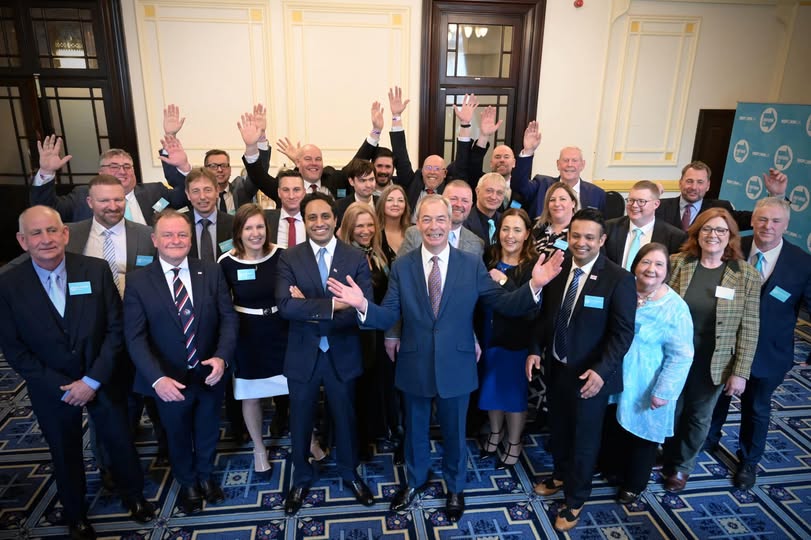
Picture credit: https://www.facebook.com/nigelfarageofficial/posts/today-i-announced-29-local-councillors-have-joined-reform-uk-from-across-the-cou/1184319953049781/

The role of the Ombudsman within the Japanese Local Government System: The Example of Kawasaki City

Professor Shunsuke Kimura

The ombudsman is an institution that serves as a voice for Parliament and the public, conducting administrative reviews through hearings and investigations of complaints and inquiries. Rooted in human rights protection, the ombudsman system monitors administrative agencies by directly addressing citizens’ claims.

This paper analyses the functions of the Japanese ombudsman system within the public policy framework, particularly considering Japan’s cultural characteristics. Despite its adoption by some local governments since 1990, the ombudsman institution has not gained widespread prominence across Japan. This raises questions regarding its effectiveness within the administrative dispute system and the reasons for its limited adoption. Research indicates that there are structural issues within Japan’s local administrative system that may hinder the mediation process.

The study employs original statistics sourced from interviews with ombudsmen from Kawasaki City, which was the first municipality to establish an ombudsman in 1990. The paper also highlights the presence of approximately 5,000 administrative advisors across Japan, which contrasts with the relatively small number of municipalities that have adopted the ombudsman system.

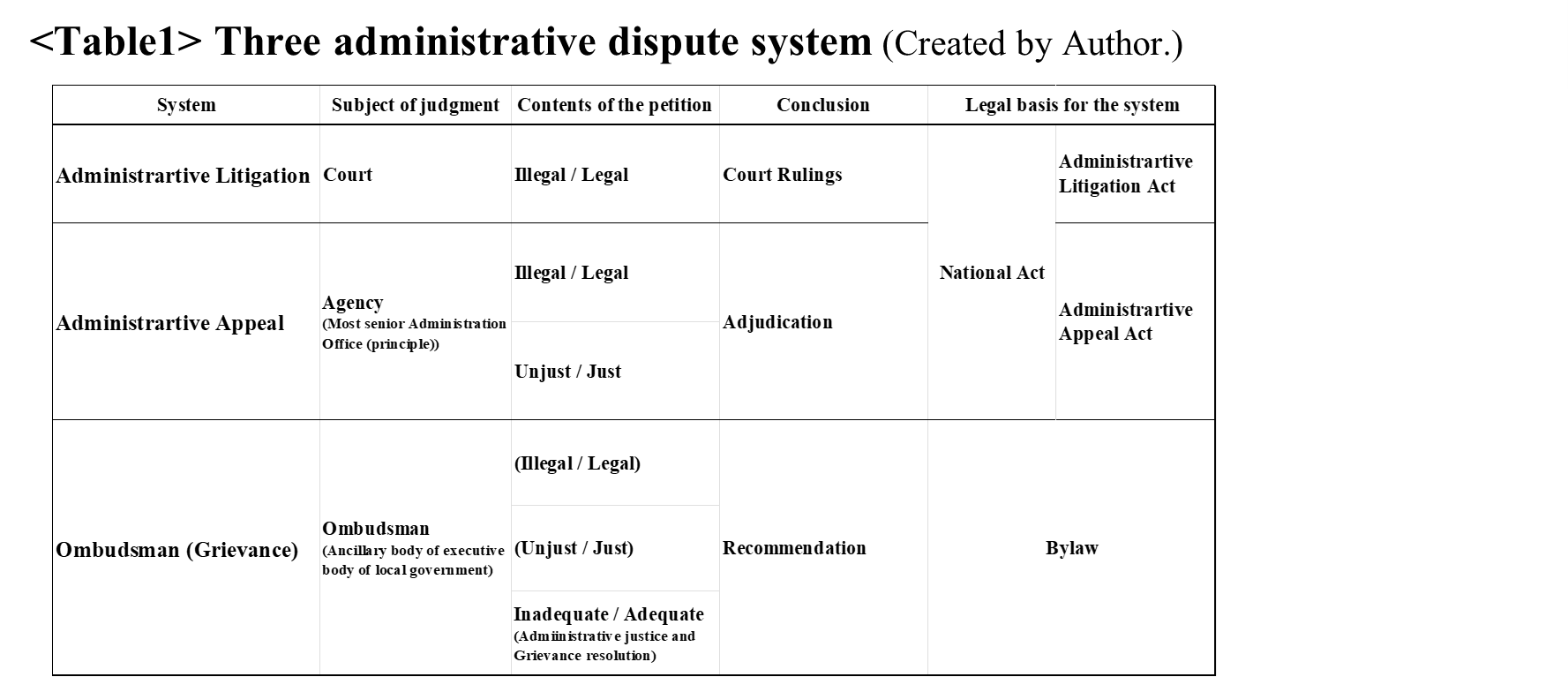
Municipal ombudsmen have contributed to addressing administrative grievances and improving local governance through reforms. The Japanese administrative dispute system comprises three subsystems: the administrative case litigation system, the administrative appeal system, and the grievance system, with the ombudsman system falling under the latter. (See Table1)

The ombudsman primarily addresses inadequate administrative actions, aiming to enhance administrative justice. Japan’s local government system consists of ordinary and special local governments, with prefectures and municipalities being the primary units.

The paper emphasizes that, unlike many countries, Japan does not have a national ombudsman system, only local government systems, which contributes to the unique characteristics of its public ombudsman framework. This framework includes legislative and executive types of ombudsmen, with the latter being more prominent in local governance.

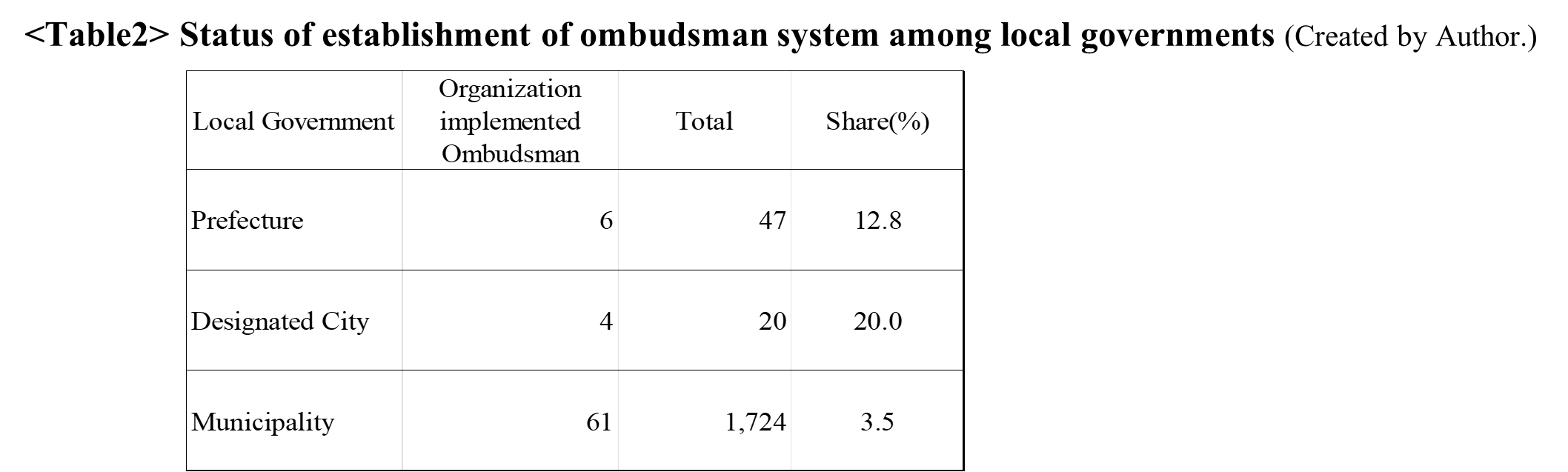
This paper discusses the varying implementation of ombudsmen across municipalities, pointing out that their presence is particularly notable in designated cities. However, the diffusion of ombudsmen remains limited, with only 71 municipalities adopting the system.(See Table2)

This limitation can be attributed to cultural factors that prioritize group cohesion over individual expression, as well as historical beliefs regarding government infallibility.

The role of the ombudsman in Japan is further complicated by the lack of national oversight and the challenges in securing competent personnel. Additionally, existing administrative bodies with similar functions pose competition for the establishment of ombudsmen.

The study concludes that while the ombudsman system has not spread significantly, it plays a crucial role in addressing administrative issues and enhancing citizen participation. The future of the ombudsman system in Japan hinges on recognizing its value in promoting administrative justice and ensuring the protection of citizens’ rights. In summary, the Japanese ombudsman system, despite its limitations, has the potential to evolve as a vital mechanism for administrative accountability and citizen engagement, particularly in an era marked by increasing complexity in governance and citizen demands.

Professor Shunsuke Kimura, PhD, is Professor and Dean of Graduate School of Global Governance, Meiji University, Tokyo, Japan. PhD(law) at Hitotsubashi Univ. After retiring from Ministry of Internal-Affairs, he has been working as a professor. He has been a Visiting Scholar at Lille Univ. in 2023 and at the University of Birmingham (INLOGOV) in 2025.