From Ghana to Birmingham: How a Global Learning Network reinvigorated Public Managers

Shailen Popat

What happens when city managers from Ghana and governance experts from the UK sit around the same table? Ideas spark, assumptions are challenged, and new ways of working begin to take shape. That’s the story behind the Ghana City Managers Community of Practice (CoP) – a bold experiment in international collaboration that’s changing how we think about public management. The full article published in the Education in Practice journal can be found here.

Why This Matters

Public managers everywhere face “wicked problems” – issues like urbanisation, climate resilience, and service delivery that defy simple solutions. Traditional training often falls short because it’s one-off and disconnected from real-world complexity. Enter Communities of Practice: long-term learning networks where practitioners and academics share experiences, co-create solutions, and build trust. They’re not just about knowledge – they’re about relationships and sustained engagement. CoPs are powerful because they bridge the gap between theory and practice. They allow managers to learn from each other, adapt ideas to local contexts, and build confidence in tackling complex challenges. For countries like Ghana, where decentralisation and urban growth create both opportunities and pressures, this approach offers a way to strengthen governance without imposing external models.

The Big Idea

In March 2025, the University of Birmingham hosted 14 senior Ghanaian officials for a week of immersive learning. Backed by the UK’s International Science Partnerships Fund, the visit wasn’t a typical study tour. It was a strategic intervention to launch a transnational CoP – one that blends academic insight with practical experience and positions both Ghana and the UK as partners in governance innovation.

The goals were clear:

  • Forge lasting institutional partnerships
  • Co-design training materials rooted in Ghanaian realities
  • Build capacity through comparative insights
  • Shape future research on urban resilience and inclusive governance

This initiative reflects a broader shift in development practice – moving away from top-down technical assistance towards partnership-based models that prioritise mutual benefit and knowledge reciprocity.

Inside the Week: What We Did

The programme kicked off with a high-energy plenary featuring voices from both sides of the partnership: Prof. Samuel Bonsu (GIMPA), Dr Nana Ato Arthur (former Head of Ghana’s Local Government Service), and Mo Baines (CEO, APSE). Their message was clear – governance challenges may differ, but the principles of collaboration and accountability are universal.

Photograph of the CPD participants and some trainers at the Edgbaston Campus

Workshops tackled decentralisation, participatory planning, and sustainable cities. These weren’t lectures – they were conversations, with Ghanaian managers sharing frontline realities and UK experts offering comparative perspectives. Institutional visits added texture: at the West Midlands Combined Authority, delegates explored regional governance and economic development strategies; at Birmingham’s Lord Mayor’s office, they saw the symbolic power of civic leadership in action. The week ended with a roadmap: virtual meet-ups, annual exchanges, and joint research projects. Participants left not just with ideas, but with commitments to keep the momentum going.

What Changed?

The impact was immediate and tangible:

  • Partnerships Deepened: UoB, GIMPA, and Ghana’s Local Government Service agreed on joint research and staff exchanges
  • Capacity Built: Delegates gained practical insights into governance models they could adapt at home
  • Training Co-Created: New modules blend academic theory with Ghanaian case studies – tools designed by practitioners, for practitioners
  • Policy Influence: Senior officials pledged to embed lessons into local reforms
  • Research Horizons Expanded: Themes like digital governance and urban resilience emerged as priorities for future collaboration

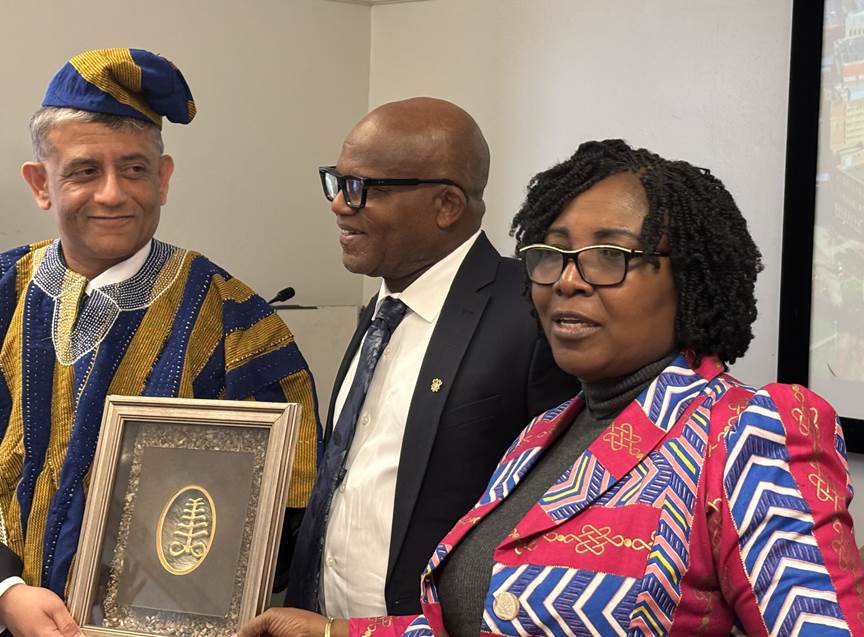
The Head of the Ghanian Local Government Service, Dr Stephen Nana Ato Arthur and the Chief Director of the Office of the Head of the Local Government Service, Madame Felicia Dapaah Agyeman-Boakye, honouring Shailen at the end of the CPD in Edgbaston.

Why It’s Different

This isn’t about exporting UK models or ticking boxes for donor reports. It’s about mutual learning and knowledge democracy – valuing local expertise as much as global frameworks. It’s also about universities stepping up as conveners of global networks, using their resources and credibility to drive real-world change. The co-designed training materials exemplify this ethos. They combine global frameworks with Ghanaian case studies, creating tools that are contextually grounded and practically useful. This approach aligns with calls to decolonise development practice – moving away from prescriptive solutions towards collaborative innovation.

What’s Next?

The Ghana CoP is just the beginning. Plans are underway to bring in managers from other African and UK cities, creating a richer, more diverse learning ecosystem. Future funding bids will build on the success of this pilot, ensuring the network grows and thrives. For INLOGOV, this story is a call to action: let’s champion collaborative governance, not as a buzzword, but as a practice that transforms institutions and communities. The challenges facing public managers are too complex for isolated solutions. By investing in relationships, shared learning, and co-production, we can create governance systems that are adaptive, inclusive, and resilient.

Dr. Shailen Popat works as an Assistant Professor in Public Policy and is the Director of the MSc in Public Management at the University’s Institute of Local Government Studies. He completed his PhD at the University of Oxford and his thesis explored the sensemaking processes of School Principals when enacting a significant new policy. He specialises in supporting public managers to enact policies in a manner that can be effective in their context and is a founding partner of a partnership between the University, GIMPA, and Ghana Local Government. Known for his student-centred approach and ability to explain complex concepts in a comprehensible manner, Shailen is considered to be an outstanding lecturer and tutor and was awarded the accolade of ‘Teacher of the Year’ at the 2022 University of Birmingham Teaching Awards, and in 2023 he was awarded a Senior Fellowship of the UK Higher Education Academy for his Educational Leadership.

Why Short CPD Training and Long – Term Mentoring Communities of Practice Should Work Together

Shailen Popat

In today’s rapidly changing public sector, professional development is no longer a luxury — it’s a necessity. But what’s the best way to equip public managers with the skills and mindsets they need to lead effectively? Is it through short, intensive training sessions, or through long – term mentoring and peer learning? My recent article, Reflections on Short CPD Training and Long – Term Mentoring Communities of Practice for Public Managers, explores this question through two linked initiatives in Ghana and the UK. You can read the full piece here, but here’s a summary of the key insights.

Two Initiatives, One Goal: Building Public Sector Capacity

In March 2024, I co – led a three – day Continuing Professional Development (CPD) workshop at the Ghana Institute of Management and Public Administration (GIMPA). Over forty senior local government officers came together to explore cultural intelligence, organisational culture, and change management. The workshop was highly participatory, encouraging reflection on power dynamics and leadership behaviours. It wasn’t just about technical skills — it was about shifting mindsets. A year later, in March 2025, we launched a transnational Community of Practice (CoP) in Birmingham. Fourteen Ghanaian city managers and academics joined UK counterparts for a week of collaborative learning, site visits, and strategic dialogue. Unlike the CPD workshop, this wasn’t a one – off event. It was the start of an ongoing network designed to foster mutual learning, co – produce training materials, and build institutional partnerships.

What CPD Brings to the Table

CPD is familiar to most professionals: structured, time – bound, and focused on specific competencies. It’s efficient and accessible, making it ideal for introducing new frameworks or addressing urgent skills gaps. Our GIMPA workshop, for example, gave participants analytical tools to examine organisational culture and power dynamics — critical for reforming local governance. But CPD has limitations. Without follow – up, its impact often fades. Participants in Accra voiced this concern: how could they sustain the momentum after the workshop ended? This reflects a broader critique in the literature — CPD can feel like a “tick – box” exercise if not embedded in a longer learning journey.

The Power of Communities of Practice

Communities of Practice, a concept popularised by Etienne Wenger, take a different approach. They’re about relational, situated learning — professionals learning with and from each other over time. Our Ghana – UK CoP exemplified this. Participants didn’t just absorb knowledge; they co – created it. They shared case studies, identified research priorities, and even laid the groundwork for joint projects and staff exchanges. This collaborative model builds trust, fosters innovation, and creates a sense of ownership. It also delivers tangible outcomes: institutional partnerships, co – produced training materials, and a platform for policy experimentation. In short, CoPs turn learning into a living, evolving process.

Why We Need a Hybrid Model

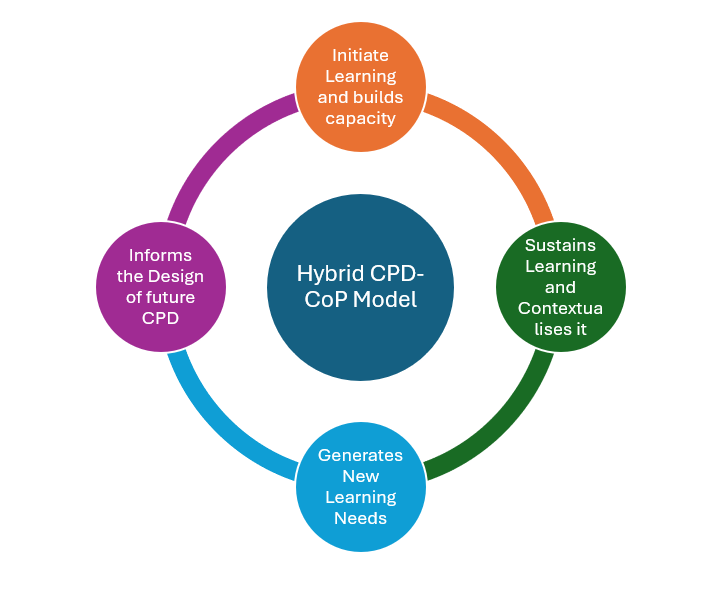
So, which is better — CPD or CoPs? The answer is both. CPD offers structure and accessibility; CoPs provide depth and sustainability. When combined, they create a dynamic learning ecosystem:

  • CPD as the entry point: Introduce core concepts and skills in a structured, time – efficient way.
  • CoPs as the follow – through: Sustain learning, contextualise it, and generate new insights for future CPD.

This cyclical relationship ensures that professional development is continuous and adaptive. It aligns with the idea of a “learning organisation” and supports the kind of hybrid professionalism today’s public managers need — technical expertise plus collaborative, contextual competencies.

The Role of Universities

Universities are uniquely positioned to make this happen. They have the research capacity, convening power, and infrastructure to sustain long – term engagement. But this requires a shift: from delivering knowledge at a distance to embedding themselves in professional ecosystems. That means co – designing curricula with practitioners, facilitating peer learning across borders, and evaluating impact not just in terms of knowledge acquisition but institutional transformation. Our Ghana initiatives show what’s possible when universities embrace this role. The CPD workshop sparked mindset shifts; the CoP built enduring partnerships and practical tools for governance reform. Together, they created a professional learning ecosystem grounded in local realities and enriched by global perspectives.

Why This Matters Now Public managers face unprecedented challenges — climate change, urbanisation, digital transformation. These are “wicked problems” that demand adaptive, collaborative leadership. Short – term training alone won’t cut it. Neither will informal networks without structure. We need integrated models that combine the best of both worlds. If you’re a public sector leader, educator, or policymaker, I invite you to read the full article here. Let’s reimagine professional development as a shared, iterative, and relational endeavour. The future of public service depends on it.

Dr. Shailen Popat works as an Assistant Professor in Public Policy and is the Director of the MSc in Public Management at the University’s Institute of Local Government Studies. He completed his PhD at the University of Oxford and his thesis explored the sensemaking processes of School Principals when enacting a significant new policy. He specialises in supporting public managers to enact policies in a manner that can be effective in their context and is a founding partner of a partnership between the University, GIMPA, and Ghana Local Government. Known for his student-centred approach and ability to explain complex concepts in a comprehensible manner, Shailen is considered to be an outstanding lecturer and tutor and was awarded the accolade of ‘Teacher of the Year’ at the 2022 University of Birmingham Teaching Awards, and in 2023 he was awarded a Senior Fellowship of the UK Higher Education Academy for his Educational Leadership.

Supporting councillors to thrive: the 21st Century Councillor Revisited

Catherine Needham

In our research on the 21st Century Councillor, we’ve found that elected members are facing a barrage of challenges:

  • Perma-austerity has deepened with sustained underfunding of public services  
  • Complexity of place has intensified, through combined authorities and integrated care systems, alongside local government reorganisation.   
  • Communities are in distress, moving from the pandemic straight into the cost-of-living crisis   
  • Incivility in public life has grown with rising issues of abuse and harassment for councillors in particular 
  • The rising profile of equality, diversity and inclusion has drawn attention to how public services systematically fail some workers and citizens  
  • Remote and hybrid working can enhance individual flexibility but can make it more difficult for councillors to build the relationships they need to function effectively. 

From interviews with councillors, we heard about the strategies they use to cope with these challenges and to support their communities to thrive. They are keeping the system human on behalf of communities. They are zooming in and out, from the micro issues facing residents to the big strategic issues of place. They act as a lightning rod, absorbing hostility whilst keeping themselves grounded and safe. You can read more about the research findings here.

If you’re a councillor – or you work in a role supporting councillors – come and join us in Andover on 4 November to hear more about this research and chat to peers about how best to manage these challenges. You’ll also hear from the Local Government Chronicle about their new campaign to support councillors.

Click here to register: 21st Century Councillors Tickets, Tue, Nov 4, 2025 at 10:00 AM | Eventbrite

From Consultation to Co-Creation: How Birmingham Can Lead the Way in Participatory Governance

Susana Higueras and Sonia Bussu

In a time of growing inequality, political disillusionment, and institutional strain, Birmingham is at a crossroads. The city’s bold initiative, Shaping Birmingham’s Future Together (SBFT), offers a timely and transformative opportunity: to reimagine how local government works with its communities.

A new report by Susana Higueras and Sonia Bussu lays out a compelling roadmap for how Birmingham City Council (BCC) can become a participatory council. Drawing on UK and international examples, as well as interviews with local stakeholders, the report argues that participatory governance must be more than a buzzword. It must be embedded into the everyday workings of the council, grounded in inclusive practices, and driven by a genuine commitment to share power.

Why Participation, Why Now?

Birmingham is one of the UK’s most diverse and youngest cities. This diversity is a strength, but also a challenge when it comes to ensuring that all voices are heard in policymaking. At the same time, the city faces deep structural inequalities, including the highest child poverty rates in the UK. Traditional top-down governance models are no longer fit for purpose. What’s needed is a shift from consultation to co-creation.

The SBFT partnership, launched in 2024, aims to tackle these challenges by fostering collaboration across public, private, and community sectors. But as the report makes clear, this vision will only succeed if participation is embedded, not treated as an add-on or a one-off event.

What Does Embedded Participation Look Like?

Embedded participation means making citizen engagement a routine part of how decisions are made, from setting priorities to evaluating outcomes. It requires:

  • Facilitative leadership that enables collaboration and power-sharing;
  • Boundary spanners, or individuals who bridge the gap between institutions and communities;
  • Strong partnerships with civil society, grassroots, and voluntary organisations;
  • Intersectional inclusion that centres the voices of those facing multiple, overlapping barriers to participation.

The report highlights that successful participatory governance is not about flashy new tools or one-off events. It’s about culture change, within the council, across sectors, and in how communities are engaged.

Lessons from Elsewhere

The report draws on global examples to show what’s possible, and what pitfalls to avoid.

  • Porto Alegre, in Brazil, was a trailblazer in participatory budgeting, enabling residents to directly allocate public funds, at one point transferring over $300 per person annually to community control. However, as political leadership shifted, the commitment to the process waned, and budget allocations steadily declined, leading to a loss of momentum.
  • Barcelona, Spain, embedded citizen participation through digital platforms like Decidim and cultivated strong ties with social movements. At its peak, over 40,000 citizens engaged in budgetary decisions. Yet, the experience underscores the vulnerability of transformative initiatives when overly reliant on charismatic leadership, making them susceptible to political cycles.
  • Camden, London, institutionalised citizens’ assemblies, integrating them into formal decision-making structures. Notably, all 17 citizen recommendations on climate policy were adopted. Still, challenges persist around ensuring inclusivity and maintaining consistent follow-through.
  • Reykjavik, Iceland, leveraged digital platforms to crowdsource citizen ideas and implement participatory budgeting. Initially successful in mobilising thousands of residents, the initiative faltered as political support diminished and the platforms remained peripheral to formal governance, highlighting the limitations of digital participation without institutional anchoring.
  • Ostbelgien, Belgium, established the world’s first permanent deliberative system linked to a legislative body. Its legally enshrined Citizens’ Council and Assemblies offer a promising model of democratic stability and accountability. However, the top-down design and limited community ownership reveal the critical need for co-creation and inclusive recruitment to prevent the reinforcement of existing inequalities.

These examples show that embedding participation requires sustained commitment, institutional support, and mechanisms for accountability.

Opportunities in Birmingham

Despite the challenges, Birmingham has a strong foundation to build on:

But There Are Challenges Too

The report doesn’t shy away from the barriers:

  • Broken trust: Communities are tired of being consulted without seeing change.
  • Hierarchical leadership: A top-down culture limits innovation and responsiveness.
  • Structural silos: Departments often work in isolation, duplicating efforts and missing opportunities for collaboration and nurturing citizen participation.
  • Unfair funding mechanisms: Smaller community organisations feel sidelined and overburdened by bureaucracy.

These challenges are not unique to Birmingham, but they must be addressed head-on if SBFT is to succeed.

What Needs to Happen Next?

The report offers a clear set of policy recommendations.

Rebuild trust through transparent communication and visible follow-through.

Trust has been eroded by repeated consultations without tangible outcomes. BCC must commit to clear feedback loops, visibly acting on community input and explaining decisions transparently to rebuild credibility and legitimacy.

Embed participation in budgeting, service design, and scrutiny processes.

Participation should not be limited to one-off events; it must be embedded across governance functions. This can include participatory budgeting, citizen panels, and co-designed scrutiny mechanisms that give residents real influence over public decisions.

Foster facilitative leadership and cross-sector collaboration.

Leadership must shift from command-and-control to facilitation, enabling shared power and collaborative problem-solving. Cross-departmental working groups and partnerships with civil society can help break down silos and foster innovation.

Work better with communities, recognising them as co-creators, not just consultees.

Community organisations should be treated as equal partners, with fair funding, early involvement in policy development, and recognition of their expertise. This means moving from consultation to co-creation, where communities help shape solutions from the outset.

Design for intersectional inclusion, addressing overlapping barriers to participation.

Inclusive participation requires acknowledging and addressing systemic inequalities. Councils must create safe, accessible spaces and use diverse engagement methods, including arts-based approaches and multilingual formats, to ensure marginalised voices are centred and valued.

The SBFT partnership can be a catalyst of this change and become the space for shared governance and accountability.

A Call to Action

The SBFT initiative is more than a policy programme, it’s a democratic innovation. It’s a chance to reshape how power is shared in the city, how decisions are made, and how communities are valued. As one community leader put it: “We’re not asking to be asked. We’re asking to lead.”

If Birmingham can rise to this challenge, it won’t just be shaping its own future. It will be setting a national, and even global, example of what inclusive, embedded participatory governance can look like in the 21st century.


DOI: https://doi.org/10.48352/inlogov.bhamx.0001

Dr Sonia Bussu is an Associate Professor at the University of Birmingham Department of Public Administration and Policy where she studies and teaches public policy. Her main research interests are participatory governance and democratic innovations, and creative and arts-based methods for research and public engagement. 

Susana Higueras Carrillo is a Peruvian anthropologist. She is PhD candidate at Goldsmiths, University of London and holds a master’s degree in Environmental Governance from the University of Oxford. She has worked at the University of Birmingham in the INSPIRE (Intersectional Space of Participation: Inclusive, Resilient, Embedded) project researching how to strengthen intersectional inclusion through arts-based methods such as legislative theatre. Her research interests lie in environmental and social justice and communicating research in creative and impactful ways.

New course for public sector leaders on growing your place

Ian Bancroft

Place Growth and Leadership is growing in importance for public bodies and public sector leaders, yet as a discipline with a set of core skills it is not well defined or supported through programmes of learning and development.

This is something I realised during my time as a Chief Executive of a growing city, Wrexham. No one advised me about how to steer the place journey of Wrexham, or about convening common purpose conversations, creating a shared vision, coaching other local leaders, overseeing the city’s master planning, encouraging inward investment, connecting with other places on similar journeys in the USA, promoting Wrexham as an international brand, and working with Hollywood stars.

Yet this is the journey I traversed, with a number of like minded local leaders to achieve city status, grow tourism and the local economy, attract inward investment including £450m philanthropic funding from the USA and a £160m investment zone, as well as being a runner up in the UK City of Culture competition for 2025.

During a conversation early in 2025 with Jason Lowther the Director of INLOGOV we discussed place growth and leadership and formed the early ideas of this unique course. We both had a similar view, that while systems leadership, visioning, public narrative are becoming more commonly taught these are not pulled together with an emphasis on using these skills to grow the place we serve. We also recognised INLOGOV with its history at being at the heart of innovative learning in Local Government was ideally placed to host such a course.

At roughly the same time I was approached by Solace (UK) to contribute to their Power of Place report, describing my journey in Wrexham, and bringing together a number of case studies by people leading place-based work across the UK. This report is a critical best practice resource for place leaders and practitioners. The Power of Place | Solace

Jason and I were delighted that after discussions with Solace (UK) that they wanted to collaborate on the course to ensure the Power of Place report is utilised fully as a learning resource.

INLOGOV in collaboration with Solace (UK) are now launching this new course ‘Place Growth and Leadership’ and are recruiting for the first cohort early in 2026. I am delighted that under the umbrella of my new company Traverse Leadership Consulting Ltd Ian Bancroft that I will be leading delivery of the course and be able to give back and share my learning with other skilled practitioners. This will include two days at the beginning and end of the course based at the UoB campus in Birmingham learning about place growth and leadership skills, considering case studies from the UK and USA including an in depth look at Wrexham and Syracuse from New York State, USA which has attracted one of the largest private sector investments into its locality in US history.

But the course will be more than this. It will provide four action learning sets, once a month, giving participants the opportunity to work through their place-based issues and opportunities with other leaders. The course will also result in further research and articles to build on the existing Power of Place report.

So, if you are a Place based leader at Director, Chief Officer, Head of Service or lead practitioner level this course is ideal for you. Those involved in Local Government Reorganisation or Devolution will recognise the importance of developing their place-based skills to improve their employability.

As a public servant wanting to make a real impact for the benefit of the people and place I served was always my overriding motivation. It is now a privilege to be able to be part of a team enabling others to grow and lead their place.

For more information and to book on the first cohort in 2026, before the end of November, click on the following link Place-based growth and leadership Tickets, Multiple Dates |   Eventbrite  or use the QR code below. Alternatively, please contact Ian Bancroft at [email protected] or on 07946 765398.

Ian is an Associate at INLOGOV and is Director of his own company Traverse Leadership Consulting (TLC). With over 35 years of experience in Local Government and 6 years as a Chief Executive Ian now harvests his learning to give back to the sector. His particular areas of expertise include: Place Growth and Leadership; Systems Leadership; Executive Coaching; Sports and Cultural Sector.

Renewing Democratic Leadership

Jason Lowther and Sonia Bussu

Legislative Theatre with West Midlands Combined Authority

As local government in England undergoes significant restructuring, with fewer councils serving larger and more diverse populations, the role of councillors is under pressure. At the same time, democratic innovations, such as citizens’ assemblies, or creative methods of participation, such as legislative theatre and digital engagement, are gaining traction. These innovations offer new ways to engage communities and strengthen democratic legitimacy.  But how do they fit with the role of elected councillors?

Recent research and practice suggest that councillors can play a crucial role in facilitating inclusive and impactful citizen participation.

Politicians’ Views on Participation

Across the UK and Europe, many elected representatives have expressed support for citizen participation in policymaking. They see it as a way to build trust, improve decision quality, acknowledge a wider range of perspectives and knowledge, engage citizens more deeply in political life, and potentially identify novel solutions to politically difficult issues. However, research by Kersting shows that this support is often conditional. Councillors tend to favour participatory instruments that reinforce their representative role, such as advisory boards or structured consultations. They are more sceptical of online platforms and randomly selected citizen assemblies (so-called minipublics), which they worry may not be genuinely representative of their electorate and may lack the capacity to understand complex issues.

Werner and Marien’s comparative experiments in Sweden and the Netherlands provide further insight. Their work shows that participatory processes consistently increase perceptions of fairness. This matters because fairness perceptions are closely linked to trust, policy compliance, and perceived legitimacy. Importantly, these effects are not limited to winners (who support the outcome of the exercise); even those who lose in participatory decisions tend to view the process more positively than in purely representative settings.

These findings highlight a tension. While democratic innovations can enhance legitimacy, councillors often feel uncertain about their role within them. Without open discussion, clear support, and integration, these processes risk bypassing councillors altogether.

Reimagining the Role of Councillors

Inlogov’s 21st Century Councillor research offers a compelling framework for renewing councillors’ roles. It describes councillors as hybrid connectors who build relationships both online and offline, multi-level diplomats who navigate partnerships across governance layers, and system stewards who shape democratic innovation and institutional change.

To fulfil these roles, councillors need support. This includes help to understand democratic innovations and any potential concerns.  They need understanding of key areas such as facilitation skills and digital engagement, confidence in narrative-building around democratic innovation, access to mentoring from peers with experience of these approaches, opportunity to explore difficult scenarios, and chance to reflect on their practice. Councils must also empower community members to scrutinise participatory outputs, and help councillors to navigate tensions between citizen input, officer advice, and party lines.

The Camden Model: Embedding Participation

Camden Council offers a practical example of how participatory processes can be embedded within representative governance. The council has institutionalised citizens’ assemblies as regular tools for major policy development, including planning, climate change, and health and social care. Assemblies are commissioned by council boards, which commit to formally responding to recommendations. In the case of the 2019 Climate Assembly, all 17 proposals were endorsed and integrated into Camden’s Climate Action Plan, with the citizen’s assembly referenced throughout the document.

This approach demonstrates how local government can lead participatory processes, ensuring they are not just consultative exercises but integral to policy development. However, several recommendations from the Camden climate assembly extended beyond the council’s jurisdiction, highlighting the structural limitations of local deliberative processes in addressing systemic issues like the climate. Councillors could have played a stronger bridging role, helping to clarify expectations and ensure that recommendations were grounded in the council’s remit. Stronger involvement from elected representatives might have thus enhanced democratic accountability.

Inclusive youth engagement in policymaking in the West Midlands

There is much more to learn and do to make democratic innovations more inclusive and effective, supporting participation from historically marginalised groups, which tend to ignore invitations to participate in citizen assemblies or formal consultation exercises.

A recent example of inclusive approaches comes from the West Midlands, where the INSPIRE project, led by the University of Birmingham, used legislative theatre to engage young people in shaping youth employment policy. Legislative theatre is a method developed by Augusto Boal that uses performance to explore lived experience, test policy interventions, and co-create solutions. It involves watching a play co-created by the participants on real issues and based on their lived experience. During the event, an audience of community members and policymakers become spect-actors, acting out alternative scenarios, proposing policy changes, and voting on them in a public forum.

The University of Birmingham partnered with the Young Combined Authority and Youth Focus West Midlands to recruit a diverse group of 15 young people (14-17 years old) who, under the guidance of legislative theatre practitioners, developed a play about barriers to work experience and youth employment. Through performances and structured dialogue with policymakers, they co-created six policy proposals. These include reforms to careers advice, work experience, and employer accountability.

Crucially, policymakers were invited to participate not just as observers but as co-creators and champions. Their involvement can help bridge the gap between lived experience and institutional action, demonstrating how local government can play a central role in democratic innovation for social change.

Councillors as Democratic Innovators

Democratic innovations in Camden and the West Midlands are two examples of how local government can promote democratic renewal. Councillors can and should play more central roles in these processes, beyond party politics, to facilitate and nurture dialogue between citizens and institutions, ensuring follow-through on recommendations, and using committee structures to embed participatory outputs.

Rather than seeing participation as a threat, councillors can embrace it as a tool to strengthen their representative role and reconnect with communities. They are uniquely positioned to bridge the gap between citizen voice and institutional action. This requires a shift in mindset and practice.

Dr Jason Lowther is Director of Inlogov (the Institute of Local Government Studies) at the University of Birmingham, and was Assistant Director (Strategy) at Birmingham City Council from 2004 to 2018.  His research focuses on the use of evidence in public policy and central intervention in local government.

Dr Sonia Bussu is an Associate Professor at the University of Birmingham Department of Public Administration and Policy where she studies and teaches public policy. Her main research interests are participatory governance and democratic innovations, and creative and arts-based methods for research and public engagement. 

This article was first published in the Municipal Journal, 25th September 2025, available online here: https://www.themj.co.uk/renewing-democratic-leadership

Picture credit: Inspire Legislative Theatre, March 2025 – photo by Bucuria Maria Polodeanu – Insta: @reelmasterproduction