Leading a Council: insights from Warwickshire

Izzi Seccombe

May 2nd 2013 was a greatly significant day. Not only was I appointed leader of Warwickshire County Council, but, as the first female leader, I felt incredibly proud and honoured to be steering our county borough into the future.

Being leader of such a wide-ranging organisation as Warwickshire County Council is both a privilege and a challenge. On assuming position in May 2013 I quickly learned the importance of co-operation and conversation with both opposition leaders and the district councils, not least because we are an administration that lacks overall control.

Underpinning this administration’s vision are two key pillars; a desire to ensure integrity of services within a constrained budget and an aspiration to drive forward Warwickshire as a centre of economic excellence.

The first pillar is perhaps the trickiest. As leader of an administration which holds no absolute control, careful consideration has to be made into the effects and impacts of key decisions that have ‘domino effects’ for external organisations and the populations we serve as elected members. It is with this in mind that the ‘shaping the future’ programme was born. Engaging with communities is vital and I hope that as many people as possible will participate in this conversation. These are our services and it is vital our values are in line with those of the communities we represent.

As already mentioned, the task of delivering our services for the most vulnerable within a constrained budget is a great one. The transformation of services should involve the integration of the ‘3rd sector’ into traditional approaches, simultaneously maintaining our services and bringing communities closer together. In doing so, we provide an answer to the great demands placed on health and social care (for example) by demographic changes in society.

The second pillar of our administration focuses on economic development and growth. Creating and maintaining valuable jobs is vital in enhancing our economic capabilities. Jaguar Land Rover is but one example where innovation and investment enhance our economy and our outlook for the future. Linked to this, the procurement of skills of our young people within a changing labour market is also an important asset in ensuring economic development. Apprenticeships are increasing; engaging members of society with their local economies, equipping them with valuable skills needed to succeed.

One of the key elements of developing a strong, stable economy is the confidence it gives to our population that they will have jobs that will be sustainable. The role the county needs to play here is in matching the skills of our young people to the job needs within Warwickshire. The Warwickshire economy, has, by and large faired reasonably well through this difficult period. We are now poised to develop a thriving economy for the future.

It is essential for the wellbeing of generations ahead that Warwickshire plays the pivotal part now in shaping our future in this area.
izzi

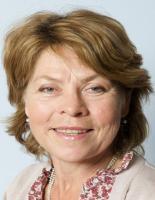
Councillor Izzi Seccombe became the first female leader of Warwickshire County Council in May 2013. She was elected as Councillor for Stour and the Vale in 2001, and prior to becoming leader was Cabinet Member for Children, Young People and Families from 2005 to 2010.


If I asked you to describe a 21st century public servant, what would you say?

Catherine Mangan

I read with interest the recent announcement from Birmingham City Council that they did not intend to recruit a replacement chief executive, but would instead create a ‘lead officer’ role. A few years ago it would have been unthinkable not to have a chief executive at the head of a council.  Now, with councils debating what their role is, and the need to seize an opportunity to make savings, more and more councils are making the decision to remove the chief executive post entirely.

Arguments about whether this is a good idea or not have been much debated in the local government world, but I’m interested in what this says to those seeking a career in local government, and the wider public service.   If the very pinnacle of public service, a council chief executive, is no longer a relevant role, what does this mean for the wider workforce?  As the ‘how and what’ of local government changes, so too must the workforce.  How can public servants ensure they remain relevant, and ready for the future challenges?   What does a public servant in the 21st century look like?  How do those of us who provide development support to the workforce best work with them to give them the skills to achieve?

These are questions we will be exploring through a new knowledge exchange project in partnership with Birmingham City Council, funded through the ESRC.  Over the next year we will examine the recent literature, carry out interviews with key stakeholders and create an on line resource to support public servants seeking support and development.   We aim to address key questions such as:

What is the range of different roles of the twenty first century public servant?  As people’s roles expand to encompass the whole person in a system, they can no longer dispense professional judgement in isolation. They need to be negotiators, brokers, story-tellers and resource weavers. Perhaps no longer a social worker but a care navigator.

What are the competencies and skills that public servants require to achieve these roles?  What do you need to be good at to be an effective family support worker?  Probably an ability to empathise, engage, motivate and inspire.  Along with the skills to get things done.   What might that look like in a professional development plan? How do we best support people to develop those roles and skills?  Skills for the 21st century public servant may not be those that can be developed through traditional training; we need to think imaginatively about supporting peer learning, sharing knowledge about what works; facilitating networks of learning.

And as the career path becomes more complex and less certain; with roles spanning organisations and sectors, how can central and local government better support and promote public service as a career?

We are looking forward to exploring the ideas and issues raised by these questions, and want to hear what those of you working in or supporting the public sector have to say.   If you’d like to know more about the project, or contribute in any way, contact us.  We’d love to hear your views.

Portrait of OPM staff member

Catherine Mangan is a Senior Fellow at INLOGOV.  Her interests include public sector re-design, outcomes based commissioning and behaviour change.  She is currently leading the 21st century public servant project, in partnership with Catherine Durose and Catherine Needham. She can be contacted about the project via email, or on Twitter – and you can join the conversation: #21CPS.

The managerial-political interface: strong relationships prosper in difficult times

Andrew Muter

The Chief Executive’s leadership position in Local Government operates in a different context to simple hierarchies. We all manage at the political interface – what some have termed a grey area between the hurly-burly of big P Politics and the general management of the organization. And the relationship at the core is that between the Leader and Chief Executive.

Much has been written and said about these relationships over the years. In particular, Simon Baddeley’s research has provided a fascinating insight into the way that Leaders and Chief Executives describe the way they work together. One of the recurring themes is the way that strong leadership relationships are under-pinned by shared reflections about the way the partnership works. It’s the ability to describe, express and check-back on what is happening that helps to define the relationship and build trust.

The Leader / Chief Executive relationship can come under the greatest of strain even in the best of times. Where trust hasn’t been built, or is undermined, the consequences are huge. So you might have expected that the impact of the harsh financial climate for local government over the last five years would have placed an increasing strain on that crucial interface between politics and the organization.

I doubt that the answer is so simple. In fact, it’s perhaps more likely that strong relationships will prosper in difficult times. The pressures of shrinking resources, transformational change and spiraling demand call for leaders to raise their games. This is a test for the relationship but it’s also an opportunity for synergistic co-leadership.

In our pre-recession world, the managerial-political interface was sometimes illustrated through the development of policies. The dividing line was that although the development and discussion of policies engaged senior managers and politicians, it was the politicians who decided. In today’s world, this may be no less true. But choices have narrowed and the pace and direction of change is relentless and unforgiving. Political and managerial careers may not have been planned around this destination, but we are where we are.

That relationship between Leaders and Chief Executives has been tested in this grave new world. Local government’s performance in handling the reductions in finance, showing that we are fleet of foot in comparison with almost every other area of public service, suggests that we might be optimistic about the resilience of our political and managerial leaders.

In a recent meeting I watched a Leader and Chief Executive of another council explaining how they were planning to deal with the challenges ahead. Their explanation was clear, compelling and seamless. The tone and content of their sentences melded with one another into a seamless narrative. They had not rehearsed their approach – they had lived it, breathed it.

In time, we may have a new academic analysis which sheds light on the stresses and strains of leadership during the austerity years. Here’s hoping it shines a light on strong and successful leadership relationships forged in the heat of battle.

muter

Andrew Muter is the Chief Executive of Newark and Sherwood District Council.

Relational leadership, group dynamics and personal identity

Kim Ryley

There is a general consensus from researchers that many of the skills and behaviours of leadership can be learned and acquired. But recent research in the United States and Britain, on the particular challenges facing public sector leaders over the next ten years, has revealed not only the need for a new skills set, but also the importance of these being underpinned by a particular personal mindset and attributes. Indeed, these explicit values, attitudes and behaviours appear essential to operating effectively in the emerging new environment – not least in generating the support and loyalty of others that will be necessary to shape the development of that environment.

It is already clear that the leaders of our public services must prepare for the future on the basis of dramatic, fundamental and irreversible change. The complexity, scale and speed of this paradigm shift requires an unusual degree of adaptability, tolerance of uncertainty and ambiguity, and the courage and resilience to take responsibility for inventing the future without the benefit of any clear blueprint to follow. The adaptive challenges involved in this are not the same as previous technical problems – they cannot be fixed by experts!

In this context, leadership is not simply about creating shared intellectual understanding. Rather it is about engendering the trust necessary to persuade and motivate people to let go of what is now expendable. Overcoming the emotional resistance involved in this is about overtly challenging the beliefs, identities and feelings that will obstruct the extensive innovation necessary to thrive in the “new normal”. That is why leadership of change is so difficult – it threatens people’s sense of professional identity and self worth.

Fundamentally, the new leadership approach is about changing behaviour, through the distribution and acceptance of loss, so that people can, themselves, make the changes necessary to adapt to the new reality that is now emerging. Whole system leadership of “place” in local public services means acting in conjunction with politicians, partners, staff and local communities to create cohesion around what needs to be done, through shared identity and purpose, and a new sense of reciprocity or “neighbourliness”.

Tomorrow’s public sector leaders will be those who feel compelled to connect with others, As well as being politically astute, they will understand the dynamics of power, be able to read other people’s behaviour, and have the credibility to secure co-operation beyond their formal authority, Like a good Buddhist, their role will be to break through the illusion of constancy by inviting uncertainty, to challenge the status quo – and to change behaviour. But, doing this will depend on them being able to demonstrate that they live the values that drive them.

The changing views of local authority leadership emerging from research surveys of council chief executives by SOLACE in the UK, and of city managers by IMCA in the United States, rate highly the ability to manage complex inter-relationships and inter-dependencies. Indeed, performance is likely to be evaluated increasingly in terms of expert use of the enabling skills necessary to create new alliances, as well as to facilitate and operate in (formal and informal) networks. These include conflict management, negotiation, problem solving and communication. The challenge for leaders in this collaborative context is to be both authoritative and participative.

What the new research also shows, however, is that successful leadership in this context will depend on behaviour and individual attributes which engage and instil confidence in potential collaborators. These attributes include being:

  • Open Minded
  • Flexible
  • Positive
  • Patient
  • Persistent
  • Decisive
  • Risk taking
  • Reflective
  • Accessible
  • Accountable
  • Friendly
  • Trustworthy
  • Unselfish
  • Honest
  • Respectful
  • Empathic
  • Attuned to others
  • Ethical
  • Committed/Passionate
  • Consistent

For leaders of complex social systems, relationships and relatedness will be primary, all else will be derivative. The new research has illustrated what skills public sector leaders need in future to be effective. But it shows also that they are extremely unlikely to actually be effective unless they also pay attention to how they exercise those new skills – and keep their attitudes and behaviours under constant observation, as others will.

ryley

Kim Ryley is a recent Past President of the Society of Local Authority Chief Executives and a Trustee of the Leadership Centre. He has 14 years experience as a Chief Executive in four upper tier local authorities. Kim is currently a freelance Leadership Development Consultant and Director of Torque Leadership Associates Ltd.

Keeping the door open to new ideas on leadership: Why the public sector may be leading the way

Ian Briggs

In 1981, Ralf Stogdill published with Bernie Bass a taxonomy of leadership research. To scholars of leadership this Magnus opus has performed two vital functions: firstly, it has been invaluable in keeping open cathedral doors in a gale;  and secondly as a work of undoubted scholarly value that it is has served to demonstrate how often confused and misplaced a great deal of leadership research in the past has been.

What is not always adequately reflected in the literature and in much of the teaching of leadership is that many of its core concepts are often based in the struggle to better understand how politicians operate.  This has, at times, been lost in translation when it is applied to occupational, industrial and military settings.

Until comparatively recent times much teaching and learning of leadership as a topic has been done through trying to better understand the key characteristics of those who in history have been seen to be successful. This has led to students digesting biographies of the ‘great and the good’ – even today in military settings it is not unusual to be encouraged to read about Alexander the Great and extrapolate from his great achievements how campaigns can be led today.

It is therefore hardly surprising that we are socialised into thinking that to be an effective leader one has to be ‘charismatic’ – this is a term that is loosely banded about to describe an engaging individual who can illicit the support and followership of others. And lest we forget there is still a huge industry out there promoting these ideas, which seem to remain highly attractive to current and budding politicians.

At the forefront of our current understanding of leadership practice, we find the words ‘transactional ‘and ‘transformational’ regularly appearing. In current lingua franca, transactional is taken to mean ‘poor’ and transformational is applied to those who are seen as being effective, ‘with it’ and engaged with current trends. However, many students of political science may recognise these terms as being applied to political leaders; where transactional political leadership is …”vote for me and I will make you better off through reduced taxes” and transformational is…”vote for me and I will do my level best to create a better, fairer world”. But returning to Stogdill’s great taxonomy we can also see that leadership as an issue, a topic and as a matter of scholarly understanding is defined by having sudden leaps of understanding with longer periods of plateaus and stagnation.

I think now we are potentially at a point where that next great leap of understanding is rapidly approaching – and it may be arising from the world of current politics and wider society. Recently we have seen a senior Minister avoiding a critical leadership issue – stating that the decision whether to allow the wearing of the hijab as a clinician or nurse should be a matter for local agreement. I thinkthat should be something where a politician can demonstrate clear leadership and stand in the ground where opinion is firmly divided. Is it ducking the issue to say this is a matter for local agreement, or it is a reflection of the changing expectations we have of those who we elect to stand in this ground?

As I write this I am preparing for some sensitive work that is attempting to reconcile differences of expectation where senior politicians are giving political oversight to what are referred to as megaprojects – think aircraft carriers, HS2, locating nuclear power generation sites and the like – many of these megaprojects being right at the heart of concern for local government and local people as well as parliamentarians. But it would seem that those drawn from professional sources that operate in the role of programme and project managers are at times failing to understand the political pressures placed upon elected representatives. Politicians, too, are failing to grasp the challenges inherent in megaprojects. What is abundantly clear is that whilst some see a leadership issue at the core of such challenges, there is not one clear off the shelf leadership model that fills the gap.

It is at that crucial, pivotal point where political aspiration comes into contact with managerial competence that we need to explore a new language of leadership. Perhaps both sides of the equation are doing what they should do; politicians are articulating social aspiration and managers and professionals are applying well known, tried and trusted mechanisms of project and programme management. However, they need a ‘Babel fish’ (with due respect to Douglas Adams and that most useful of all managerial textbooks – the Hitch Hikers Guide to the Galaxy) to fully understand each other and each other’s roles.

Perhaps we need to develop a new model of leadership, one where the long term success (or otherwise) of leadership can only be judged by those who will step into the shoes of the leaders of today, a model of leadership that accepts that quick wins are just not possible and that we have to encourage leaders to think beyond the immediacy of the delivery of milestones and concentrate upon how they pass on their leadership much like we as humans do when we pass on our DNA!

But Stogdill’s taxonomy reveals that where we have enjoyed in the past great leaps forward in our understanding of leadership, it seems to have corresponded well with periods of plenty and economic growth. If we are to face another six years of austerity the question remains: from where are the resources to come from to help us capitalise upon the learning we need to engage today? It could be that when the fourth edition of this taxonomy appears we will have a new chapter that offers clear explanations of the ‘pivotal role of leaders in meeting social expectation’ drawn from how we managed to deal with complex, wicked problems of new high speed rail, aircraft carriers for the new age, new environmentally friendly towns and how we managed to generate new sources of energy. But, unless someone throws a bit of money towards us to help research this phenomena then that chapter will take a little longer to write and the current edition will continue to hold open the cathedral door in a gale.

briggs

Ian Briggs is a Senior Fellow at the Institute of Local Government Studies. He has research interests in the development and assessment of leadership, performance coaching, organisational development and change, and the establishment of shared service provision.

George Osborne’s budget surplus: paid for by local government

Chris Game

In his party conference speech on Monday, Chancellor of the Exchequer George Osborne announced that a Conservative Government would seek, by the end of the 2015-20 Parliament, to have eliminated completely the roughly £120 billion national deficit and be running a budget surplus. It would do so, moreover, without raising taxes or cutting capital spending. The audience and most of the business world applauded, naturally, while Labour spokespersons seemed at least temporarily stunned.  The best immediate response they could manage was that the Chancellor’s record for meeting his past deficit-elimination targets was pretty flaky, so why should this one be any different.

In fairness, they had cause to be taken aback. The last time a government managed what is sometimes termed an absolute budget surplus – meaning it generated more revenues, including tax yields, than it spent – was in 2001, and it’s only happened about seven times in the past half-century. Not as rare, then, as a Brit winning Wimbledon or the Tour de France, but more so than England winning the Ashes (10, if you were wondering), and excuse, surely, for another spasm of flag-waving and nationalistic celebration?

Possibly, though probably not for most of those in or reliant upon local government, for whom it’s hard to know which scenario would be more painful: the achievement of a surplus by 2020, or being forced to aim for one and not achieving it.

The problem is that this budget surplus isn’t quite the kind of target that Local Government Association Chair, Sir Merrick Cockell, suggested subsequently at a Localis conference fringe event.  He observed that a surplus could be arrived at by one of two ways – either by government planning for the public finances to go into the black following spending reductions, or through growth in the economy increasing revenues.

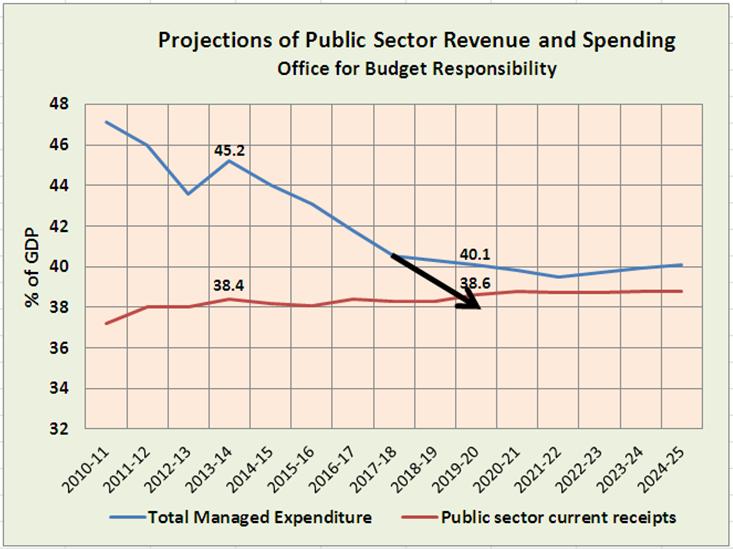
Technically, of course, Sir Merrick’s right. But, wearing his LGA hat, he must know that a budget surplus by 2020 is not going to be achieved under a Conservative or Conservative-led Government either by some hitherto undreamt of explosion of economic growth, or by two lines on a graph, expenditure and revenue, each moving chummily towards the other and eventually converging.  He must know, because he’ll have seen the projections, that in this instance one line, revenue, stays unhelpfully almost horizontal throughout virtually the whole of the relevant  period, leaving the expenditure line to do all the converging on its own.

game

The graph is drawn from projections published this July by the Office for Budget Responsibility (OBR), to which local government followers of LSE’s Professor Tony Travers are regularly commended, most recently in his article in this week’s Public Finance. More specifically, the projections are from the supplementary data published alongside the OBR’s annual Fiscal Sustainability Report, of which this summer’s was the third.


Total Managed Expenditure (TME) covers all spending by central government, local authorities and public enterprises: both the directly controllable Departmental Expenditure Limits (DEL) – the budgets set for departments, Non-Departmental Public Bodies and local authorities in the three-yearly Spending Reviews – and the frustratingly uncontrollable Annually Managed Expenditure (AME) – departmental spending that can’t reasonably be restricted to three-yearly cycles (mainly social security benefits, tax credits and public sector pensions) plus debt interest. Public Sector Current Receipts (PSCRs) are largely taxes and National Insurance Contributions.

There are two potentially deceptive features of the graph as I’ve set it out: the conflated vertical axis, and the 2010-11 starting date. Between them, they have the effect of emphasising the single-year spending blip in 2013-14 and de-emphasising the remarkable nature of the trend.

The historic trend of public spending is, if I correctly recall my Latin, prorsum et sursum, onwards and upwards. Between 1956-57, the year I went to the secondary school in which I learned that Latin, and 2009-10 there was an average growth of 3.2% a year; from 2000-01 an average of 4.7%.  We’re now in an 8-year period in which it’s projected to fall by an average of 0.3% a year, in the middle of which a small upward AME lurch is but a proverbial pimple.

Sharp-eyed readers will have detected by now that, rather disappointingly after all that earlier talk of convergence, the two main lines on the graph don’t in fact converge – in 2020 or indeed at any subsequent date. The gap – the public sector net borrowing requirement – has certainly lessened, from 9.9% of GDP in 2010-11 to 6.8% in 2013-14. But the OBR’s current forecast still shows a gap of 1.5% (around £30 billion) in 2019-20, and that, of course, is one measure of the scale of the surplus problem.

The PSCR line, having struggled up to 38% in 2011-12, just stays there, projected by the Office for Budget Responsibility to fluctuate throughout the rest of the decade by barely half a percent, presumably irrespective of the political complexion of the post-2015 Government.

So, even if the Chancellor hadn’t confirmed that the deficit-vanishing trick was going to be accomplished without tax increases, it’s clear that whatever convergence there’s going to be will have to come, as suggested on the graph, from further spending cuts – and at a time when the long-term spending pressure of an ageing population is already growing by the year.

The OBR has a whole mini-vocabulary for deflecting responsibility when particularly its longer term forecasts turn out rather differently. My addition to the graph, therefore, is what they’d call an illustrative, broad-brush projection, rather than a precise forecast. The thing is, I can’t rid my mind of the image of a black arrow, heading straight for local government.

game

Chris Game is a Visiting Lecturer at INLOGOV interested in the politics of local government; local elections, electoral reform and other electoral behaviour; party politics; political leadership and management; member-officer relations; central-local relations; use of consumer and opinion research in local government; the modernisation agenda and the implementation of executive local government.