Council Tax Support – anatomy of a Pickles’ localism triumph

Chris Game

Shortly before the dissolution of Parliament, Communities & Local Government Secretary Eric Pickles issued an apparently self-penned eulogy of his ministerial record, entitled on the Government’s own website, in characteristic, cod Churchillian, style: Local Government: Delivering for England. It makes an interesting document, as would be hoped of one requiring two separate links.

First, I want to emphasise that it’s a genuinely useful exercise. It’s already easier than probably ever before to find out what the government thinks its policy is, at any particular time, both generally and by department and topic. Currently it has 224 of them. The DCLG has 24, including four each on local government and housing, and a rather extraordinary 215 “contain ‘local self-government’”.  There’s at least a Masters dissertation, surely: which nine Coalition policies failed to tick the ‘local self-government’ box?

Pickles’ eulogy, though, is quite different: a consummate politician’s listing of 60+ bullet-pointed triumphs and achievements, the like of which I at least can’t recall having for any previous administration.  The gov.uk version even gives us a proxy measure of the difference – in the dozens of instances of ‘[political content removed]’. And there’s another dissertation: the insight provided by the redacted and unredacted versions into civil service interpretation of ‘political content’ in the run-up to a General Election.

None of this, however, provides more than the opening key to the main subject of this blog. Somewhere between Pickles’ 50th and 60th bullet points – shortly before “supporting the Royal Wedding, Diamond Jubilee and VE Day by cutting Whitehall and municipal red tape on holding street parties, and introducing new laws to cut ‘elf and safety’ red tape on community events” – was “localising Council Tax Support (CTS), so councils are rewarded for getting people off the dole and welfare dependency and back into work, £1 billion has been cut from previous Council Tax Benefit (CTB) funding, and councils themselves bear the responsibility of increasing the living costs of some of their poorest residents.”

OK, I’d better come clean.  The ‘elf and safety’ bit is totally genuine – straight from the Pickles jar, as it were – but I’m afraid the last couple of clauses, after ‘back into work’, are mine, though, I would claim, entirely accurate and in a way slightly admiring.

For the CTB changes were Pickles’ self-styled muscular localism at its most politically skilful – a devolution of an important responsibility, impossible for councils to refuse, yet accompanied by conditions and constraints that meant any flak would go to them and any credit to the Conservative part of the Coalition.

The publication in the middle of the election campaign of the New Policy Institute’s third annual CTS monitoring report provides a timely opportunity to review one of the Coalition’s key and most controversial social policies, whose approaching launch was covered at the time in these columns.

The essence of the 2012 Welfare Reform Act was to replace, from April 2013, the means-tested Council Tax Benefit, paid for by the Department for Work and Pensions but administered to nearly 6 million recipients by local authorities, by Council Tax Support schemes individually determined and operated by the authorities themselves, and funded through business rates retention. It sounded like a laudable transfer of responsibilities from Whitehall to town hall – until you came to the attached strings.

First, with the professed aim of strengthening councils’ incentives to get people back into work, the amount the Government would pay local authorities for their new schemes would be 10% less than for CTB – creating for my own authority of Birmingham, for example, a funding gap of nearly £11 million.

Second, it ruled that pensioners receiving CTB must, and other particularly vulnerable groups should, be protected against any reduction in support – meaning in Birmingham that 54,000 pensioners were protected, while 83,000 working-age recipients were left shouldering potentially the whole savings burden.

It was only here, then, that the localism bit actually kicked in, with councils having the discretion, within a very tight deadline, to devise their own schemes to achieve these savings – and collect the taxes from their tens of thousands of new and aggrieved taxpayers.

In practice, this discretion amounted to three unenviable choices: spreading the cut in funding equally across virtually all CTB recipients apart from pensioners; giving the rebate to certain groups only; or continuing with the full rebate, and filling the gap either through raising council tax or finding savings elsewhere, on top of the savings already being demanded by the Government.

It would have been odd for a policy wholly designed to produce local difference not to do so, and there was and continues to be significant variation, in the metropolitan West Midlands as across the country. The practices adopted by the seven West Midlands metropolitan boroughs, though not statistically reflective of the national picture, can usefully illustrate it.
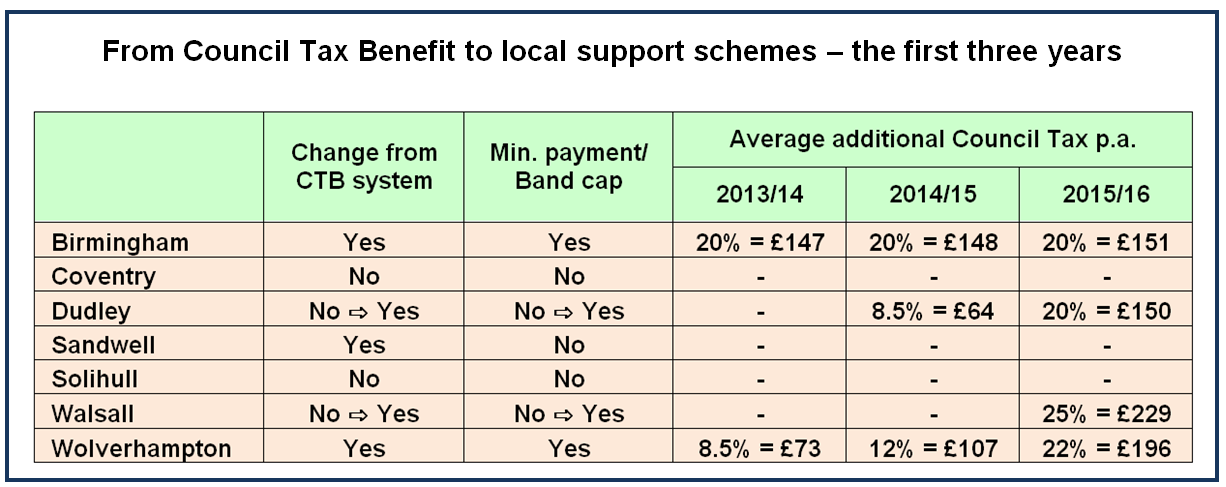
Game 9th April blog table

At that first time of asking in 2013, nearly 18% of the 326 English councils decided to continue with the same CTB-level rebate and somehow find the money, including four of the West Midlands seven.

70% of councils nationally and in the West Mids Birmingham and Wolverhampton – the two with the largest affected caseloads – introduced ‘minimum payment’ schemes, requiring everyone to pay at least some council tax, regardless of income. In Birmingham, therefore, it meant that almost all working-age people paid at least 20% of their council tax, representing an average annual payment of £147 or just under an extra £3 per week.

The remaining authorities, including Sandwell in our table, rejected ‘minimum payment’ but introduced other changes. Sandwell’s adjustments over the three years have included changing the income taper – the amount by which support is withdrawn as income increases; lowering the maximum savings limit over which one is no longer eligible for benefit; and reducing the second adult rebate – the benefit homeowners not on a low income receive if they share their home with someone (non-partner) on low income.

The main trends identified by the New Policy Institute over the now three years of CTS’ operation are the drop by nearly a third in the number of authorities still retaining all features of CTB, and the increase in percentage minimum payments – both seen in the West Midlands table. Nationally, 2.3 million low income families will pay on average £167 more in council tax in 2015/16 than they did under CTB, and 11% of those 2.3 million have also been affected by the ‘Bedroom Tax’ or ‘removal of the spare room subsidy’.

As for local councils, as is usually the case, they’ve generally coped – possibly too effectively for their own good. Some council tax collection rates have fallen fractionally, but nowhere (to my knowledge) as drastically as some predicted at the time. New council schemes to reduce worklessness are springing up all the time, but it’s difficult to identify which, if any, of these is incentivised by the CTB changes.

Something, though, is quantifiable.  Roughly £1 billion has been transferred from central government’s welfare bill to the shoulders of local government – and is being borne variously by increased bills for council tax support claimants, reductions in the claimant count, increased council tax bills for all, and reductions in other council budgets.  But then that’s muscular localism for you.

Chris Game - pic

Chris Game is a Visiting Lecturer at INLOGOV interested in the politics of local government; local elections, electoral reform and other electoral behaviour; party politics; political leadership and management; member-officer relations; central-local relations; use of consumer and opinion research in local government; the modernisation agenda and the implementation of executive local government.

An earlier version of the blog was published by The Chamberlain Files.
Queen Cersei and the evaporating Revenue Support Grant

Chris Game

Next week is the last week of Hilary Term, or revision week at the end of Spring Term, as it’s known here at the UoB and most other universities who feel no great affinity to the probably inappropriately named 4th Century St Hilarius of Poitiers. Over the many years in which I lectured undergraduates, I used rather to like it: end of the course/module in sight, legitimate chance to share and spread gossip about approaching local elections, lecture attendances boosted by students desperate for exam hints. Plus, nowadays, plenty of discussion-prompting visual aids – one of which is the pretext for this blog.

SIGOMA is not – disappointingly perhaps – an African hip-hop band, but less catchily the Special Interest Group of Municipal Authorities (outside London) within the Local Government Association. Yes, even the brackets are part of the full name – which has to convey that its 45-council membership comprises most major urban authorities in the North, some in the Midlands, plus the ‘South Coast regions’ of Plymouth and Portsmouth. The 45, claim SIGOMA, share similar characteristics and can therefore advantageously speak with a collective voice – moreover, with one that, particularly following the Coalition’s changes to the local government funding system, needs to be distinctive from that of the LGA with its responsibility for somehow representing the interests of all its 400+ member authorities.

These funding changes, argues SIGOMA, are so divisive, and their impacts so damaging to areas with characteristics like those of its members, that they threaten to set region against region in the manner of – well, Game of Thrones.  As even non-followers of the popular TV series may be aware, the US fantasy drama chronicles the violent dynastic struggles for control of the Iron Throne of the Seven Kingdoms of Westeros. SIGOMA’s spoof YouTube video is Game of Cuts Winter is Coming for Councils – and, at under 2½ minutes to Game of Thrones’ soon-to-be-five seasons, it’s inevitably (even) less subtle.

The Sean Bean character, Lord ‘Ned’ Starp, Warden of the North (possibly Steve Houghton, Leader of Barnsley MBC, SIGOMA’s administrative base?) and his mate from the Coastal Ports, protest that “our people are already on their knees … the sick have no one to care for them, and our children nowhere to read …”, while the spokesperson for “the hamlets of Bucks and Berks” remonstrates that they too are suffering, with “not enough funding to keep our tables supplied with swan and game”.  But sadistic Queen Cersei of the South and her incest-conceived son, King Joffrey, are unmoved: “All the regions have had to make their sacrifices. The money has been spread evenly and you will cope, for the sake of the Seven Kingdoms”.

Doubtless, Local Government Minister Kris Hopkins’ family arrangements are altogether more conventional, but his presentation of the 2015-16 finance settlement last December suggests similarly briefed scriptwriters:

“The local government settlement is fair to all parts of the country – north and south, rural and urban, city and shire – therefore every council should be able to deliver sensible savings while protecting frontline services for local taxpayers … Those facing the highest demand for services continue to receive substantially more funding. For example, Middlesbrough has a spending power per household of £2,441 which is £871 more than the £1,570 per household in Windsor and Maidenhead.”

As noted in my recent blog assessing that settlement this has been the standard – and increasingly disingenuous – government line for the past five years. That blog, though, was largely about ministers’ ploy – what one might call the ‘spending power sleight of hand’ – to mislead the media and public from the outset about the true severity of their cuts to the funding of the local government sector as a whole.  SIGOMA’s current campaign – Protecting Vital Services – is about the discriminatory distribution of the cuts within the sector, and particularly the impact of the funding changes since 2013-14, which cumulatively have switched the determination of government funding from assessed needs formulae to councils’ tax-raising capacity.

The big change was the introduction of the Business Rates Reduction Scheme (BRRS). It was cautiously welcomed by local government for its devolutionary principle, but SIGOMA-profile authorities were immediately concerned that, as BRRS funding increased and Revenue Support Grant (RSG) correspondingly decreased, the big gainers would inevitably be already prosperous authorities with higher rate-raising capacities, and the gap between them and the less well-off with the highest demand for services would continue to grow.

The New Homes Bonus Scheme (NHB) story was not dissimilar. It was launched in 2011-12 to incentivise local authorities to grant planning permissions for new homes and bring empty properties back into use. For each additional home they would receive for six years an annual bonus payment equal to the council tax generated – from the government’s own funding. Again, it was cautiously welcomed, although it was obvious that authorities with higher banded housing would be the bigger beneficiaries. But no sooner was it established than the government funding bit switched to a top-slicing of RSG, and again poorer authorities have been absolute, rather than just relative, losers.

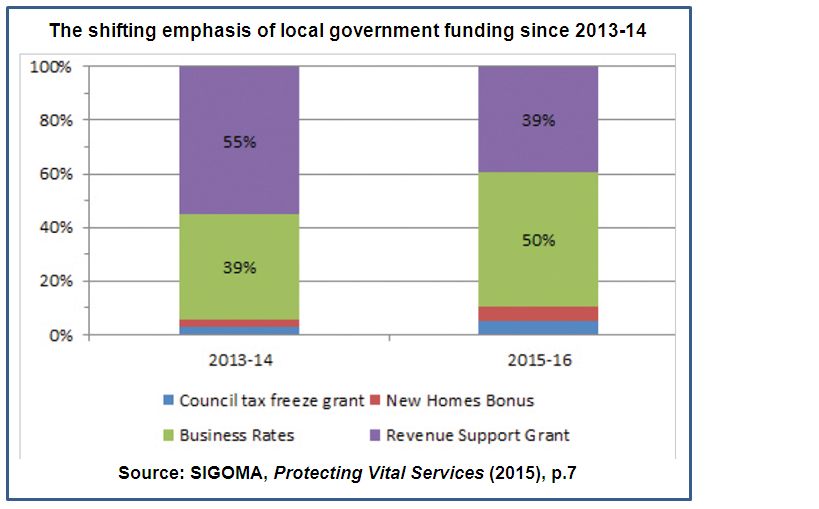
The Council Tax Freeze Grant was slightly different, in being from the beginning a disadvantageous bribe to councils to cut their spending, but its relevance in this context is that it too is top-sliced from RSG. Put just these three policies together over the three most recent finance settlements, and RSG – the principal source of central government funding of non-schools revenue expenditure and traditionally the mechanism for recognizing councils’ differing resource needs – has shrunk as a proportion of local government funding by over 5% a year.

Chart Game blog

SIGOMA calculates that over just these three years authorities with higher grant dependency and greater formula share in RSG have lost proportionately twice as much (around 20%) as those with more buoyant rates bases and greater protection within RSG (around 10%).

Incidentally, further confirmations of deprived areas suffering most harshly from the government’s cuts have been produced over the past few weeks alone in an Institute for Fiscal Studies Briefing Note, by the Association of North East Councils, and, most tellingly, in evidence from the DCLG itself in the Public Accounts Committee’s report on the Financial Sustainability of Local Authorities (paras 8ff.).

Game of Cuts doesn’t go into the intricacies of RSG that SIGOMA’s Protecting Vital Services study does, confining itself to the billboard-style message that “Since 2010 local government in England has lost more than 40% of its core funding. Urban authorities, largely in the North and the Midlands, have lost the most money as a result of these cuts.” You don’t get SIGOMA’s proposed ‘fair and sustainable’ three-block future funding model either, but both productions, in their very contrasting ways, are worth a look – even if you don’t have a bunch of students to entertain.

Chris Game - pic

Chris Game is a Visiting Lecturer at INLOGOV interested in the politics of local government; local elections, electoral reform and other electoral behaviour; party politics; political leadership and management; member-officer relations; central-local relations; use of consumer and opinion research in local government; the modernisation agenda and the implementation of executive local government.

Grubby-handed local politicians? It’s called local democracy and devolution, Sarah!

Chris Game

The BBC’s Radio 4 Today programme isn’t what Americans would call a Hot Talk show, and nicely spoken presenter Sarah Montague, even in her own fantasies, is no shock jock. So listeners must have been slightly surprised to hear her, while questioning the proposed devolution of NHS funding to Greater Manchester’s combined authority, talk of “local politicians sticking their grubby hands into the decision-making process” (07.50).

She tried laughing it off and rephrasing, but it was already out there – an unintended confirmation of the dismissiveness with which so much of our London-centric media treat sub-central government. For them, it’s apparently a world too complicated to try to understand and explain; one in which every small service variation is a product not of local democratic choice, or the Lyons Report’s ‘managed difference’ (p.3) – but a ‘postcode lottery’ and thus an easy cue with which to stir up listener and viewer outrage.

With Scotland and Devo Manc putting down serious markers and new combined authorities springing up seemingly every week, English devolution will be a major issue at and following the General Election, whether parties and voters want it or not.

Voters, we know, aren’t clamouring for it. A YouGov/Prospect poll just after last September’s Scottish referendum presented a large sample of English voters with a list of 18 specific things Britain’s government might do over the next few years, and asked them which four or five they felt were the most important.

Probably unsurprisingly, tightening immigration rules came first, favoured by 55%, then providing more money for the NHS and holding down gas/electricity prices. “Giving more powers to English regions and local councils” came 17th, just 12% according it any importance at all.  Unpromising, but, unlike England’s cricket World Cup campaign, there are some definite positives out there.

First, as many local authorities used to find when they could still afford to commission annual surveys of residents’ views, councils and councillors generally have a better image, not only than Westminster and Whitehall, but than they themselves sometimes realise.

The Local Government Association (LGA) still does undertake such surveys, its most recent, by Populus last October, broadly confirming previous findings. Around 70% say they’re satisfied with their own council, and, asked who they’d trust most to make decisions about how services are provided in their local area, 72% said councillors, 11% MPs, and 7% government ministers.

But that’s the easy bit. These encouraging levels of satisfaction and trust relate to councils’ currently very constrained tax powers and policy discretion. They quickly dissipate when it’s suggested those powers be extended or more strategic service decisions be made locally.

The YouGov/Prospect poll also asked its English respondents at which level – England-wide, regional, local – decisions on ten services should be made. For six services the choice was overwhelmingly national, including VAT and unemployment benefit rates, the core curriculum, and NHS drug and hospital treatments. Refuse collection frequency was the only decision even a bare majority (53%) allocated to local councils, and 38% wanted even that to be national or regional.

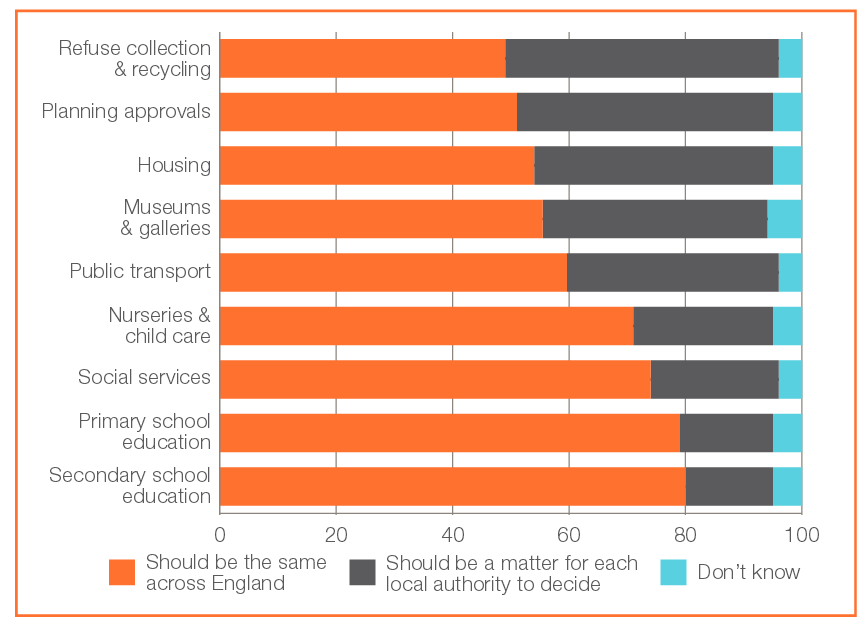
This English predisposition towards uniform national standards in almost everything can seem extreme, but it clearly runs deep and is well documented.  A 2012 YouGov survey for the Institute of Public Policy’s Future of England report asked a similar question: whether certain policies should be the same across the whole of England or should be matters for local authorities to decide.

Again, as shown in the chart, there wasn’t a single service – refuse collection, planning approvals, housing, museums and galleries – that a majority of respondents saw as a chiefly local government responsibility.

Game blog pic

It’s perfectly possible, even reasonable, to suggest that differently worded questions would elicit different answers; that, if you put respondents in a focus group, presented them with evidence, and let them think for more than five seconds before answering, they’d change their minds; even that, dammit, they’re just wrong. The fact remains that this is what they instinctively think and say, and it presents an unignorable hurdle for would-be devolvers, especially politicians. There are signs, though, that at least the height of the hurdle is adjustable.

Returning to the recent YouGov/Prospect survey, although, refuse collection excepted, there was no service on which respondents came near to preferring local to England-wide decision-making, the picture changed a bit when regional and local preferences were combined.

Put brutally, it’s ‘local councils’ – the label, the actuality, or both – that aren’t trusted with anything more than our rubbish. Combine them with ‘regional level’, and there are clear majorities for the sub-national determination of strategic policing priorities (64%), siting of new towns and major new housing projects (60%), and rules governing social housing rents (52%).

Interestingly, there were some arguably similar findings in the surveys of Londoners and ‘London business decision-makers’ by ComRes in January.  In both surveys there were majorities (56% and 60% respectively) in favour of “Local Government having greater control in London over tax levels and how those taxes are spent”.

It quickly turned out that the tax levels most respondents had in mind were limited to business rates and stamp duty land tax. Nor was there anything remotely approaching majority support for even business rates being set by ‘local borough councils’. But again, combine local and ‘regional’ tiers – in this case the boroughs and Greater London Authority/’City Hall’ – and majorities in both samples (58% and 73% respectively) were in favour of ‘Local Government in London’ setting business rates, with over a third in each case prepared to add stamp duty land tax as well.

All of which seems to suggest that, in a future of large, and in some cases almost regional-scale, combined authorities, committed devolvers have at least something positive to work with – provided, of course, media presenters keep their grubby centralist hands out of the debate.

Chris Game - pic

Chris Game is a Visiting Lecturer at INLOGOV interested in the politics of local government; local elections, electoral reform and other electoral behaviour; party politics; political leadership and management; member-officer relations; central-local relations; use of consumer and opinion research in local government; the modernisation agenda and the implementation of executive local government.

International Women’s Day and Britain’s gender gap of shame

Sunday sees the 107th celebration of International Women’s Day (IWD), and for the 102nd year on March 8. It’s a longer history than is often supposed and, reflected in its still occasionally used Leninist title – International Working Women’s Day – a more socialist one. There were conspicuous exceptions, but the West as a whole didn’t really latch on to it until, following International Women’s Year in 1975, the UN proclaimed March 8 as the UN Day for Women’s Rights and International Peace and started increasingly to badge and orchestrate it.

That’s fine for those countries where it’s a public holiday, and for those who don’t celebrate Mother’s Day until early May. We, though, link that American creation to Mothering Sunday and the traditional Christian practice of visiting one’s mother church on the fourth Sunday in Lent (March 15 this year). There’s the risk, therefore, particularly when you throw in Valentine’s Day, of IWD morphing into another of those fluffy Spring days when women get a bit of a day off, like domestic servants of yore, and maybe a meal out.

With this in mind, I thought I’d do a quick check on who was doing what in furtherance of the cause. First – partly because they’re doing it literally as I’m typing (Thursday 5th a.m.) – MPs (well, some of them) are debating IWD-related matters in the Commons Chamber, thanks to an initiative from the Backbench Business Committee. Less fleetingly, the Commons Library has produced one of its invariably informative Briefing Notes on IWD itself and women’s equality generally, with some excellent data and references, including some examined later in this blog.

I then googled ‘IWD local government’ and immediately discovered that the first week in March was ‘Women in Local Councils Week’ – which sounded really admirable, until I realised it was in Northern Ireland; oh yes, and in 2012. Not this year apparently, and nothing either on the LGA website. So it was up to individual councils, of which the most prominent (if you live in Birmingham, you’d almost guess this) was Manchester.

You have to admire them: first Combined Authority, by a distance; centre of Chancellor George Osborne’s ‘Northern Powerhouse’; a specially tailored, top-of-the-range Devo Manc devolution package; and only last week a ground-breaking health and social care spending deal.

For IWD, the city council’s website has a classy-looking IWD page, its own IWD theme – ‘Breaking Through’ (snappier, certainly, than the UN’s ‘Empowering Women – Empowering Humanity: Picture It!’), its own annual IWD awards, plus a comprehensive listing of events.

But then, in addition, it has the chutzpah to claim itself as “the birthplace of women’s suffrage in the UK” – yes, of the whole suffrage movement, rather than, presumably, of the Women’s Social and Political Union at the Pankhursts’ Manchester home as late as 1903. Even the Manchester Suffrage Committee (1867) was preceded by Sheffield’s (1851); and what about Jeremy Bentham’s persistent advocacy, the 1832 and 1835 Acts that gave at least some women the actual right to vote, etc.? So, come off it, Manchester, don’t be greedy!

There was another surprise on the IWD website itself – that, of the 1,000+ IWD ‘events’ already registered, the UK will be contributing virtually twice the number of any other single country, the US included. Not all are happening this weekend; indeed, in the date-ordered listings the first actual IWD event doesn’t appear until page 17 – “A Gathering of Goddesses, celebrating ourselves, all women and Mother Earth” at The Hurlers stone circles in Cornwall.

Sadly, one thing the Goddesses won’t be celebrating is this country’s narrowing gender gap – because it isn’t. Over the past decade, according to the best comparative data available, the UK’s overall gender gap hasn’t closed at all in absolute terms. Judged alongside some 120 other countries, the relative gap has widened, as it has on all major sub-indexes, on some of which it has widened absolutely.

The instrument that measures these things is the World Economic Forum’s Global Gender Gap (GGG) Index, the 2014 report of which is its 9th annual edition.

Being an index, its principal interest is less in actual levels than in the gaps between men and women in four main categories (sub-indexes). Economic Participation and Opportunity records labour force participation rates, remuneration, and career advancement. Educational Attainment is about access to primary, secondary and tertiary education. Health and Survival combines sex ratios at birth – to capture internationally the phenomenon of ‘missing women’ – and healthy life expectancy. Political Empowerment compares the ratios of men and women in ministerial and parliamentary positions.

In all indexes, the highest possible score is 1 (equality) and the lowest is 0 (inequality), although in my own adaptations I prefer to lose the decimal points and percentagise the proportion of the possible 100% gender gap that’s been closed.

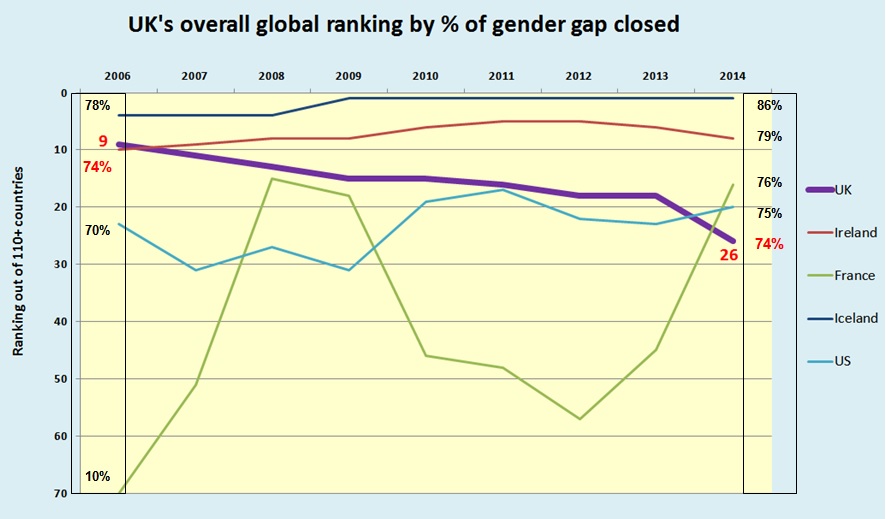
And the UK’s embarrassment, particularly on International Women’s Day, is that since 2006 our overall gender gap hasn’t closed by a single percentage point. In my graph, 74% of the gap was closed in 2006, and in 2014 it was still 74%, our ranking having dropped from 9th to 26th.

gender graph

Meanwhile, all sorts of countries had overtaken us – not just the US and the volatile French, but from parts of the world one wouldn’t necessarily expect: Nicaragua (6th), Rwanda (7th), the Philippines (9th), Latvia (15th), Burundi (17th), Bulgaria (22nd), Slovenia (23rd) and Moldova (25th).

As already indicated, there’s not much to celebrate in any of the indexes, but naturally some make less embarrassing reading than others. In education, for example, we have a rare sub-index measure of more than 1.00 – a 1.36 female-to-male enrolment ratio in tertiary education – although it’s more than cancelled out by a 0.94 ratio for primary education.

Two sub-indexes are particularly gloomy. On none of the five Economic Participation measures is the UK ranked even as high as 45th, with ratios for career advancement of 0.52, for estimated earned income of 0.62, and wage equality for equal work of 0.69. And a Political Empowerment graph would look very similar to the overall one, the key difference being that the UK’s purple line of shame this time would signify an actual widening of the gender gap, with our ranking plummeting from 12th in 2006 to 33rd.

As we approach the election, our ratios of women in parliament and in ministerial positions are 0.29 and 0.19 respectively – compared, for instance, to Denmark 0.64, 0.83; Finland 0.74, 1.0; South Africa 0.81, 0.59; and Rwanda 1.0, 0.65. Of which the best that can be said is that at least the bar for the next lot to try to jump is set pretty low.

Chris Game - pic

Chris Game is a Visiting Lecturer at INLOGOV interested in the politics of local government; local elections, electoral reform and other electoral behaviour; party politics; political leadership and management; member-officer relations; central-local relations; use of consumer and opinion research in local government; the modernisation agenda and the implementation of executive local government.

What is local government for?

Howard Elcock

Do we know what local government is for? Is it just a device for providing services to people at the behest of the central government, or does it provide local citizens with a means of making policy choices about what they want their councils to do? In the 19th century John Stuart Mill and Charles Toulmin Smith debated this issue, with Mill taking a centralist view that local government is an agent acting for the centre and a training ground for would-be Parliamentarians, while Toulmin Smith argued that local authorities are and must be elected bodies chosen by local people to make local choices on their behalf(Chandler, 2007), a view echoed by Professor John Stewart (1986).

Today local authorities are much too dependent on central government to be able to make major local choices. In 1976 the Layfield Committee said that if central government provided more than 40 per cent of local authority funding, this would make local councils excessively dependent on the centre. Today that proportion is between 70 and 80 per cent as a result of rate capping, the bitter legacy of the Poll Tax and incremental funding decisions to support local services with central grants. Beyond all this, local authorities are dependent on Westminster and Whitehall for their very existence, as has been demonstrated by repeated and largely enforced reorganisations imposed on local government by Parliament since 1972.

The role of local government can be discussed in terms of its five purposes. The first is to represent the different political balances in different parts of the country. In England this has become an acute issue as a result of the recent Scottish independence referendum because devolution for England is being discussed partly in terms of proposals such as “English votes for English laws” and the creation of an English Parliament that treat the country as a unit and ignore the major differences in the economic interests and political balance between the North and the South-East, which ought to be reflected in any proposals for constitutionals change. Enhancing the autonomy of local authorities would be one way of achieving this.

Secondly, councillors are the only elected representatives apart from Members of Parliament who can hold public servants to account on behalf of their electors. Thirdly, local authorities can adopt varied methods of providing local services which may provide models for other public authorities to copy. Fourthly, local authorities provide responsive and accessible services that can be sensitive to local needs and wishes – something the central government with its responsibility for 60 million citizens cannot hope to achieve. Lastly, local control of certain activities has long been regarded as a defence against tyranny. For example, the local control of police forces ensures that the central government cannot enforce its policies on the control of public order without persuading local police forces to comply with its demands. Again, the dispersed ownership of computer systems may provide a protection against an all-knowing and all controlling central state.

However, all these purposes are in danger of being diluted or even lost as a result of excessive central control. The diminished powers of local authorities mean that they are not able fully to represent the views and interests of their local citizens. Secondly, their ability to hold public servants to account has been weakened by the creation of increasing numbers of non-departmental public bodies (“Quangos”) with no local and tenuous national accountability to elected representatives, as well as by the enforced privatisation of local services including care homes. Thirdly, local initiatives are stifled both by financial restrictions and excessive regulation, especially through target setting by Whitehall departments. Fourthly local government has been made less local by the creation of smaller numbers of increasingly large units of local government, especially unitary authorities that cannot easily identify and respond to the concerns of local communities within their wide areas. Lastly, central control over public services has been increased by financial constraint, reorganisation and over-regulation, thus increasing central control even over services such as policing where local control is an important bulwark of democracy and accountability, which has not been significantly reversed by the 2011 Localism Act (Jones and Stewart, 2012).

It will take bold Ministers and a collective commitment by the central government to reverse these trends, particularly because the Treasury will be staunchly resistant to an effective programme of renewed devolution of powers and functions to local authorities. Such a programme would have to include an end to council tax capping, the introduction of new sources of local revenue such as a local income tax together with the reduction of central government grants towards the 40 per cent limit recommended by the Layfield Committee. This must be accompanied by renewed creation of truly local democracy by strengthening the powers of parish and town councils and securing their creation where they do not now exist. The dead hand of central regulation and target setting must also be relaxed. Lastly, the rights, duties and powers of local government must be guaranteed under a written Constitutional settlement. I fear that this is too big an agenda for any of our political parties to cope with.

References

Chandler, JA, (2007) Understanding local government, Manchester, Manchester University Press

Jones, G and JD Stewart (2012): “Local government: the past, the present and the future”. Public Policy m& Administration, volume 27, no. 4, pp. 346-367

Layfield Committee (1976): Local Government Finance, Cmnd 6453, London, HMSO

Stewart, JD,(1986): The New Management of Local Government, London, G Allen & Unwin

DSCF5376_Elcock_small

Howard Elcock is Professor (emeritus) at Northumbria University. He is author of Administrative Justice (1969), Portrait of a Decision: the Council of Four and the Treaty of Versailles (1972), Local Government (three editions 1984–1994) and Political Leadership (2001). His current research includes political leadership and elected mayors; local democracy; and the ethics of government.

The expansion of arms-length government is not necessarily at odds with democratic accountability

How democratic is arms-length government? Catherine Durose, Jonathan  B. Justice and Chris Skelcher argue that those who consider it to be an undemocratic phenomenon over-simplify, and make the case for assessing the question in a more citizen and community focussed manner.

It is relatively uncontroversial to assert that modern democracies should aspire not only to democracy but also to efficiency and reliance when and as appropriate on expert, evidence-based judgments in designing and implementing governing arrangements and public policies. It is also frequently accepted that these values are often at odds with one another. Can we have both democracy and efficiency in governance? The still-expanding practice of decentralization and delegation of a variety of activities from national and subnational governments to a variety of non-state organizations has been portrayed as evidence supporting both negative and affirmative answers to that question.

Is this practice of “arms-length government” – the use of organisations other than government departments or ministries to undertake public functions such as developing policies, allocating resources, delivering services, and performing a variety of regulatory and adjudicatory functions – counter-democratic? Our research suggests that the answer is something like “not necessarily,” and “it depends.” Close centralized state control is not in every case necessarily democracy-enhancing, but neither can it be dispensed with thoughtlessly.

The challenge for institutional designers and operators is to distinguish the specific combinations of objectives, contexts, and governing designs that can achieve a favourable balance of democracy, expertise, and efficiency. More controversially, we suggest that many well intentioned advocates who share those three broad goals may need to abandon their familiar state-centric perspectives on the problem if they hope to solve it.

One dominant, state-centric perspective on arms-length government sees it as delegated governance, and suggests that agency problems and conflicts of interest will tend to lead to a democratic deficit when governing tasks are delegated (by the elected representatives who lead the state, which is the seat of legitimate collective authority) to independent agencies or quasi- or non-governmental organizations.

From this perspective the use of “arms-length” or “third-party” entities may be portrayed as a way to ensure market efficiency, reliance on technical expertise, and consistent decision-making and implementation, albeit at the expense of diminishing democracy  by reducing the directness of elected representatives’ control over decisions and operations. Or, in some variants of the argument, this delegation trades “democracy” in the form of maximizing individuals’ welfare against “democracy” in the form of engaging individuals actively and expanding their capacity for collective self-determination.

An alternative, “polycentric” perspective articulated in the work of scholars including Elinor and Vincent Ostrom, Bruno Frey, and Archon Fung, views the state not as the sole seat of legitimate governing authority but rather as one locus of  democratically legitimate decision making and authority: often necessary, but not always an optimal or sufficient instrument of self-governance and collective action.

This perspective views individuals and communities rather than the state as the basic locus of legitimacy, and suggests that questions about the normative desirability of governing and service-provision arrangements should be approached empirically and on a case-specific basis. This approach complicates the task of design and evaluation by offering only “it depends” as the generic answer to the arms-length question, but compensates for the additional effort by offering a way for us to see and realise possibilities that might be missed by dismissing non-state institutions of collective action out of hand.

We recently completed a multi-year project, funded by the ESRC, that brought together scholars, practitioners and activists from several countries, sectors, and types of organisation to explore the question of “arms-length government” or “governing beyond the state” in research seminars we organised at the University of Birmingham and De Montfort University. We took away from those discussions an appreciation of the manifold ways in which the polycentric perspective offers not just a valuable theoretical framework for designing and evaluating governing arrangements but also a way to make sense of the astonishing variation in the types and quality of arrangements in use today.

One set of lessons drawn from the seminars is compiled in the pamphlet Beyond the State: Mobilizing and Co-Producing with Communities. In the first part of the pamphlet, organizers Alejandra Ibañez and Lina Jamoul and researcher Liz Richardson demonstrate how community organizing and self-organization can potentially mobilize local resources for the co-design and co-production of services and empower diverse communities through constructive advocacy and negotiation. They trace the progression from oppositional mobilization to the negotiation of arrangements that generated shared power to and within case studies from Chicago and London. In the second part, Catherine Needham, Janet Newman, Chris Sherwood, and Jess Steele note that the language of co-production encompasses both the liberation and empowerment of power to and power with, and a darker side of more coercive personalization of centrally designed and dispensed services.

In a subsequent review of academic literature on arms-length government, we built on a key insight we gained from the contributors to the pamphlet. A shift in perspective from the state-centric model of legitimate and accountable governance to a polycentric perspective facilitates the analysis of approaches to collective choice and public policies in ways that engage with the potential for undemocratic or inequitable results as one relevant design consideration, rather than as an inevitable product of “delegation” by elected officials. (The article, published in Policy & Politics, is available here.)

In short, blanket generalisations about the negative implications of arm’s-length government for the quality of democracy, based on narrowly state-centric models of democratic legitimacy and accountability, are often factually incorrect and unnecessarily limit the scope of analysis in ways that may foreclose opportunities to increase both democracy and efficiency. At the same time, in the world of political practice, the increasing frequency and diversity of applications in a variety of contexts provides an abundance of material for thoughtful empirical assessment, particularly if we approach it in a way that views strong state institutions as one part of a larger configuration of institutions, rather than as the only legitimate seat of democracy.

And in fact, it is clear that citizens, practitioners, and scholars around the world are taking up the challenges of designing, implementing, evaluating, and then redesigning configurations of institutions and practices that sometimes manage to increase community power (to and with) and democracy.

durose     Jonathan Justice      skelcher-chris

Dr Catherine Durose is Senior Lecturer and Director of Research in the Institute of Local Government Studies at the University of Birmingham and works with the Public Services Academy.

Jonathan B. Justice is Associate Professor, School of Public Policy & Administration, University of Delaware

Chris Skelcher is Professor of Public Governance, Institute of Local Government Studies at the University of Birmingham

This blog also appeared here.