What are the career backgrounds of city managers in the United States?

Wesley Meares, Beth M. Rauhaus and William Hatcher

In our recent Local Government Studies article, we report the career paths of city managers from a nationwide survey of 345 chief administrative officers leading cities throughout the United States (U.S.). We sought to understand who the chief administrative officers are, how they arrived in their current position, and the significant challenges they face. Exploring these topics helps us describe the composition of local government managers, and knowing the career paths of these public administrators helps our field in preparing future managers for their service. While these topics have been researched in the past, for example, by Watson and Hassett (2004) and Folz and French (2005), an updated view of chief administrative officers of U.S. cities was needed. To explore these questions, a survey was sent to chief administrative officers of small, medium, and large cities throughout the U.S. From our survey, we learned three key takeaways.

Who: The Make-Up

Local government management in the U.S. needs to diversify. Most survey respondents reported being white males, with nearly half being 55 or older and only slightly over 18% reporting as female. Public administrators must reflect and mirror the communities they serve, and local government management in the U.S. does not represent the nation’s diverse population. Thus, diversity needs to be a focus of the field in the future. There will soon be an opportunity with the impending retirements of many in local government management – what the ICMA has labeled a “silver tsunami.” This oncoming wave shows up in our survey’s findings. Over 50% of those surveyed indicated they intended to retire in the next ten years, and 30% said they would retire within five years. The need to hire the next generation of local government managers is an excellent opportunity to increase gender and racial diversity in local government.

How: Career Pathways

Local government management is more stable than in the past. Of those surveyed, the average tenure in their current positions was a little over seven years. One career pathway to local government management is having prior work experience in the area. Most of those surveyed were hired into their current positions as external candidates, often making lateral moves in their careers. Another career pathway to local government is having experience in budgeting and planning. City managers identified developing negotiation skills, having a mentor, and earning an MPA as other critical pathways to local government management.  

What: Major Challenges

Local government management is more concerned with technical aspects of the job (time management, leading teams, human resource actions, etc.) than political conflict and relations with the public. This is a surprising finding. On the one hand, it is positive that city managers are concerned with the nuts and bolts of their jobs. However, on the other hand, many of the challenges they face will surround issues of politics. For our field of public administration to advance democratic governance, we need public administrators to be concerned about politics and community outreach.

With the fast-approaching retirement of many within local government, there is an opportunity for U.S. cities to diversify their workforce, particularly those leading cities. Our study’s data on career pathways provide a roadmap to help public administration scholars and instructors help achieve effective, efficient, and equity in local government management.

Wesley L. Meares is an Associate Professor of Public Administration in the Department of Social Sciences at Augusta University, where he serves as the graduate program director for the Master of Public Administration program. His research focuses on housing policy, community development, sustainability, and local government administration.

Beth M. Rauhaus is an Associate Professor of Public Administration and the MPA Program Coordinator in the Department of Social Sciences at Texas A&M University, Corpus Christi. Her research explores issues of gender and diversity in the public sector.

William Hatcher, Ph.D. is a professor of public administration and chair of the Department of Social Sciences at Augusta University. His research explores the intersections of public administration and healthy policy, public administration education, and public budgeting.

References:

Folz, D. H., & French, P. E. (2005). Managing America’s small communities: People, politics, and performance. Rowman & Littlefield.

Watson, D. J., & Hassett, W. L. (2004). Career Paths of City Managers in America’s Largest Council‐Manager Cities. Public Administration Review, 64(2), 192-199.

Picture credit:Luis Marina
Is Government Giving Value For Money?

Jason Lowther

When money is short, how we spend it becomes even more important. As central government reheats its arguments for austerity following the chaos of the last few weeks, I’ve been reflecting on the contents of the 2021 budget (just a year ago).  The 2021 budget set out not just spending plans, but also a souped up approach to measuring outcomes and cost-effectiveness of government spending. How are these playing out, and will they survive the No 10 merry-go-round?

Rishi Sunak, then eight months into the job as Chancellor, noted that government borrowing was relatively high after the pandemic, warned of the public finances’ exposure to rises in interest rates, and outlined how spending was being linked to the delivery of outcomes alongside across the board ‘efficiency savings’:

The fiscal impact of a one percentage point rise in interest rates in the next year would be six times greater than it was just before the financial crisis, and almost twice what it was before the pandemic…

Decisions have been based on how spending will contribute to the delivery of each department’s priority outcomes, underpinned by high-quality evidence. The government has also taken further action to drive out inefficiency; SR21 confirms savings of 5% against day-to-day central departmental budgets in 2024-25. (page 2)

The “priority outcomes” are the latest in a long line of attempts to prod government spending into delivering effectively on political priorities, rather than blindly increasing/decreasing by x % compared to last year.  A 2019 report from the Institute for Government helpfully outlines many of these earlier initiatives (summary from the House of Commons Library) including:

  • “Scrutiny programmes” and the Financial Management Initiative (FMI), introduced under Thatcher.
  • The Cabinet Office and Treasury set up the Financial Management Unit (FMU) in 1982 to help with creating plans under the FMI.
  • The “Next Steps” report, published in 1988, which recommended the establishment of executive agencies to carry out the executive functions of government.
  • Tony Blair’s administration developed a greater focus on performance targets and Public Service Agreements (PSAs) which put these targets on a formal basis.
  • In 2001, Blair’s government also set up the Prime Minister’s Delivery Unit (PMDU), which was intended to coordinate PSAs and bring them under more central control.
  • Under the coalition government in 2010-15, PSAs were abolished and replaced with Departmental Business Plans (DBPs). These shifted the focus from targets to actions – in other words, they listed what each department would do and by when, rather than what they sought to achieve.
  • Under the Conservative government in 2016, DBPs were renamed to Single Departmental Plans (SDPs), which were themselves renamed to Outcome Delivery Plans (ODPs) in 2021. According to the NAO, SDPs (and by extension, ODPs) are supposed to be “comprehensive, costed business plans”.

As well as having to write down what outcomes they want to achieve, and how they will know whether that is happening, under the SDP system departments were also required “to assess progress in delivering their priority outcomes [and] … share regular performance reports with HM Treasury and the Cabinet Office”. 

In the 2021 spending review, the departmental outcomes were spruced up to reflect the (now last-but-one) PM’s five priorities of levelling up; net zero; education, jobs and skills; recovering the NHS; and reducing the volume and harm of crime.  

This blog’s audience may be interested in “Where does local government fit in this compendium of key priorities?”  The answer is a little depressing: on the last line of the last page (page 30 of 33), just before the devolved government departments. The relevant outcome is inspiring enough: “A sustainable and resilient local government sector that delivers priority services and helps build more empowered and integrated communities”, albeit with the reassuringly non-SMART measure that “the department will provide narrative reporting on progress for this outcome”.  Of course I exaggerate, because local government has critical inputs to very many of the earlier outcomes too, but it’s hard not to conclude that local services and communities were not yet at the top of the ministerial attention list.

Will the “priority outcomes” survive the whirlwind of ministerial movements and unforced economic missteps?  After the last seven weeks, I’m not going to make predictions – but we should know in the next month, and alongside the financial figures they could be our best hint yet on where a Sunak government is heading.

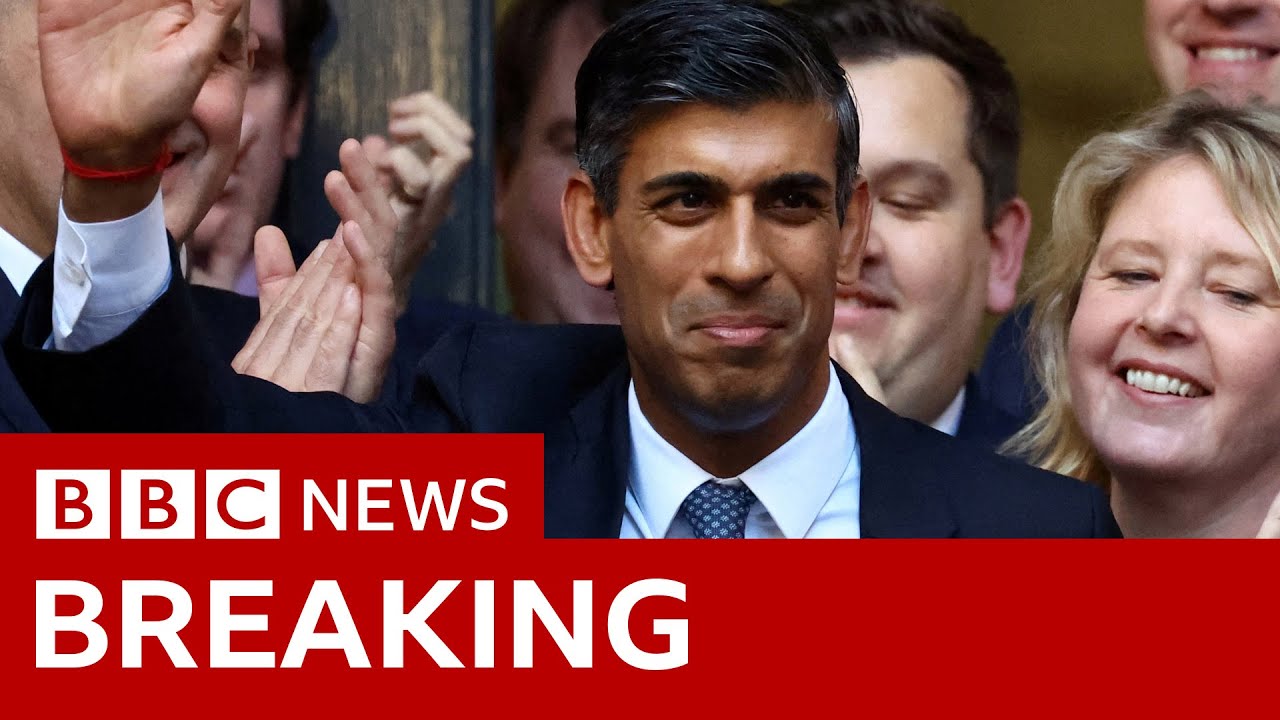
Picture credit: https://www.youtube.com/watch?v=Du_6mRV8Hm8

Jason Lowther is the Director of INLOGOV. His research focuses on public service reform and the use of “evidence” by public agencies.  Previously he worked with West Midlands Combined Authority, led Birmingham City Council’s corporate strategy function, worked for the Audit Commission as national value for money lead, for HSBC in credit and risk management, and for the Metropolitan Police as an internal management consultant. He tweets as @jasonlowther

Are councils representing their communities?


Jason Lowther

Fresh from this year’s successful Solace Summit, the organisation this week launched a new report on “Understanding and Improving Equality, Diversity and Inclusion in the Local Government Workforce”.  It’s a challenging but inspiring read raising fundamental issues for the sector where a recent survey found that more than 80% of children’s services directors in English upper-tier local authorities were white British and only 2% identified as black African or Caribbean while Asians were not represented at all. 
[Full disclosure – Inlogov and the LGA supported the research, which was commissioned by Solace, undertaken by Shared Intelligence, and funded by Zurich Municipal].

Many councils are publishing only limited information on the diversity of their workforce.  The Solace research analysed workforce profile reports of the 152 “top tier” local authorities in England.  The research found that just over half (55%) of these councils publish detailed statistics of their workforce in terms of ethnicity and provide the necessary level of information to compare with the local workforce by sub-category of ethnicity. A further 38% only disclosed an overall percentage of BAME employees, and EDI Workforce reports were not found for a dozen councils.  Almost a fifth of the reports were seriously out of date (19% from before 2020).  The best performing area was the West Midlands, with 12 of their 14 councils publishing complete data.  Only about half of the councils nationally provided pay and grade information by ethnicity.  The report recognises that workforce data is often unreliable or out of date.

Some councils are achieving a workforce that reflects their community’s ethnic mix.  Out of 140 councils with complete and partial information, in 49 councils the percentage of BAME employees is greater than the BAME working population. However, outside London and the East Midlands, in each region the council workforce has a lower BAME percentage than the local working population.  The representation of minority ethnic groups appears to drop significantly at senior or leadership positions, and among the top earners. 

The report makes three big recommendations to improve the value of council workforce data.  First, being transparent about the quality and completeness of the information for example by including the response or completion rate for ethnicity data in the council’s HR system.  Secondly, adopting  a consistent categorisation of ethnic groups at sub-category level (in line with the Census 2021).  Thirdly, standardising the data presentation, for example using a standard approach of recording ethnicity at 10,000 pound pay bands and median pay gaps.

Solace has committed to champion diversity.  The Solace launch webinar for the report saw Non-Executive Director Leads on Diversity & Inclusion, Nazeya Hussain and Chris Naylor, discuss Nazeya’s powerful lived experiences and the organisation’s “statement of intent” championing equality, diversity & inclusion across local government.  

In a country where over 20 per cent of the population reports being from a minority ethnic group and yet Black and minority ethnic people are 2.5 times more likely to be in relative poverty than their white counterparts and Bangladeshi men are still 3 times more likely to die from Covid, more councils need to look like their local community.  This report shines an important light on how to get there, and how we can better check whether progress is being made.

Jason Lowther is Director of the Institute for Local Government Studies (INLOGOV), University of Birmingham

Picture credit: EpicTop10.com https://www.flickr.com/photos/182229932@N07/

Black History Month

Picture source: https://www.evertonfreeschool.com/2020/10/06/black-history-month-2/

Cllr Ketan Sheth

Black History Month creates a moment when we can step back and reflect together, as well as individually, on  the immense contribution of Black, Asian and minority ethnic communities whose rich history, culture, and experiences, have shaped Brent and beyond.

The NW London Joint Health Scrutiny Committee comprises 8 NW London boroughs. As Chair, I know we simply could not function without the dedication, the skills, and above all, the compassion that thousands of people from our diverse communities contribute to the NHS, day in and day out.

The difference this makes to all our lives, is immeasurable. Black History Month affords us an opportunity to acknowledge and thank them for the important work they do: their continuing contribution to the care, the culture, the shaping, and well-being of Brent.

The colour of someone’s skin should not determine how they are perceived, considered, and treated – positively or negatively – but the impact of the pandemic has highlighted many disturbing features of inequality in our communities. Many of these problems are not new. They have existed for far too long.

Black, Asian and minority ethnic communities are more likely to be affected by life-changing diseases like diabetes, prostate cancer, and sickle cell than people from other backgrounds.  Living  in less-affluent areas, they are more  greatly affected by poor housing as well as poor air quality from the busy urban roads that run through their neighbourhoods. There is a big gap in life expectancy between richer and poorer areas irrespective of race, but these communities are disproportionately affected. 

To tackle these inequalities, the North West London Integrated Care System is launching a  joint initiative between the local NHS and NW London boroughs, which will seek to build real understanding of what matters to our residents, how we can work with them to remove barriers to health equality to deliver healthier neighbourhoods and better outcomes. 

This initiative is the first tangible benefit I have seen emerge from the  new Integrated Care System, which has health services and local authorities coming together to address many of the challenges that impact our well-being. That is, health and care services, employment, education, housing, and the environment we live in.

We might perhaps reflect for a moment on the work of the great poet, James Berry OBE, who never avoided the difficult issues of injustice in history, or in the present, but always sought for mutual understanding. His poem, “Benediction,” stresses the need for us truly to hear one another, and truly to see, and through so doing, to understand. He said:

Thanks to the ear that someone may hear

Thanks to seeing

that someone may see

Thanks to feeling

that someone may feel

Thanks to touch

that one may be touched…

Black History Month is a reminder to us to truly hear and see one another, to celebrate our heroes and tell the stories that, for so long, have been hidden or forgotten. It is also a reminder that the evils of the past have resonance today, reflected in the impact of poverty and institutional racism that many in our communities experience as part of their daily lives. Ultimately, it is an opportunity to continue to learn, understand and come together to pull down these barriers and build healthier and fairer neighbourhoods.

Cllr Ketan Sheth is Chair of Brent Council’s Community and Wellbeing Scrutiny Committee

Pushing experts under a big red bus?

Picture source: https://paulcairney.wordpress.com/2020/07/08/covid-19-policy-in-the-uk-did-the-uk-government-follow-the-science-reflections-on-sage-meetings/
Jason Lowther


Politicians have a complex relationship with experts and the evidence the latter provide.  Back in May 2020, I reflected in the Municipal Journal on how Michael Gove’s statement in the Brexit campaign that ‘people in this country have had enough of experts’ had turned 180-degrees.  With the arrival of Covid, the PM told his 9th March 2020 press conference ‘we are doing everything we can to combat this outbreak, based on the very latest scientific and medical advice’ and this line was consistently reiterated by other ministers.  Thirty months on, Rishi Sunak (Chancellor in 2020) railed against the government’s main Science Advisory Group for Emergencies expert group (SAGE) saying ‘If you empower all these independent people, you’re screwed’. 

Sunak’s argument, presented in an interview with the right-leaning Spectator magazine, seems to be that the SAGE experts failed to consider any non-health impacts of Covid control measures (particularly lockdowns) and refused to show politicians their workings.  In the article he’s quoted as saying ’I was like: “Summarise for me the key assumptions, on one page, with a bunch of sensitivities and rationale for each one”, in the first year I could never get this’.  This doesn’t seem to match with the published SAGE ‘consensus statement’ on school closures issued in February 2020, which very clearly sets out its assumptions and explicitly states:

As well as the large economic and educational costs of school closures, including increased levels of workforce absence in the health and care system and elsewhere, school closures could have adverse consequences: As infections appear to be more severe in older people, putting children in the care of their grandparents may result in a higher number of severe cases. Once schools are reopened, the number of cases may increase again, with the overall attack rate not being reduced.
(SPI-M-O: Consensus view on the impact of mass school closures on 2019 Novel Coronavirus, Feb 2020)

Later, when facing the December 2021 Omicron variant, Sunak is said to have used his own alumni and private sector analyses to challenge SAGE advice for further lockdowns with the PM and in cabinet.  He argues that the scientific evidence failed to provide a balanced analysis of lockdown decisions, saying ‘I would just have had a more grown-up conversation with the country’.  Sunak also claimed that dissenting voices in SAGE discussions were edited out of the minutes, an assertion he supported by describing a Treasury official sitting in on the discussions and reporting disagreements and uncertainties back to him. 

SAGE scientists see this differently.  Former SAGE member Prof Ian Boyd from the University of St Andrews commented: ‘It is nonsense to suggest that Sage was insensitive to the issue of the long-term effects of lockdowns – a whole subgroup dedicated itself to trying to understand what this might look like. Sage was discussing the topic of excess deaths in detail in April 2020.  Those who attended Sage meetings were acutely aware of the trade-offs associated with implementing specific actions, such as closing schools. To the extent that it was possible with the information available at the time, these deals were included within the uncertainty expressed in the advice provided to politicians. It is simply unacceptable to rewrite history, by blaming scientists, to save a political class that has systematically failed to respond to the messages that scientists have been providing to them for many, many years’.

There are valid reasons to criticise elements of the advice system the government put in place during the pandemic.  The limitations of ‘a model in which a specialist committee produces consensus statements that spare policy makers any requirement to make choices on matters in which they have no competence’ have been demonstrated in analysis by Lawrence Freedman of the intelligence failings relating to the UK entry to war with Iraq as well as the Covid pandemic.   His analysis recommends a model with more opportunities for policy makers to engage with the experts as both the advice and the policy is developed.   The editor of the Lancet, Richard Horton, argued that expertise around public health and intensive medical care should have been in the SAGE discussions.  I argued in the MJ piece that having practical knowledge from local councils and emergency planners could help avoid recommendations that prove impossible to implement effectively, since esteemed experts can still make recommendations which are impossible to implement in practice.  But it’s simply wrong to suggest that SAGE ignored key evidence on non-health effects of Covid control measures or sought to silence dissenting views.  If the trade-offs and assumptions were not considered by the Cabinet, the blame for that lies not with the scientists but with the politicians.

This article appeared in the Local Area Research Intelligence Association newsletter on 27 Sept 2022

Jason Lowther is Director of the Institute for Local Government Studies (INLOGOV), University of Birmingham

T

“The Greatest Political Party on Earth” – Prime Ministerial hyperbole

Chris Game

Reader alert!  This blog’s sole excuse is its loose topicality. Its connection with local government, certainly, is tenuous in the extreme, and needs rationalising right away.

My chief role in INLOGOV, throughout most of my time as a full-time employee, was as Convenor of its undergraduate degree, latterly entitled the BSc in Public Policy, Government & Management. When we launched its predecessor in the early 1980s, ICT was in its youth, if not infancy. PowerPoint presentations, when they arrived, were seriously challenging, and one was constantly looking out for new IT developments that might illustrate current events and generally enhance the student learning experience.

The technology left me behind years ago, but the fascination with entertaining visual aids remained. Meanwhile, we quickly learnt that casually deployed, but now much more easily checkable, references and assertions, particularly superlatives, were a gift to the evolving technology. I was naturally aroused, therefore, by our new PM’s extraordinary phraseology in acknowledging her leadership victory: “Thank you for putting your faith in me to lead our great Conservative Party, the greatest political party on Earth.”

Never mind that she hadn’t had the faith of even half of that party’s modest-sized 170,437-member electorate.  Why the senseless GPPoE bit?  ‘Oldest PPoE’ might just have worked – by treating the C17th Tory Party’s demise in the 1830s and 1840s as an evolution, rather than dissolution, into the Conservative Party.

‘Great’, though – definitionally, etymologically – is chiefly and initially about large size. But accuracy, etymology, or even common sense clearly aren’t what Liz Truss is about, and I half-thought, therefore, of trying to make a blog out of it.

At that point, though, I hadn’t fully grasped, in addition, the extreme limitation of the Truss vocabulary, and there was suddenly more material to work with: the PM’s apparently considered evaluation, to her fellow MPs, of the late Queen as “one of the greatest leaders the world has ever known”.

Apart from the “one of”, no qualification or explication in sight. No “constitutional”, or “peacetime”, or even “modern-day”. Not “one of the world’s most recognisable faces”, possibly after Hitler. Or one of the most photographed. Not even one of the greatest women leaders, which would get rid of all those tricky men – Jesus Christ, Muhammad, Buddha, Confucius, Gandhi, Einstein, Mandela and the rest of the usual crew.

Actually, “one of the greatest women leaders” might at least have generated some informative debate. Elizabeth II’s chief competition would then have been merely Elizabeth I (obviously), Russia’s Catherine the Great, Austria’s Maria Theresa, and, with perhaps 30 seconds Googling, probably Ancient Egypt’s Pharoah Hatshepsut, and China’s C19th Empress Dowager Cixi.

If there really has to be a QEII superlative, there’s possibly “the most recognisable face in the world”. “Head of the world’s most effective democratic monarchy” could have done – interesting, and still a pretty big deal – but might have required a few seconds’ thought. And, pleasingly, that’s just what it got – even including a superlative. Not from Truss, but from local government, or, more specifically, LGIU Chief Executive, Jonathan Carr: “Her Majesty Queen Elizabeth II – our country’s greatest public servant”.

Sadly, though, it seems we’re simply going to have to get used to these ludicrous hyperboles as a Truss ‘thing’, though hopefully, PLEASE, not on a twice weekly basis. Meanwhile, back to her “greatest political party on Earth”, and, while there’s no knowing what, if anything much, she may have had in mind, it almost certainly wasn’t anything measurable or internationally comparable.

‘Great’, though, remains in the first instance a size adjective; so, as they say, needs must. Membership size of national parties is one of the many countable phenomena nowadays measured and compared – skilfully, entertainingly, and literally movingly by YouTube Ranking Charts. Other providers are available, but in my limited, amateurish judgement, these are the most comprehensive, user-friendly, and have the better background music tracks.

I’m a fan, and, were I still lecturing, the charts would be an early student recommendation. Not, sadly, in most cases for any immediate relevance to the world of local government, but for their sheer fun – and, by my reckoning, the products of often quite impressive research. 

The above link will get you to a whole catalogue of charts, usually headed by the ever popular ‘Top 10 Largest Armies in the World, 1816-2021’, which will serve as a brief illustration – yes, that’s 205 years of annual rankings, Napoleon to Putin.  Actually, Putin would be dead envious. In 1816 Russia’s 800,000 ‘Active Military Personnel’ easily outnumbered the world’s next four largest armies – the UK (255,000), Austrian Empire, France and Prussia – combined.

A century later in WWI we had 4.4 million troops, behind only the German Empire, Russia and France, and in WWII that increased to over 5 million – modest compared to the US and the Soviet Union (10 million+), but comparable to Nazi Germany and Japan, and, unsurprisingly, way ahead of France.

We finally dropped off the Top 10 chart altogether in 1963, as eventually did France in 1991. And today, if you were wondering … Russia’s I million+ troops rank them in a rather modest 5th place, behind China 2.1 mill., India 1.5 mill., the US 1.4 mill., and North Korea 1.3 mill.

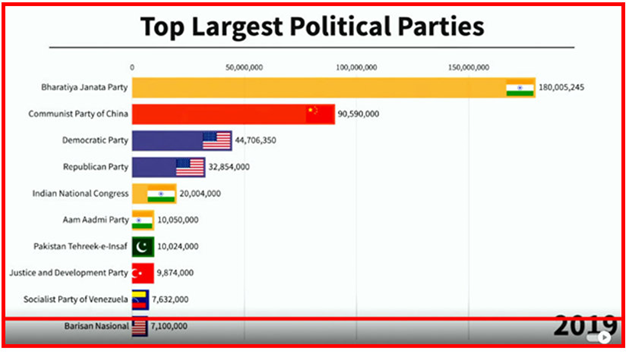
Apologies for that even further digression. Back to “the greatest political party on Earth” – by registered party membership. The principle is the same as for ‘Largest Armies’ – annually reported, with the totals, bar lengths and positions constantly changing, starting here in 1950, rather than 1816; checked and validated as much as possible, which explains the present-day absence of the Communist Party of the Soviet Union. Missing too is the UK Conservative Party – because, well, you can guess from all the other figures running into the several millions how far down the list its 172,437 would be.

To summarise: largest parties in 1950 were the US Democrats and Republicans (7.2 and 6.5 million members respectively), followed by the Communist Party of China (CCP) (6.5m) and the Indian National Congress. Not making the chart, but impressive in their way, the Conservatives’ membership would have been in the high 2 millions (including at least my father, not sure about mother) with Labour, excluding affiliated TU members, around 1 million.

Within two years the CCP had overtaken both US parties individually, and by the mid-1970s both combined. By 2019 it had 90,000 members, the two US parties 77,000 between them.  All three combined, however, had long since been massively overtaken by India’s Baratiya Janata Party (BJP), Narendra Modi’s Hindu nationalist party.

Founded in a 1970s multi-party merger, the BJP had grown gradually, topping 5 million members for the first time in 1993, compared to the Indian National Congress Party’s 13 million. By 2002, however, its then 15 million members had overtaken the Congress Party, following which it grew fast and steadily, reaching 38 million in 2006, overtaking the Chinese Communist Party’s 78 million in 2010, and in 2014, with 129 million members sweeping to national power under Modi, who remains PM today.  

And that, Prime Minister, is what the currently “Greatest Political Party on Earth” looks like.

Chris Game is an INLOGOV Associate, and Visiting Professor at Kwansei Gakuin University, Osaka, Japan.  He is joint-author (with Professor David Wilson) of the successive editions of Local Government in the United Kingdom, and a regular columnist for The Birmingham Post.