The Road to A Soft Brexit

Jon Bloomfield

The election result has been a game changer. The electorate has turned down the Theresa May/Daily Mail offer of a hard Brexit and the threat of walking away from the negotiations with the European Union. The issue did not get the in-depth discussion during the election that it should have, but the result is a rebuff to Mrs. May and all her Government Ministers claiming that ‘no deal is better than a bad deal.’

The new parliamentary arithmetic means that the road is now open to negotiate a soft Brexit. That means accepting the result of the 23rd June referendum but recognising that for reasons of economics, geography, history and culture a close working partnership between the UK and the Continent is in the interests of both parties. Hence, the UK should seek a partnership and cooperation arrangement with the EU across a whole range of areas – the economy, security, culture, the environment, research – where the UK has vital interests with our closest neighbours.

Furthermore, events are pushing the EU as well as the UK in that direction. Firstly, after the latest terrorist horrors in Manchester and London, who is seriously going to suggest that the UK should pull out of its intelligence sharing and security cooperation with European police and counter-terrorism services? A handful of little Englander ideologues will object to UK cooperation because it is overseen by the European Court of Justice but that will not resonate on many doorsteps. Secondly, the disastrous performance of President Trump in Saudi Arabia, at NATO and the G7 has given renewed momentum to the desire amongst European leaders for greater self-reliance. The swift declaration with the Chinese government upholding their joint commitment to the Paris agreement on climate change after Trump’s announcement of US withdrawal is an early example. Thirdly, the election of Emmanuel Macron as the new French President adds a powerful, new political figure pushing for collective action at the European level.

Until now the main political obstacle has appeared to be migration. The May government has argued that the UK must pull out of the Single Market and the Customs Union because membership of either is incompatible with the UK controlling its own migration policy. This view is regularly echoed by EU leaders and Commission President Juncker who talk about Single Market membership requiring adherence to the four principles of the Treaty of Rome, including the free movement of labour. Yet the way to combine a migration policy that is fluid enough to preserve economic dynamism and rigorous enough to inspire public confidence lies in articles 48 and 49 of the original treaty of Rome. Article 48 states that “freedom of movement for workers shall entail the right (a) to accept offers of employment actually made; (b) to move freely within the territory of member states for this purpose.” Article 49 calls for “the achievement of a balance between supply and demand in the employment market in such a way as to avoid serious threats to the standard of living and level of employment in the various regions and industries”.

In other words, these have to be managed processes. The treaty is not a neoliberal free for all. Freedom of movement is specifically tied to agreed, contracted employment and recognises the need to balance labour supply and demand. Here is the basis for a serious negotiation between the UK and the rest of the EU.

Importantly, this is the view of Jean Pisani Ferry, the author of Macron’s Presidential policy programme and now his chief economic adviser. Nine months ago Ferry wrote a pamphlet for the influential Breughel think tank with four other senior EU policy makers entitled Europe After Brexit. The authors argue that in an increasingly volatile world, neither the EU nor the UK have an interest in a divorce that diminishes their influence, especially as the balance of economic power shifts away from the North-Atlantic world. They propose a new form of collaboration between the EU and the UK, a continental partnership which would consist of participating in the movement of goods, services and capital and some additional labour mobility, as well as in a new system of inter-governmental decision making and enforcement of common rules to protect the homogeneity of their deeply integrated economies. On migration, the Brueghel authors see it primarily from a functional, economic rather than constitutional/political viewpoint. Hence managed labour mobility is required for the interdependent parts of the European economies to function smoothly and to enable firms to transfer staff to other countries easily, but there is no legal necessity for unrestricted labour mobility. Ferry’s co-authors are policy and political heavyweights including Norbert Röttgen, the Christian Democrat Chairman of the Foreign Affairs Committee of the German Bundestag and Andre Sapir, an adviser to two previous European Commission Presidents. Thus, there is intellectual heft behind the case for pursuing a managed migration policy within the framework of the Single Market. Currently, the 10,000 lorries a day that pass through Dover are the most visible indicator of how interdependent the UK and Continental economies have become. That is why it is so crucial to both the UK’s and Europe’s economic well-being that this tariff-free, seamless trade is retained. There is a viable political path here for a soft Brexit and now there is also a window of opportunity.

Throughout the election Jeremy Corbyn’s team took the political initiative. He should keep this momentum and bring the new parliamentary arithmetic to bear. For starters, his Labour negotiating team should:

* bring together all MPs regardless of party who want to pursue the soft Brexit option. They should re-draft the terms of the UK negotiating position and seek to win Parliamentary approval for it.

* open informal discussions with Pisani Ferry in France, Röttgen in Germany and other key players across Europe.

Calls for a second referendum are dead. They hampered both the Liberal Democrats and the SNP in the election. But what is on the cards is the negotiation of a proper, collaborative partnership with the EU. It will be complicated and difficult but the opening is now there. Can a progressive alliance come together to take it?


Jon Bloomfield is an Honorary Research Fellow at INLOGOV and an expert on EU funding, European and EU issues of regional and local government who carries out research on the EU and contributes to INLOGOV’s post-graduate programmes.


Land Value (or Garden) Tax and the General Election – more Adam Smith than Jeremy Marx

Chris Game

One consequence of Theresa May delaying until mid-April her U-turn on holding a General Election was seen almost immediately – when it was decreed too late for the General, local and mayoral elections all to take place synchronously. It could have saved money and probably doubled the local and mayoral turnouts. Which in turn would almost certainly have avoided the unfortunate situations in the West Midlands and Liverpool City Region, where the new metro mayors, Andy Street and Steve Rotheram, were elected with vote mandates – 239,000 and 171,000 respectively – significantly smaller than were achieved in May last year by their respective Police and Crime Commissioners.

Another consequence of the May delay is that, with the parties’ General Election manifestos published almost immediately after the local elections, we heard – even before ‘security’ issues captured the campaign – less directly about local government than we might normally have done. Until now, that is – for I’ve prepared a micro version of the Local Government Election Manifesto Quiz that I’d previously have endeavoured to inflict on my captive undergrads. It’s based on the local government sections of the Conservative, Labour, Liberal Democrat and Green party manifestos – with links and page references for the exceptionally keen or doubtful.

Which manifesto do you reckon (or recall):

  • mentions “local government” just twice in 84 pages (pp. 32, 81)?
  • proposes (p.103) creating a Minister for England in the Department for Communities and Local Government?
  • will introduce (p.27) a ‘presumption of devolution’, whereby devolved powers transferred from the EU post-Brexit will go straight to the relevant region or nation?
  • wants (p.94) ‘devolution on demand’, enabling devolution of Westminster powers to groups of councils working together – like a Cornish Assembly or Yorkshire Parliament – with or without a mayor?
  • would (p.74) replace Police and Crime Commissioners with accountable police boards of local councillors?
  • will encourage councils to economise by painting yellow lines where you can park?
  • wants (p.17) more empty homes brought back into use, and a trial of a Land Value Tax (LVT) to encourage the use of vacant land and reduce speculation?

The answers, apart from the Monster Raving Loony Party’s yellow paint one – just to check you were paying attention – are in the order the parties were listed above: C, L, L, LD, LD, G. Points for correct answers, none for incorrect – except the last one, for which you can award yourself points for either Labour (p.86) or the Lib Dems (p.40), as well as the Greens.

Which is one of several noteworthy things about this relatively sudden cross-party interest in land value taxation. First, it was indeed mentioned by all three parties, and in almost identically vague terms. The Greens’ “trial” was the strongest commitment – appropriately, with their Co-Leader Caroline Lucas being probably the tax’s most prominent recent parliamentary advocate. The Lib Dems would merely “consider” it, while for Labour it’s one possible “new option” in an overall review of local government funding. In no manifesto – including, I emphasise, Labour’s – is it a policy, plan, pledge or commitment. None give it more than a part-sentence, and there’s not a figure or any other detail in sight.

Which might explain why, when the respective manifestos appeared, it received effectively no media attention whatever. Until last week, when Conservative campaign headquarters was presumably tasked with fabricating something to counter the damage done by Labour turning Theresa May’s social care charge into a ‘dementia tax’. Accordingly, the nerdish-sounding LVT was frankensteined into a culture-threatening – sorry: Marxist, culture-threatening – ‘Garden Tax’ aimed at undermining the foundations of English family life as we know it. The inaptly-named ‘red-top’ Conservative-supporting tabloids were accordingly briefed and unleashed.

“Labour’s secret plans, hidden in the small print of Jeremy Corbyn’s manifesto”, contain “proposals to replace council tax and business rates” with “a destructive, devastating tax on homes and gardens that a Tory analysis estimates would result in a yearly tax bill of £3,837 for an average family home in England – a massive 224 per cent increase on the current average billsend house prices plummeting, and plunge mortgage holders into negative equity.” Since when there have been daily updates in the same vein, with even Philip Hammond, in possibly his final days as Chancellor, accusing Labour of a “Marxist tax grab”.

There’s a minor irony here. The principle of land value taxation – the recognition that land’s true ‘location’ value derives less from the actions of the individual owner than from the wider efforts of the community in creating transport links, schools, hospitals and other infrastructure, and the community should benefit from this ‘unearned betterment’ part of the value accordingly – does indeed have history. Far from an invention of Corbyn’s Labour Party, it dates back well beyond Marx to at least the 18th Century classical economists, Adam Smith and David Ricardo: hardly proto-Marxists. Indeed, the bearded one himself dismissed it as a distraction from the historically inevitable transition from capitalism to communism.

Others, however, have supported it, and even enthused, seeing its combination of economic efficiency and progressiveness (the wealthiest paying most) as close to a ‘perfect tax’ – which even I, as an economic illiterate, can see is somewhat overegging it. Even so, its signed-up supporters make an impressive list, including the then Liberal, Winston Churchill; economics textbook king, Paul Samuelson; Mrs Thatcher’s favourite economist, Milton Friedman; the Adam Smith Institute, and the Institute for Fiscal Studies. The truth is that any future review of local finance would be more criticisable for omitting LVT than for including it.


Chris Game - pic

Chris Game is a Visiting Lecturer at INLOGOV interested in the politics of local government; local elections, electoral reform and other electoral behaviour; party politics; political leadership and management; member-officer relations; central-local relations; use of consumer and opinion research in local government; the modernisation agenda and the implementation of executive local government.

The General Election – Opportunity Nottingham Considers the Complexities of Voting for Those Facing Multiple Needs

In this post Opportunity Nottingham offer a different perspective on election coverage. They talk about the importance of listening and responding to those facing multiple needs in the run up to this election.

With the upcoming general election just weeks away, it is important that everyone who has the right to vote is given the opportunity to do so. However, for vulnerable and marginalised people, this right is not always easy to exercise. If you subscribe to the view that better engagement equals more effective policy, then surely this must begin with the democratic process?

At Opportunity Nottingham, we support one such marginalised group. Our Beneficiaries face multiple and complex needs, specifically; substance misuse, homelessness, offending and mental ill health. In order to deliver this support, we work in partnership with agencies and organisations including those in the areas of social justice, social care, housing and healthcare. Beneficiaries often have pro-longed contact with these types of services, and frequently report feeling ‘passed from one service to another’, having to tell their story repeatedly. This can lead to disengagement from services and those deemed as ‘in authority’, as people inevitably fall through the gaps. It makes sense therefore, that people facing multiple and complex needs become disengaged from the political process. Lack of trust, lack of understanding and lack of access to information all have their part to play.

After the general election was called, we had a meeting with our Expert Citizen Group (a group of people who are experts through lived experience of multiple needs) and asked if they would be voting. The response was almost unanimous. Firstly, they didn’t know how to register to vote; and secondly, they didn’t have enough knowledge surrounding the election. As a team we explored the voting process in more detail, and one of the main issues to arise, was the assumption that in order to vote you must have a fixed address. This assumption meant that many of our Expert Citizens thought they were not eligible to vote.

We also spent time discussing why it is so important to vote, particularly in relation to how policy decisions will be influenced by the electorate. For example, if there is an increase in homeless people registering to vote, politicians are more likely to make decisions around issues that are relevant to them, such as healthcare and social housing.

During the meeting two of our Expert Citizens registered online to vote, with the rest taking away the necessary registration forms to register. Evidence (if needed) that if the process, reasons and potential outcomes of voting are understood, a vote is more likely to be made.

Whilst a snap election gave us limited time to encourage registration, it has highlighted a number of ‘needs’ for the future if the most marginalised in society are to get their voices heard;

  • A need for the voting system to be understood by all of society
  • A need for voting criteria to be clearly communicated
  • A need for voting information to reach those who might not easily access mainstream media and information sources.

Research can test the value of this and, critically, identify practical ways to enfranchise those whose lives could be turned around with the right support.

Opportunity Nottingham supports individuals (Beneficiaries) facing multiple and complex needs in Nottingham City. To join the programme, Beneficiaries must be experiencing at least three out of the following four criteria of homelessness, offending, substance misuse and mental ill health. The project has two main aims; to empower those facing multiple needs to live fulfilled lives, and to drive system change and better support those facing multiple needs. To find out more email [email protected] or call 0115 850 4128.

BA%20Team%20Four.jpg


This blog was jointly penned by Sam Ward (Personal Development Coordinator), Robert Eagle, Sandra Morgan, Deonne Peters, and Lee Orrell (Beneficiary Ambassadors) at Opportunity Nottingham, and Zoe Benedelow, Service Manager from SEA (Services for Empowerment and Advocacy).

May’s Conservatives: closer to a genuinely national party than Thatcher in ’83?

General Election, opinion polls, YouGov regional poll, regional variations, 1983 General election, Margaret Thatcher, Sadiq Khan

You might think, given the record of opinion polls in the 2015 election campaign, that there’d be slightly fewer of them this time. Dream on! So far this month national voting intention polls have averaged well over one a day. Of the 28, precisely none have shown the Conservatives on less than 44% – that is, over 6% higher than they managed in the 2015 election; and just one – the ‘outlier’ of those published this past weekend – put Labour behind by less than 10%, compared to the 6.6% GB gap last time.

There is an iron law in opinion poll reporting: the more eye-catching and exceptional the finding, the louder it will be reported, and the more likely it is to prove a ‘rogue’ result. Unsurprisingly, therefore, this ‘single-figure lead’ poll prompted instant speculation about whether Corbyn’s Labour could win more votes than it did under Miliband, or even increase its return of 232 MPs, which at least temporarily displaced the McLuskey-prompted ruction about whether just 200 Labour MPs would qualify as a successful campaign.

That would in fact be Labour’s worst result since 1935, worse even than 1983, when under Michael Foot’s leadership it was reduced to 209 MPs. And, while the PM may understandably wince at personal comparisons with Margaret Thatcher, and in her party’s ‘Reddish Tory’ manifesto has certainly distanced herself ideologically, it still seems most likely that it is with that latter election that, as polling day approaches, statistical comparisons will be made – starting in the second part of this blog.

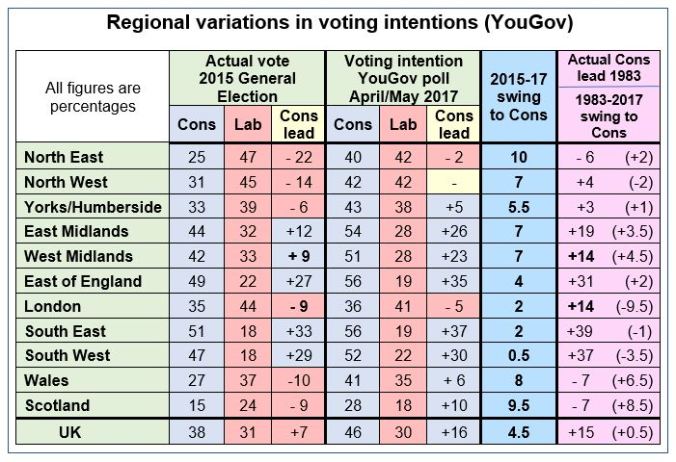
The first part looks at something arguably more interesting – the regional variations in current voting intentions, as collated by YouGov in a total GB sample of over 17,400 respondents, and compared to the actual votes in the 2015 election, summarised in the central sections of the table below.

Regional%20voting%20intentions%202.JPG

The ‘headline voting intention’ that would have been reported in YouGov’s late April/early May polls – that is, excluding ‘don’t know’s and ‘won’t say’s and weighted by respondents’ self-described likelihood to vote – would show the Conservatives with a 16% lead over Labour, with the Lib Dems on about 10% and UKIP around 7% and sliding.

The modesty of the Lib Dems’ post-2010 recovery, the recent collapse of UKIP, and the performance of other smaller parties are obviously important and will be decisive in many individual constituencies. But my main concern here is the bigger picture: the variation in the Conservatives’ current lead across the regions, and the extent to which the figures support the claim that Theresa May is increasingly keen to make of her party being truly national in its appeal and support.

We’re used to seeing political maps of the UK, whether of national or local government, from a ‘geographic’ viewpoint: each constituency or council a blob of appropriate colour the relative size of its land area. Shown such a map of the 2015 election results, an innocent visitor would probably conclude that, in England and Wales at least, we’re already there: more or less a one-party state. Even London, where Labour took 45 of the 73 seats, has to be magnified to look more than a red smudge in an ocean of bright blue.

Now, though, following the local elections, Conservatives actually are the largest party in every English county and county unitary authority except Durham, and the regional YouGov polls tell a similar story. The swing of support between the two major parties since May 2015, coupled with the respective performances of UKIP and the Lib Dems, has put us on the brink of becoming, as well as just looking cartographically, a one-party state.

In under two years, one English region, Yorkshire/Humber, has swung from majority Labour to majority Conservative. A second, the North West, has seen a 14% lead completely disappear. And, most strikingly, Wales and Scotland, for decades dominated almost monopolistically by Labour, are both currently showing the Conservatives with a clear two-party voting lead.

In general, and with one big exception, the below-average 2015-17 swings from Labour to Conservative have been in the already strongest Tory areas – the South East, South West, and East of England. And the above-average swings have been in the traditionally strongest Labour areas, where they can make the relatively greater electoral impact: the North East, an early deliverer in the form of an unexpected mayoral victory in Tees Valley; the North West, May’s choice for her launch of the party manifesto; the Midlands, Scotland and Wales.

The massive exception to all this is obviously London, increasingly unmoored in so many respects, it seems, from the rest of the country. Current voting intentions don’t quite match the 44% to 35% split in 2015, and with which Sadiq Khan won the mayoralty last year, but they’re very close.

London’s real political exceptionalism, however, is shown when we start comparing with 1983 and the figures in the final columns of my table. In that election the regional voting figures in London and the West Midlands were close to identical: 44/45% Conservative, 30/31% Labour, 25/27% SDP-Liberal Alliance, and in both cases a (highlighted) 14% Conservative lead.

By 2015 that lead had been reduced to 9% in the West Midlands, but in London had been reversed to one of 9% for Labour. And over the past two years that divergence has accelerated, with the Conservatives 23% ahead in the West Midlands and Labour 5% ahead in London.

The last (bracketed) column in the table is intended to take advantage of the fact that nationally the Conservatives’ current lead in voting intentions is effectively the same as that achieved by Margaret Thatcher’s party in 1983, and to see how the different regions compare and contrast.

Headed massively by London there are four minus signs, but the seven pluses suggest that May’s Conservatives are indeed developing a claim to be a more genuinely nationally supported party than we’ve seen for at least several decades.


Chris Game - pic

Chris Game is a Visiting Lecturer at INLOGOV interested in the politics of local government; local elections, electoral reform and other electoral behaviour; party politics; political leadership and management; member-officer relations; central-local relations; use of consumer and opinion research in local government; the modernisation agenda and the implementation of executive local government.

The Leadership Conundrum in Turkey’s District Governance – Insights from Doctoral Research

In this post Saban Akca presents findings from his recently completed PhD research into the behaviour of district governors in Turkey. His thesis is titled ‘The Complex Role of District Governors in Turkey: A Case of Sui Generis Public Leadership’. 

Turkish district governors are centrally appointed public administrators who represent the Turkish state at localities across the country. They have been charged with various and diverse responsibilities, including security and public order, and they are liable to ensure the smooth delivery of other public services. However, they have enjoyed a great deal of power in local administration for more than 170 years, their co-existence with locally elected mayors and the latter’s unparalleled and rapid accumulation of power are now hitting hard the very existence of the orthodox foundation of governorships nationwide.

After this brief introduction about the roles of the Turkish governors I am now ready to explain why I have been conducting a leadership study on them. First, it should be underlined here that the study – based on my personal experiences of the perceived inadequacy of training services delivered by the Training Department of the Turkish Interior Ministry for intern governors –aimed to examine a specific ‘governorship course’. However, the direction of the study evolved into one that focuses also on governor leadership exercises, mostly because the course is a mere mannequin of the status quo, rather than a transformative leadership programme.

The study has focused on the challenge within public leadership of reconciling the sometimes conflicting interests of the national and local state. As representatives of the Turkish state at the local level, governors have undertaken a traditional local leadership role. The research for the study has examined the ways in which different governors interpret, approach and play out their leadership roles within the districts to which they are appointed, and, in particular, the ways in which they balance the respective interests of the central state with those of the locality, as shaped by the democratically elected local government system.

Much of the research focus has been on governors as individuals – rather than as a group or as an institution. In this vein, the key research question for the thesis has been ‘How do Turkish governors, in the exercise of their leadership role, balance out their responsibilities towards the central government, as servants of the central state, with those towards the locality and the communities over which they have jurisdiction?’ In addition to that and in further elaboration of governors’ leadership characters and the effects of contingencies on their leadership, the second research question is: ‘To what extent, and in what ways, are differences in the approach of governors shaped by and contingent on local circumstances as opposed to more personal traits?’.

A case study design was devised, involving 30 district governors, selected from across Turkey, and semi-structured interviews were conducted with each to explore both the perceptions and perspectives of each with regard to their leadership role and the extent to which these differed from district to district in reflection of contextual factors.

The findings demonstrated a considerable range in perspectives on and approaches to the leadership role and in the strategies and modes of operation in the pursuit of governance at local level. At the same time, the findings also highlighted some commonalities; for example, a strong ambition from an early age amongst some to become a district governor. Similarly, there was shared recognition of the importance of the adaptability of leadership strategies to local circumstances, and recognition that there cannot be ‘one model’ for this governance role. Furthermore, the findings suggested that district governors tend to approach their role as father figures, for the district population as well as for their own civil servant employees.

Recent public administration reforms in Turkey, and specifically, moves to devolve more powers to municipalities, imply changes in the role and influence of district governors. Accordingly, the research sought to understand how interviewees were viewing these changes and their implications for their role into the future. In this respect, almost all the governors expressed apprehension and much uncertainty about future prospects.


Saban

Saban Akca holds a law degree from the University of Ankara, Turkey and did his master study on the European Union at the Keele University in 2011. After achieving his lawyer qualification at the Ankara Bar Chamber in 1999, he followed a career in the Turkish civil service as a district governor from 2000 until 1 September 2016.

The local and mayoral elections – and the significance of that 4-2 scoreline

Chris Game

Local elections present the INLOGOV blog with an annual dilemma. They’re the heartbeat of democratic local government, its lifeblood, or something equally vital. So, they must be covered and key results namechecked. But INLOGOV’s not a news service, and, with so many Friday counts nowadays and results instantly available on social media, you have somehow to strike a balance.

The first part of this blog, therefore, will give the headlines, from a strictly local government perspective. That means, first, changes in council control; second, changes in councillor numbers; and third, excluding one minor indulgence, no conjecturing whatever about implications for that other election.

Conservatives, of course, were the big winners, almost everywhere. So, to be perverse, we’ll start with a titbit of consolatory Labour news, from the seven unitary polls. Durham it still controls, and Northumberland – thanks to the Conservative candidate in the potentially decisive ward literally picking the short straw – stays technically hung, though no longer under Labour minority control. After mass gains from particularly Independents, Conservatives are the largest party in Cornwall and back in control in the Isle of Wight.

Of the 27 non-metropolitan counties, even before last Thursday Labour had majority control in only Derbyshire and Nottinghamshire, and shared minority control in Cumbria and Lancashire. Conservatives are now in control of the first and last of these and are easily the largest party in the other two. Cambridgeshire, East Sussex, Gloucestershire, Lincolnshire, Norfolk, Oxfordshire, Suffolk and Warwickshire all swung from minority to majority Conservative control.

As was widely, and even gleefully, reported, UKIP too lost heavily, its single gain in Lancashire being rather more than counterbalanced by at least double-figure losses in Cambridgeshire, Kent, Lincolnshire, Norfolk, Suffolk and West Sussex.

Turning to overall councillor numbers, the Conservatives gained what for a party in national government was an almost mind-boggling 563 seats: 319 in England, 164 in Scotland, far more than doubling their previous representation, and 80 in Wales – the latter, according to more knowledgeable commentators than I, putting the party on course (in that election I’m not mentioning) for its first nationwide Welsh victory since the Earl of Derby managed it in 1859.

Labour’s car crash involved losing net 382 councillors – bringing to 15 years the period since, in terms of councillor numbers, it was the largest party in GB local government – UKIP 145, and the Liberal Democrats what must have been a deeply dispiriting 42.

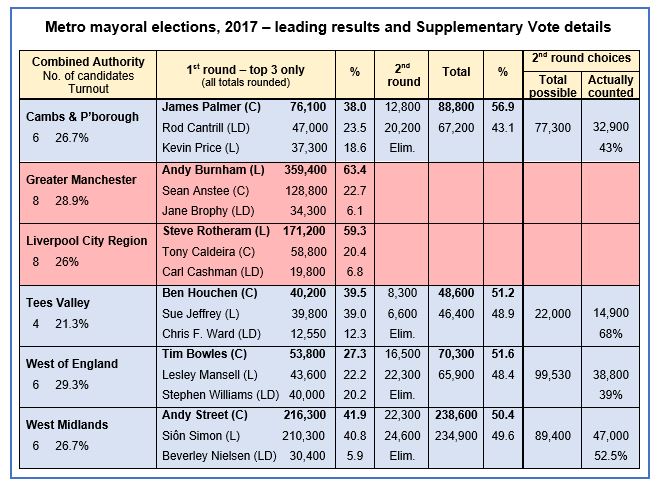
And so to what, for the immediate future of at least England’s sub-national government, were surely last week’s most important elections, and collectively way up there amongst the most mind-boggling: those of our first(?) six metro mayors. I can hardly imagine the odds you could have got, even a week ago, on four of the six being Conservative. However, it’s there in my table, in blue and pink. And, whatever one’s reservations about elected mayors and the whole limited, top-down, Treasury-driven, fiscally minimal devolution model, I’d suggest that nothing over the past 11 months has given it a greater boost.

MetroMayoralresults-3

The first several months of May’s premiership she spent almost visibly dithering over what to do about the severed agenda of devo deals and elected mayors she’d inherited from the axed George Osborne and shuffled ex-Communities Secretary, Greg Clark. Then – I simplify enormously – two things happened.

First, Andy Street decided he’d stop being MD of the John Lewis Partnership and run as a Conservative for the biggest and politically most attractive metro mayoralty of all, the West Mids – in time to be adopted, and then paraded with May at the party’s October Birmingham conference.

At the same time, something else helped change her view that one big reason why metro mayors were a bad idea was that most, if not all, would be Labour. Several of Clark’s nine envisaged metro-mayoral city regions, during the May-created devo vacuum, started for various reasons to lose interest or patience and drop out – West Yorkshire, Sheffield City Region, the North East – and the political arithmetic began to alter. To the extent that I suggested she could realistically conceive of the first set of mayoral elections producing three Conservative and three Labour mayors. Even for the sake of an eye-catching headline, though, I’d never have contemplated 4-2.

And, as the table shows, three of the four results, after the two counts involved in the Supplementary Vote (SV) electoral system, were extremely close. Street’s majority was exceptionally so – 0.71979% of over half a million votes cast, to be precise. This in itself would weaken any victor’s mandate, particularly when achieved in what, by the standards of anything other than Police and Crime Commissioner ballots, were very low-turnout elections.

The SV system was adopted for mayoral elections almost by accident, and many consider that the more familiar Alternative Vote – that we rejected for parliamentary elections in the 2011 referendum – would be fitter for this particular purpose. Its defenders, though, claim it has worked well in London, is voter-friendly, produces clear winners, and is accepted by all concerned.

My table would suggest otherwise, at least on its first showing. In the West Midlands, in a hugely significant election decided by well under 4,000 votes, over 40,000 votes that might have contributed to the result didn’t do so. They were either not used at all, or were cast for candidates who, highly predictably in this instance, had already been eliminated after the first count.

It’s impossible to avoid the conclusion that large numbers even of the small minority who turned out didn’t fully comprehend the system they were voting in – for which the Electoral Commission must be held chiefly responsible. As also for the huge disparities in candidate expenditure permitted before the ‘regulated’ campaign period, which again in such a closely run race can and will be alleged to have been decisive. In short, the Commission, as well as the mayors themselves, have plenty of work to do in what is only a three-year term to 2020.

Chris Game - pic

Chris Game is a Visiting Lecturer at INLOGOV interested in the politics of local government; local elections, electoral reform and other electoral behaviour; party politics; political leadership and management; member-officer relations; central-local relations; use of consumer and opinion research in local government; the modernisation agenda and the implementation of executive local government.