Getting under the skin of council budgets: what does good scrutiny look like?

Cllr Ketan Sheth

It’s a testing but all-too-familiar mix: funding cuts from central government, skyrocketing demand for local services, a growing population, tough choices and communities vulnerable as they recover from the social and economic shocks of the pandemic. As we approach budget setting, our situation in Brent – a NW London borough – mirrors the position of local authorities around the country.

​Against this challenging backdrop, I believe the role of effective Scrutiny is more important than ever, and so too is learning from one another.

This year, I co-chaired Brent Council’s Budget Scrutiny Task Group. It was our job to get under the skin of budget proposals, to grasp their real-world effects, to understand any mitigations, and to make recommendations where we felt the decisions of our Cabinet, and Full Council, could be strengthened.

To bring forward a balanced budget, this year we were called to scrutinise a package of savings totalling £2.7million, alongside Council Tax increases.

A deeper approach to scrutiny

Given the stark financial picture across the country, from the outset, we wanted to make sure that scrutiny was grounded in the complex reality of the difficult decisions that the Cabinet needed to take. We were determined that the scrutiny process must add value.

As a group, we worked with officers to develop a much broader approach than simply reviewing proposed savings. Instead of solely relying on the community consultation undertaken by the Cabinet, we went into detail on the impacts and sought out testimony from people on the ground. We felt we needed to get a deeper understanding of the experience of those who use Brent’s services and the complexity of their situations.

The idea was to test underlying assumptions made in the proposals, in order to give Cabinet and Full Council information and evidence to base their decisions on. We identified a number of areas to probe:

1. Impacts of Covid-19 on income from business rates, Council Tax and rents;

2. The impacts on health inequalities work when grant funding ends;

3. Implications of Covid-19 on the adult social care budget, especially mental health;

4. Pressures within the Dedicated School Grant; and

5. How the council’s £17m Covid-19 recovery package is being spent

The task group agreed a mix of less conventional scrutiny methods to build this holistic view, including focus groups and detailed evidence sessions with people on the ground. From local head teachers to voluntary and community sector partners, teams from our well-being  services, and Brent Hubs staff (Brent Hubs are spaces in the community bringing lots of services together under one roof to improve access for residents with more complex needs).

By taking this approach, we were able to assess the wider financial and service context, identify possible future budget pressures and the likely emerging needs of our communities.

It allowed us to make a number of nuanced, practical recommendations when reporting back. Most focused not on the savings themselves, but on how the Cabinet  might work differently to overcome and address some of those pressures. Helpfully, the group also identified areas where we felt the Council could effectively lobby for more support nationally and regionally. We’ve also put in place mechanisms for pulling insights from these testimonies as well as learnings from this deeper process through to future budget scrutiny cycles. Ultimately, we are all trying to deliver a better outcome for local people, and so I’m a big believer in the power of scrutiny to support good decision-making. I think that this is best realised by being a “critical friend”. The deeper, more contextual approach we took in Brent this year achieved just that, and I look forward to seeing these efforts bear fruit when the budget is taken to Full Council later this month.

Cllr Ketan Sheth is Brent Council’s Chair of Community and Wellbeing Scrutiny Committee and co-chaired its Budget Scrutiny Task Group

What have apprenticeships ever done for us?

Dr Stephen Jeffares

It is national apprenticeship week! This year’s theme is “build the future”. We thought it an opportunity to celebrate the public servants on INLOGOV’s somewhat unique apprenticeship programme that seeks to build the future generation public service leaders.

Picture credit: Mark Cohen, https://www.flickr.com/photos/143106192@N03/

I can’t blame you if you tend to glaze over when you read about apprenticeships.  The world of modern apprenticeships is mired in jargon which can be daunting if not off-putting to those new to it. It was certainly a steep learning curve for colleagues when we first set about designing the programme back in 2016. But please read on.

There are now many universities and other education providers delivering the Senior Leader apprenticeship. But from the beginning we wanted to explore how we could take what a somewhat generic set of management competencies and translate into a vision for the future of public service.

There were moments in 2016 and 2017 where we were starting to regret embarking on that journey but it all fell into place on the morning we welcomed our first cohort to the campus. The energy in the room is always life affirming and reminds you that managers in public service are not the faceless bureaucrats as often portrayed, they are clever, creative, curious and dedicated to their local communities. On top of that, working with groups of public servants is what we do, what we have always done since our formation in the mid 1960s.

Leading and managing public services is a tough job, there is no typical week and work is rarely confined to 9-5. When the financial crash bit in 2009-2010 and the austerity budgets took hold making cuts to the development of public sector leaders was perhaps the easiest and most popular cut to make. Since then, our public servants have had to continually adapt and innovate and adjust to new ways of working, with reduced budgets and higher expectations.  As we emerge from the latest chapter of the global pandemic our local authorities are looking to new ways to support local communities. To succeed we need to develop our leaders.

You could say the apprenticeship levy and programmes like the Senior Leader apprenticeship has thrown management development a lifeline – it offers a means for local authorities to foster the next generation of public service leaders by giving them time away from their day-to-day work, an opportunity to develop new knowledge and skills, build networks with colleagues from across the country and learn from world leading academics in some of the finest research intensive universities.

Last month the second cohort of our programme completed their End Point Assessments, assessed by the Chartered Management Institute. Confirmation that everyone has passed, several with distinction is one of the emails that brightens your day. For this group it is job done as they resume normal duties.

There are three unique features of an apprenticeship programme that distinguish it from your regular part time postgrad qualification. The first is time. Learners are given 20% of their regular working hours a year to dedicate to their studies and development. This puts the student at a huge advantage as all too often part time qualifications have to be completed in evenings, weekends and holidays. This can be jarring to line managers however – they can often be somewhat surprised, horrified even, to consider letting their brightest and best be away for a 5th of a time. But they soon realise it does not mean losing somebody a day a week, that learning can be flexible and fit around major projects, furthermore that off-the job means undertaking special projects and much needed energy and capacity.

The second feature is commitment – The funding is structured to ensure that all parties -learner, line manager and programme leader are committed to each and every apprenticeship. It is this focus that means we can be sure people are on the right programme at the right time and that they are going to be supported through. All too often postgraduate study is undermined by a lack of commitment. It can seem pedantic to have tripartite commitment statements, but it matters and it works.

Third is support – we have always supported our postgraduate learners with academic tutors / dissertation tutors, welfare tutors etc, but apprentices get a dedicated practice tutor who meets with apprentice and line manager regularly to identify priorities, and discuss progress.

This programme is arguably the most demanding programme we have ever delivered.  Not only do our students have to complete 6 taught modules but they have to complete a portfolio evidencing their competencies as a senior leader, a strategic business proposal, a project presentation and a professional discussion with an external assessor. But with the time, commitment and support in place we are seeing first hand it is possible to succeed.

All this week we’ll be taking over the INLOGOV blog. Tomorrow we’ll offer an overview of the programme – its structure and expectations.

Later in the week you can read some accounts of some recent apprentices – what motivated them to do an apprenticeship at this stage in their career, their experiences and their tips for anyone considering applying to the Senior Leader programme.

We’ll be hosting lunchtime webinar on Thursday 3rd March at noon, where you can hear more about the programme and pose questions to me – the Academic Programme Director. You can sign up for the webinar or access to the recording here:

https://bham-ac-uk.zoom.us/webinar/register/2316440021075/WN_SJvks70eRzig6ucW2jrmPQ

Alternatively, if you’d like to speak one to one please email me and we can set up a call [email protected]

Dr Stephen Jeffares is Associate Professor in Public Policy and Digital Government at the Institute for Local government studies. He is also Director of INLOGOV’s Public Management and Leadership apprenticeship programme and author of three books: Hybrid Governance, Hashtag Politics and the Virtual Public Servant.

Monday Jan 17th 2022 – The Great Parliamentary Resistance (Part 1)

Chris Game

About the first sizable 2022-dated research-based publication I at least scanned was the alliteratively subtitled The Great Reset: Public Opinion, Populism, and the Pandemic by Cambridge University’s Centre for the Future of Democracy.  Based on massive international data sets, it finds that (summarising outrageously), while the pandemic has generally reversed the rise of populist leaders, parties and attitudes, the cost has been “a disturbing erosion of support for core democratic beliefs and principles, including less liberal attitudes with respect to basic civil rights and liberties, and weaker preference for democratic government.”

The UK Government can obviously provide numerous illustrations – from its treatment of refugees and asylum seekers to a Justice Secretary who wants to rewrite the Human Rights Act minus its “wokery”.

But then, literally following the weekend of my coming across The Great Reset, we had the extraordinary, in parts even historic, Monday evening of the Great Parliamentary Resistance.

Both Houses were involved, and two separate Government Bills, both as controversial as they are important, both the subject of consequential, even history-making action simultaneously throughout the evening – and virtually all of at least interest, where not of direct relevance, to an Institute of Local Government Studies.

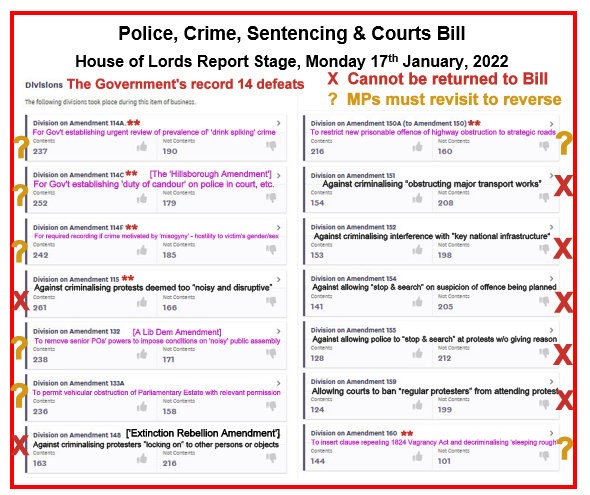
This Government, even in its legislative behaviour, is greedy, disorganised and unscrupulous, and on that Monday 17th it was all on display – the problem being that, with the more complicated (House of Lords) action being summarily and potentially misleadingly reported, doing justice to the historic legislative events seemed a bit too much for a single blog.  What’s more, I didn’t come across a single stealable visual aid.

So, I took a decision: two separate but linked blogs. The second – because it makes better chronological sense – will cover the hugely controversial Elections Bill, that seeks to ‘Reset’ some of those core democratic beliefs and principles referred to above: among other things, introducing mandatory voter ID at polling stations, undermining the independence of the Electoral Commission, and changing the electoral system for Mayors and Police & Crime Commissioners.

Its intentions to restrict voting are blatantly partisan; it has been rammed through Parliament, added to and amended, minimising legislative scrutiny; and on that Monday evening it received its Third Commons Reading on more or less straightforward partisan lines (https://www.bbc.co.uk/news/uk-politics-60037651), and thereby progresses to the Lords.

Both Jason Lowther and I have blogged previously about aspects of the Bill, and Part 2 of ‘The Great Parliamentary Resistance’ will shortly update them.

For the remainder of this Part 1, though, it’s across to the Lords and their truly historic Monday evening, when they savaged the Government’s ‘flagship’ Police, Crime, Sentencing and Courts Bill – and not once or twice but an apparently Parliamentary record 14 times! 

Even the Bill’s title suggests a huge legislative gallimaufry, and it is – a classic Priti Patel production, taking the whole of the second part of last year to progress through the Lords to last Monday’s Report stage. That time lapse proving, pleasingly piquantly, the key to some of the Government’s difficulties.

For Patel evidently thought it would be a clever wheeze to use the Lords’ extended deliberations as an opportunity to add all sorts of additional clauses to the Bill, covering some of the myriad things that had enraged her since March – like Insulate Britain’s M25 traffic obstructions last September and Extinction Rebellion protests around November’s UN Cop26 climate summit.

All of which meant that there were three distinct types of Government defeats – sorry, votes – taking place at this Lords Report Stage.  First, the ‘normal procedural’ ones, on parts of the Bill as received from the Commons last July, that the opposition parties in the Lords would like to see reconsidered by MPs and ideally amended or removed. This will kick off the process so whimsically known as ‘parliamentary ping pong’ between the two Houses.

Patel’s ‘late additions’, though, are another matter entirely: criminalising protests deemed too noisy and disruptive … and protesters ‘locking on’, either to each other or immovable objects … and interference with key national infrastructure … and obstructing major transport works … and allowing police to stop and search without giving reasons … and allowing courts to ban regular protesters from even attending protests …   The Lords defeated all of these and MPs can’t reinstate them, as they never voted them into the Bill in the first place, so they’re removed altogether – or at least until Patel repackages them into another Bill for the new parliamentary year starting in April.

Then there are the Lords’ own ‘late additions’ – reviewing the prevalence of ‘drink-spiking’ crime … and crime motivated by ‘misogyny’ … and removing police powers to determine what constitutes a ‘noisy’ assembly … and belatedly repealing the 1824 Vagrancy Act, thereby establishing that begging or sleeping rough should no longer, in this post-Napoleonic/Waterloo era, constitute criminal offences.

None of these were in the Bill when it left the Commons, but they are now – and if MPs don’t like them, they’ll have to vote them down.

What concerned me about the initial reports I read of the Great Lords Monday Night Rebellion was that most seemed, albeit understandably, excited by the record 14 Government defeats, to the point of failing to note the really rather significant differences in the categories and potential significance of the defeats – even some of those with a stake in some of that detail, like Police Professional or Green World.  

So, having recently received my copy of the Inlogov Associates Handbook and being slightly apprehensive that the Director might try to inveigle me into some actual lecturing, I thought I’d prepare the first new overhead I’ve attempted for, well, a few years now – summarising at least my understanding of the current state of play. Hope it helps!


Photo

Chris Game is an INLOGOV Associate, and Visiting Professor at Kwansei Gakuin University, Osaka, Japan.  He is joint-author (with Professor David Wilson) of the successive editions of Local Government in the United Kingdom, and a regular columnist for The Birmingham Post.

NHS is a precious resource but this resource is finite

Cllr Ketan Sheth

As another week passes, Covid-19 infections in London have continued to fall. This is extremely encouraging news. After almost two years, I’m sure everyone is keen to start moving forward with their lives and moving back as close as we can to the life we knew before the pandemic.

But while the case numbers are moving in the right direction, it was actually some other figures published by the NHS in recent days that I would like to focus on in this blog. In December alone, England’s ambulance services answered more than 925,000 calls to 999. That’s 20% more than December 2020 and means a call came in every three seconds. These are truly incredible numbers, and represents the unwavering commitment and hard work of our emergency services.

London Ambulance Service has told me that as bad as the pressure was for them when Covid first appeared in 2020, 2021 was even more challenging. This might come as a surprise to many people. But as the capital began to open up and all remaining restrictions were removed last July, our health services saw a level of demand never seen before during summer months.

In fact, 2021 was London Ambulance Service’s busiest ever year, receiving a record two million 999 calls. That is simply astounding, and I would like to say a huge and heartfelt thank you to all of the staff and volunteers at London Ambulance Service.

The NHS is a precious resource. But this resource is finite, so we must use it wisely so the sickest and most seriously injured people get care quickly in their hour of need. We can all do our bit to help. It’s important people only call 999 in a life-threatening emergency. Otherwise, we should take a moment and just think about the many alternatives which are more appropriate. For example, please do visit NHS111 online or call 111 if you need urgent medical advice and are not sure what to do. Our GP surgeries and pharmacies are also open and able to help. Urgent treatment centres are there for those needing attention for something which is serious but not life-threatening. Finally, at this time of New Year’s resolutions, I’m sure we could all do more to look after ourselves from eating healthily to getting more exercise. Prevention, as they say, is better than a cure.

The past 22 months have undoubtedly been exhausting and stressful for all of us, but for those caring for the health of 9 million Londoners, perhaps even more so. We owe all those on the front line tremendous thanks for all they have done and continue to do as we emerge from the shadow of the pandemic and another extremely busy winter. But actions speak louder than words. Doing your bit in one of these ways is perhaps the best way to show thanks to the dedicated staff and volunteers working for our NHS.

Cllr Ketan Sheth is Chair of the NW London Joint Health Scrutiny Committee

Notwestminster: Writing the future of local democracy

Dave McKenna

Next month, Notwestminster takes place again after a year off.  

It’s an event that we love here at INLOGOV and have been delighted to support
previous events as well as go along and share some of our work such as the 21st
Century Councillor research

If you haven’t heard of it before, it’s perhaps best described as a mini
festival of all things local democracy – an informal mix of workshops and
speakers that takes place in Huddersfield. This year it’s taking place in
the hallowed halls of Huddersfield University on Saturday 26th February.

What makes it really rock is the mix of people – volunteers, citizens, council
officers, councillors and yes, even academics, all mix together to discuss a
shared (and sometimes nerdy) appreciation of all things local democracy.

Here’s a section of the workshops to give a flavour:

• Pirates, Citizens and the future of local government

• Zines for democracy

• Creating 100 ideas for the North

• Dramatic Communication Strategies

• How can measuring political literacy help to improve local democracy?

• Fair and equal voting rights for young people across the UK

So, if you’re up for the challenge of renewing our democracy, please join in
for a day of workshops, quick-fire talks, conversations and inspiration in
Huddersfield. Notwestminster is a free event and everyone is welcome to
take part.

You can find out more and sign up here:

https://notinwestminster.wordpress.com/notwestminster-2022/

Hope to see you there.


Dave McKenna is a Research Fellow in INLOGOV.

Policy problems are complex. So what?

Koen Bartels, Selen Ercan and John Boswell

Image: Robert Couse-Baker

There is no denying that we live in complex times, featuring a global pandemic, climate change, and structural inequality. Complex problems are often incredibly difficult to address. Policy makers, practitioners and scholars have known this for a long time. In 1973, Horst Rittel and Melvin Webber introduced the term ‘wicked problems’ to describe problems that were so complicated and ambiguous that those involved could not even agree on what the problem exactly was, and how a good solution would look like. Twenty years later, Jan Kooiman argued that the governance systems in place to address these complex problems are equally complex.

Yes, policy problems are complex. So what?

We are not asking this question out of apathy. Instead, we want to find out what it actually means to call policy problems ‘complex’. What difference does it make to those involved to call a problem complex? How do they make sense of complexity and deal with it? In what ways can we understand and study complexity? And is it possible to somehow solve complex problems? These were the kind of questions we addressed during this year’s section ‘Navigating Complexity in Policy and Politics: Prospects and Challenges’, which we co-convened at the annual ECPR conference 2021.

Panels explored complex problems in different policy areas and contexts including ecological sustainability, criminal justice and urban transformations. We have learnt, for example, how Roma migrant women navigate and reorganise their everyday lives when their husbands ‘disappear’ to jail, leaving them in a tremendous state of uncertainty posed by highly discriminatory criminal justice system. Another panel speaker revealed the practical consequences of the complex child protection system in Chile: this system led to tragic policy failures that destroyed or even ended children’s lives. Several presentations explained how governance systems ‘locked in’ the status quo continued to frustrate policies and efforts to promote sustainability.

This year’s section also featured a roundtable on Nicole Curato’s recent book Democracy in Times of Misery. We had the opportunity to ask Curato questions about her ethnographic work in the Philippines, and the ways she uses normative political theory to make sense of the emerging democratic practices in the aftermath of natural disasters. As we heard from Curato and other contributors of the roundtable, one key challenge for democracy we identified is to listen to the ‘unspeakable tragedies’ taking place in the world and celebrate the ‘humble victories’ through which citizens reclaim public space.

What emerges as an important avenue for better understanding complexity both from the panel discussions and the roundtable on Curato’s book is the need to focus more on the everyday lives of ordinary citizens. Shifting the focus from the trade-offs policy makers face when dealing with complex policy problems to the ways citizens experience complexity can offer novel ways of comprehending and addressing complexity. One of the panel speakers explored how citizens make sense of austerity and the ways this influences their political views. Another panel speaker explained how a focus on people’s experiences of the area in which they live can help understand how to best give shape to economic development policies, such as the UK government’s Levelling Up agenda.

Similarly, a focus on the everyday practices of policy makers can cast new light on how they deal with complexity. One panel speaker for instance explained why they publicly remain proponents of collaboration to deal with ‘wicked problems’, despite their privately held ‘wicked thoughts’ about the frustrations and limitations they experience in practice. If you must know, they do it to get access to other actors, build alliances, infiltrate networks, or channel conflict. So, by acknowledging the complexity of policy problems, policy makers can justify inaction or reinforce the status quo.

Methodological innovations, such as ‘Trajectory-Based Qualitative Comparative Analysis’, can help to trace the complexity of urban transformations. While action research can help to foster joint learning about how to work with, rather than control or resolve complexity. One participant wrote in her paper: “We are drowning in the ocean of theories and case studies of water governance, but why does it not match up with the successful implementation of those goals?” There is an important role here for policy analysts to foster learning and change in collaboration with stakeholders. In fact, many presentations demonstrated significant (untapped) potential for helping to harness the complex problems they identified.

We might even say that, like the weather, many participants were talking about complexity but not doing anything with it. Nearly everyone evoked the notion ‘wicked problems’ to frame their research, but relatively few actually used looked at the world in terms of complexity. Complexity theory is one of the major innovations of the past decades in the Social Sciences and has also gotten a foothold in the field of Public Policy. It views the world in terms of complexity that cannot be controlled or known objectively. Like the flight patterns of a flock of birds, the world is unpredictable and emergent. We need to accept this and make sense of the ‘complex adaptive systems’ that take shape (and are constantly changing) in interaction between webs of interdependent actors. This, again, asks for stakeholders to engage in ongoing learning and adaptation as they collaboratively confront the complex problems they face in everyday practice.

Koen Bartels is Associate Professor at INLOGOV and Co-Convener of the ECPR Standing Group Theoretical Perspectives in Policy Analysis

Selen Ercan is Associate Professor at the Institute for Governance and Policy Analysis at the University of Canberra, and Co-Convener of the ECPR Standing Group Theoretical Perspectives in Policy Analysis

John Boswell is Associate Professor at the Centre for Citizenship, Globalisation and Governance, University of Southampton and Co-Convener of the ECPR Standing Group Theoretical Perspectives in Policy Analysis