Local Government in the Czech Republic During Two Recent Crises

Dr Paul Joyce

A recent book on local government in Czechia offers valuable lessons for anyone involved in local governance, emergency planning, or public sector reform. The book, edited by Balík and Špaček, explores how local government responded to two major crises: the COVID-19 pandemic and the influx of refugees following the Russian invasion of Ukraine.

The editors describe Czechia’s  local government as “fragmented”. By this, they do not mean fragmented in terms of lack of coordination. Instead, they use the term in a structural and territorial sense: the country has a very large number of small municipalities. In fact, there are over 6,000 municipalities in Czechia, and the median size is fewer than 500 residents.

At first glance, this sounds like a recipe for weakness. However, the book tells a very different story. During both crises, support and coordination from the national government was widely experienced as slow, inconsistent and, at times, chaotic. By contrast, local mayors often stepped forward quietly and decisively to support their communities. As Balík and Špaček put it:

“Mayors of small municipalities rarely speak of crisis management in systemic terms; instead, they focus on immediate, practical solutions to specific problems… Small local governments tackled emergencies as they came with the capacities they had… The ability of small municipalities to adapt quickly and provide personalised assistance was critical in the early stages of both crises…” (2026, p.177)

In many places, local government was really the only consistent source of stability. One of the key strengths highlighted in the book is social capital – the trust, relationships, and local knowledge embedded in communities. This proved crucial, particularly during the refugee crisis:

“The strength of small municipalities was in the individual commitment, personal ties, and local knowledge—knowing who to turn to in case of problems and how to solve specific issues” (Balík and Špaček, 2026, p.176).

Even in very small towns and villages in Czechia, local government is present and visible. Mayors and councillors are highly trusted, far more than national politicians, and citizens see them as accessible, familiar, and reliable. In crisis conditions, this trust enabled rapid mobilisation of volunteers, associations, fire brigades, community groups and informal support networks.

Interestingly, the book also notes that although inter-municipal cooperation is voluntary and not financially incentivised by national government, over 80% of Czech municipalities are involved in some form of collaboration. During the crises, some mayors consulted colleagues in neighbouring areas, shared information, and worked through voluntary municipal networks.

However, and this is an important point, the book does not show that there was a large, coordinated, systematic collaborative governance response at national scale. There is no hard data indicating how widespread or effective inter-municipal cooperation was during the crises. What the authors do state is that cooperation was informal, uneven, and dependent on existing relationships and trust.

In fact, they emphasise that local responses were often “highly individualised”. In other words, municipalities generally acted on their own initiative, using their own judgement, knowledge and resources to solve immediate problems. Horizontal networks sometimes supported this, but they did not replace largely autonomous decision-making.

What stands out most during the crises is vertical incoherence: poor communication, unclear leadership, and constant change in guidance from central government. Mayors described regulations changing “three times a day”, written in legal language that nobody understood, and official information arriving after the media had already reported it. In the early stages of both COVID-19 and the refugee crisis, national guidance was often described as vague, delayed or non-existent.

As a result, mayors relied heavily on their own judgement and “common sense”. Why? Because they had to respond to reality as it unfolded in front of them. This leads to an important conclusion: Czechia was not “saved by collaborative governance” in a formal, system-wide sense. Instead, it was held together by local leadership, strong relationships, deep community knowledge, and trust.

Implications for UK local government

For those working in or with UK local government, the Czech experience raises important questions.

For years, public sector reform has often focused on scale, efficiency, and consolidation. We tend to assume that bigger organisations are stronger, more capable, and more resilient. The Czech case challenges this assumption. It suggests that in times of crisis, small, trusted, locally embedded structures can be incredibly powerful.

This does not mean the UK should “fragment” its local government system. But it does suggest that structural reforms aimed purely at efficiency can come at a hidden cost: the loss of proximity, trust, responsiveness, and local knowledge that make rapid, context-sensitive action possible.

The Czech experience also highlights the risks of poor vertical coordination. When national guidance is unclear or incoherent, the pressure falls heavily on local government. In those moments, what really matters is not the size of the organisation, but:

•           The quality of relationships

•           The level of trust

•           The strength of civic networks

•           The confidence of local leaders

•           The use of local knowledge

For the UK, the message may be this: alongside reform for efficiency and scale, we need to invest in robust governance, that is, in communication, trust, community capacity, and strong vertical relationships between central and local government.

Reference: Balík, S. and Špaček, D. (eds.) (2026) Fragmented Local Government Systems and Crises: Experiences from Czechia. Governance and Public Management Series. Cham: Palgrave Macmillan / Springer Nature Switzerland AG. https://doi.org/10.1007/978-3-032-01897-7

Paul Joyce is an Associate at INLOGOV, University of Birmingham, a Visiting Professor in Public Management at Leeds Beckett University, and Publications Director of the International Institute of Administrative Sciences (IIAS) which is headquartered in Brussels, Belgium. He has a PhD from London School of Economics and Political Science
A Very Local Authority

Garath Symonds

When I was asked by the Chief Executive to take over a failing project to create a
contact centre for vulnerable residents, I said yes without hesitation. It felt like an
opportunity to be of service to residents, but beneath the surface I may have acted in
service of something closer to home, my own need to succeed in the eyes of
authority figures.


In local government, authority often hides anxiety. When fear rises, the system looks
for a heroic leader, someone who can carry its tension. The more I looked confident,
the more authority I was lent, and the more anxiety I absorbed. It was an
unconscious exchange. The organisation offloaded its unease, and I absorbed it. It
was as if I had been unconsciously elected by the group to hold the system’s
anxiety.


Over time, the project began to take on a life of its own. Meetings were charged with
feeling but framed as technical debate. The numbers, the charts, the plans, all
attempts to manage the anxiety that no one wanted to name or think about. We were
defending ourselves against the fear of not knowing with Gantt charts and risk
registers. Bureaucracy had become a collective defence against thought. And so had
action, the more stuff we got done the better we felt, whether we were doing the right
stuff didn’t matter. Anxiety was running the show, but it wasn’t possible to say so.


When the contact centre finally launched, the context shifted again. It was delivered
on time and within budget, yet there was no sense of relief. We had achieved the
task but not addressed the underlying social problem, and therefore the anxiety in
the system persisted. When a new CE and corporate team arrived, the story
changed again. What had been previously praised became problematic. The project
was now the cause of the organisation’s distress, a helpful target for blame, blocking
any real strategic thinking about what might be needed.


That experience taught me that authority is never just structural it is emotional and
symbolic. It moves between people and roles, attaching itself to those who can carry
what others cannot. When we lead, we enter this unconscious network of
projections, hopes and expectations. The question is not whether this happens, but
whether we notice it.


Local government lives with a chronic tension between its wish for certainty and the
reality of uncertainty, much of its life is shaped by unspoken feeling. Inspections,
budget cuts, audits, change and political pressures all produce emotional
reverberations that are felt long before they are understood. Without reflection
systems repeat their defensive strategies without understanding them.


Developing this very local authority starts with self-leadership, the inner work of
noticing what is being projected into us, what emotions we are carrying on behalf of
the wider system. It asks for a disciplined curiosity about anxiety: what it signals,
where it belongs, and how it can be thought about rather than acted out. It is less
about providing answers and more about creating a space in which meaning can
emerge.


This kind of authority is quietly radical. It might involve naming the unspoken mood in
a meeting, holding silence when others rush to fill it, or acknowledging a tension
rather than smoothing it away. Containment is not about comfort; it is about
thoughtfulness under pressure. It is the ability to stay connected when people and
systems fragment.


The lesson I took from this experience was that leadership is always personal. The
system’s anxiety finds its way into us, connecting with our personal relationship to
authority formed in childhood. How we hold it determines whether it becomes
creative or corrosive force on our leadership. We are not separate from the
organisations we lead; we are expressions of them. Authority, in this sense, is not
only delegated but matured, a relationship between our inner world and outer role.
In this sense authority, is the internal capacity to remain reflective in the face of
collective anxiety. It is the ability to recognise projection without retaliating, to
distinguish what belongs to the self and what belongs to the system, and crucially for
leaders to help others recover their capacity to think.


As local government faces what Sarah Longlands, Chief Executive of the Centre for
Local Economic Strategies, recently described in The MJ as “change rippling through
local government … from structural reform and new combined authorities to health
integration and the push for financial sustainability,” this capacity has never been
more needed. These transitions demand not only new governance models but
leaders who can bear the anxiety of change without collapsing into a desperate need
for certainty. The future may depend less on structural reform and more on this
reflective discipline, the capacity for thought that keeps authority truly local.

Garath Symonds was a senior leader in local government for 20 years and is now
a practice tutor at INLOGOV, an executive coach, organisational consultant and author
of ‘The Anxious Leader: How to Lead in an Uncertain World’. His work helps leaders
make sense of anxiety as data for reflection, containment, and transformation.
http://www.spacetoreconnect.com

Crisis management in cities: how politicians and public servants worked together during the Ukrainian refugee reception

Dr. Nicolai De Wulf, Prof. Dr. Joris Voets

When Russia invaded Ukraine in February 2022, millions of people fled their homes seeking safety across Europe. In Belgium, cities such as Antwerp, Ghent, and Mechelen were suddenly faced with the urgent task of housing and supporting thousands of Ukrainian refugees. Local leaders had to act fast, building emergency villages almost overnight. But how do politics and administration work together when everything is urgent?

In my recent article in Local Government Studies (co-authored with Joris Voets), we examined how local governments managed this unprecedented crisis and how politicians and civil servants collaborated under pressure. Our study provides new insights into how city administrations function when crises disrupt “business as usual”.

The local dimension of crisis management

Local governments are the first to respond when crises hit. They are close to citizens, know their communities, and must act fast. But crises like the arrival of Ukrainian refugees test even the most prepared administrations. They demand not only logistical problem-solving, like building emergency housing, but also leadership, trust, and coordination across political and administrative levels.

The study draws on 25 interviews with mayors, aldermen, and senior civil servants in Antwerp, Ghent, and Mechelen. These cities hosted the highest numbers of Ukrainian refugees in Flanders and each built an “emergency village” to provide collective housing.

Politics and administration: not separate worlds

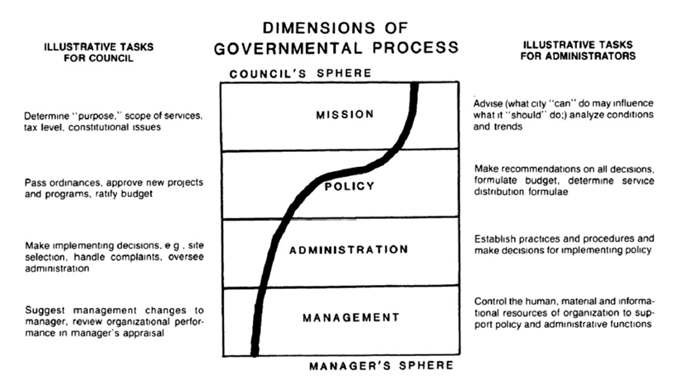
Traditionally, politics and administration are seen as separate spheres: politicians make decisions, and civil servants carry them out. However, decades of research, including the complementarity model developed by Svara, show that successful governance depends on cooperation between the two. The shared responsibility is aptly visualised:

The study addresses the following research question: ‘How complementary are the interactions between politics and administration in cities during the management of the Ukrainian refugee crisis?’

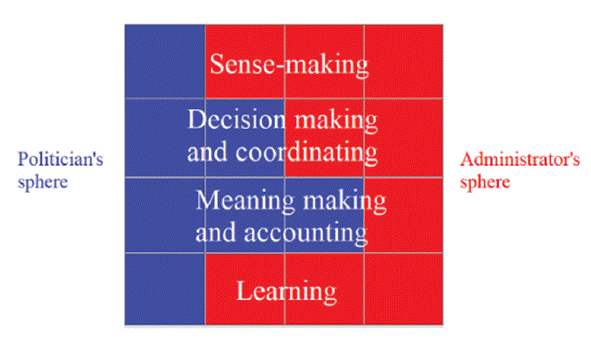
Our study shows that this politico-administrative complementarity is clearly observed during the Ukrainian refugee crisis. Crises blur boundaries: decisions must be made quickly, communication is intense, and trust becomes vital. We replaced the 4 building blocks of ‘regular’ policy making (missions, policy, administration, and management) by 4 crisis management tasks (sense-making, decisions making and coordinating, meaning making and accounting, and learning). We visualised the politico-administrative role division, as for example for the case in Antwerp:

Overall, the tasks of sense-making and learning are predominantly performed by the administration. It has to be noted that the ‘lessons learned’ primarily relate to adaptations along the way, rather than formal evaluations. The decision and coordination task shows a very mixed image: in each of the 3 cases under study, the responsibility of the decision lies, of course, with the politicians. However, the deliberation preceding the decision always showed a shared effort. The meaning-making and account-giving task is predominantly taken on by the politicians involved, most notably the mayors.

Three cities, three approaches

Antwerp had a clearly structured crisis response, with distinct political and administrative levels. The Emergency Planning Coordinator (EPC) played a key role as liaison between the mayor’s team and the city administration.

Ghent adopted a more collaborative approach, with large crisis meetings that included both the College of Mayor and Aldermen and the Management Team. This inclusivity built broad consensus but also slowed decision-making.

In Mechelen, the acting mayor and Emergency Planning Coordinator shared leadership, while the city’s political “DNA” of human rights and diversity shaped its narrative and public communication.

In all cases, civil servants were observed operating in a political world. Primarily the Emergency Planning Coordinators, but also civil servants such as project managers, can play a very determining role in the structuring of the crisis management approach, decision-making, and coordination.

Lessons for local crisis management

Complementarity works: Trust and mutual respect between political and administrative leaders were crucial. In all three cities, politicians and administrators worked as a team, but with notable differences in style. City identity shapes response, each city’s political culture influenced how it managed the crisis.

The study highlights that crises are not only technical challenges but governance challenges. They reveal the real dynamics of how cities work.

For practitioners, the message is clear: invest in relationships between political and administrative leaders before the next crisis hits. For scholars, this case offers evidence that Svara’s complementarity model holds up even under crisis conditions, but needs adaptation to capture the intensity and speed of crisis decision-making.

As crises become more frequent, cities need to build governance systems based on trust, expertise, and teamwork. Complementarity between politics and administration is not a luxury, it is what keeps local government resilient when it matters most.

Dr. Nicolai De Wulf (ORCID 0000-0002-1748-6604) finalised his PhD focusing on politico-administrative relations within local government. In the PhD three topics are studied through a politico-administrative lens: policy integration and coordination, partisan political staff, and crisis management. The PhD was supervised by prof. dr. Joris Voets.

Prof. Dr. Joris Voets (ORCID 0000-0002-8266-8607) is an associate professor in the Department of Public Governance and Management at Ghent University, Belgium. His main research interests are inter-organisational networks and local government.

Intervention 3.0: Designing a Responsive Model for Local Government Support in England

Jason Lowther / Paul Joyce / Philip Whiteman

The arrival of the new UK government looks set to result in a new policy on central government’s intervention powers in local authorities, the third generation of such policies this century.  This article suggests some key lessons from earlier models. 

Intervention 1.0 was facilitated by Best Value legislation that an “authority must make arrangements to secure continuous improvement in the way in which its functions are exercised, having regard to a combination of economy, efficiency and effectiveness” (Local Government Act 1999).  This remains the basis of statutory interventions today.  But the context could not be more different. 

The Blair government commissioned an extensive set of national performance indicators, developed independently by the Audit Commission with a common definition and quality assured through local audits.  The “District Auditor” role maintained in depth contextualised knowledge of each local council, and could identify and flag significant governance or performance issues at an early stage.  As well as diagnosing problems, the Audit Commission’s national studies provided evidence-based recommendations to help improve local services’ economy, efficiency and effectiveness.

The strengths of this model were the comprehensive nature of the evaluation, its collective and mutually supportive use of expert agencies to provide an evidence base, and the sanctions that went with it including transparent public reporting.  Inlogov produced a series of reports diagnosing and explaining the causes of poor performance, analysing recovery planning and strategies for organisational recovery, evaluating various policy instruments for recovery (such as lead officials) and identifying the key developmental mechanisms for recovery. 

Our reports clearly demonstrated that the context for poor performance determines effective mechanisms for recovery: one size definitely does not fit all.  The causes of failure are varied, such as ineffective leadership arrangements and inadequacies in the operating culture. 

Improvement mechanisms need to address issues of cognition, capability and capacity.  Cognition is the council’s awareness and understanding of their performance trajectory, which is often resilient to changes in political control.  Capability concerns the construction and institutionalisation of a change-oriented vision by council leaders.  Finally, capacity is the ability to deliver the required vision and change. The required change mechanisms are both internal (such as leadership change) and external (for example, peer mentors, expert advisors, and funding). 

Intervention 2.0

The arrival of the Coalition government in 2010 brought rapid changes to intervention.  The Audit Commission was summarily discarded, publicly justified by claimed savings of £50m.  In reality, recent research by the Audit Reform Lab at the University of Sheffield suggests that English audits have higher costs and greater delays than in Wales or Scotland (where centralised oversight arrangements were maintained). 

From 2010 to 2020, central government intervention was relatively rare with formal interventions in only four councils.  However, from 2021 this situation changed substantially with interventions in eight councils in three years (none of these councils were controlled by the ruling national party).  In the same three years, there were statutory best value notices in a further nine councils.

It’s fair to describe this phase of intervention as less structured and evidence-based, without robust national data or independent routine inspection of councils.    

There has been limited evaluation of Intervention 2.0 to date.  Our early research findings based on three case studies suggest a five-stage model of intervention: (i) crisis revelation, (ii) delegitimisation, (iii) imposed reforms, (iv) capacity building, (v) restoration or reorganisation.  We conclude that under localism interventions were not merely administrative responses to failure but were deeply political acts that reshaped the legitimacy and capacity of local governance. The Commissioners, acting as technocratic agents of central government, connected central and local government, and had the effect of buffering the political tensions of intervention, while leading a process in which managerial competence rather than local democracy steered intervention.

Where next for intervention?

The raft of interventions related to section 114 notices, the establishment of the new Local Government Outcomes Framework and local audit reform including the Local Audit Office indicate a new phase of intervention and open opportunities to develop a more systematic and evidence-based approach.  More thought is needed on how this should work in future, including the role of peer reviews and inter-council support arrangements.  The centralisation of intervention power and the dominance of technocratic intervention needs to evolve to suit devolution and to provide greater support for local democracy. This could build on the new audit arrangements through a “district auditor” type overview of governance.

The acid test of reforms should be that while central government would still be able to intervene when councils were failing, the intervention process would minimise the suspension of local democracy, do as little damage as possible to the public’s trust in their local council, and foster good local democratic political leadership.

This article first appeared in the Municipal Journal on 16 October 2025 titled “How not to damage democracy”. It is available here: https://www.themj.co.uk/damage-democracy

Dr Jason Lowther is director of INLOGOV (the Institute of Local Government Studies) at the University of Birmingham.  Prof Paul Joyce is an Associate at INLOGOV.  Dr Philip Whiteman is a lecturer on public policy and administration at INLOGOV.