The role of the Ombudsman within the Japanese Local Government System: The Example of Kawasaki City

Professor Shunsuke Kimura

The ombudsman is an institution that serves as a voice for Parliament and the public, conducting administrative reviews through hearings and investigations of complaints and inquiries. Rooted in human rights protection, the ombudsman system monitors administrative agencies by directly addressing citizens’ claims.

This paper analyses the functions of the Japanese ombudsman system within the public policy framework, particularly considering Japan’s cultural characteristics. Despite its adoption by some local governments since 1990, the ombudsman institution has not gained widespread prominence across Japan. This raises questions regarding its effectiveness within the administrative dispute system and the reasons for its limited adoption. Research indicates that there are structural issues within Japan’s local administrative system that may hinder the mediation process.

The study employs original statistics sourced from interviews with ombudsmen from Kawasaki City, which was the first municipality to establish an ombudsman in 1990. The paper also highlights the presence of approximately 5,000 administrative advisors across Japan, which contrasts with the relatively small number of municipalities that have adopted the ombudsman system.

Municipal ombudsmen have contributed to addressing administrative grievances and improving local governance through reforms. The Japanese administrative dispute system comprises three subsystems: the administrative case litigation system, the administrative appeal system, and the grievance system, with the ombudsman system falling under the latter. (See Table1)

The ombudsman primarily addresses inadequate administrative actions, aiming to enhance administrative justice. Japan’s local government system consists of ordinary and special local governments, with prefectures and municipalities being the primary units.

The paper emphasizes that, unlike many countries, Japan does not have a national ombudsman system, only local government systems, which contributes to the unique characteristics of its public ombudsman framework. This framework includes legislative and executive types of ombudsmen, with the latter being more prominent in local governance.

This paper discusses the varying implementation of ombudsmen across municipalities, pointing out that their presence is particularly notable in designated cities. However, the diffusion of ombudsmen remains limited, with only 71 municipalities adopting the system.(See Table2)

This limitation can be attributed to cultural factors that prioritize group cohesion over individual expression, as well as historical beliefs regarding government infallibility.

The role of the ombudsman in Japan is further complicated by the lack of national oversight and the challenges in securing competent personnel. Additionally, existing administrative bodies with similar functions pose competition for the establishment of ombudsmen.

The study concludes that while the ombudsman system has not spread significantly, it plays a crucial role in addressing administrative issues and enhancing citizen participation. The future of the ombudsman system in Japan hinges on recognizing its value in promoting administrative justice and ensuring the protection of citizens’ rights. In summary, the Japanese ombudsman system, despite its limitations, has the potential to evolve as a vital mechanism for administrative accountability and citizen engagement, particularly in an era marked by increasing complexity in governance and citizen demands.

Professor Shunsuke Kimura, PhD, is Professor and Dean of Graduate School of Global Governance, Meiji University, Tokyo, Japan. PhD(law) at Hitotsubashi Univ. After retiring from Ministry of Internal-Affairs, he has been working as a professor. He has been a Visiting Scholar at Lille Univ. in 2023 and at the University of Birmingham (INLOGOV) in 2025.


Cyclopean ‘local’ government and the end of local democracy?

Chris Game

As with another quite recent blog of mine, it’s important to start with the alert that most of its style, structure and content stem directly from its having been written in the first instance not for an academic readership, but as a column for probably this week’s Birmingham Post. There are a few additions and subtractions, plus, barring a dramatically uncharacteristic Lowtherian intervention, one guaranteeable difference: the title.

At the time of writing this intro I don’t know for certain what the Post editor’s choice of words and punctuation will be – except that it won’t comprise nine words, including three longish ones. Space and layout, you understand. It will, however – because regular authors do have at least some bargaining ‘say’ – open with that key word that many/most Post readers will barely recognise.

To summarise the whole thing: here in Britain we already have, and in England, following last December’s devolution White Paper, are about to develop still further, a scale of ‘local’ government that makes a complete mockery of the term ‘local’; and the present Government, with no noticeable public consultation, is embarked on increasing that non-local size still further – to truly Cyclopean dimensions.

And, as I sought to explain to the Post editor, by introducing this concept, rarely if ever used in modern political debate, both the Post and I will become – well, you never know – possibly a little bit famous. Here’s the reasoning.

First, ‘Cyclopean’, used in the context of local government.  Ancient Greek, pretty obviously, it originally described an architectural style in which the walls, towers and other fortifications of ancient cities like Mycenae (a 70-odd mile day trip SW of Athens) were constructed from massive limestone boulders – of the scale shown in the accompanying illustration – fitted extremely closely together without apparently having been substantially reshaped and without use of mortar or cement. 

So preternaturally impressive were these city constructions – the hilltop Mycenae was perhaps the most famous, but there were numerous others – that the myth developed that they must have been built by the Cyclopes, a race of superhuman giants in Greek mythology, and the only humans physically capable of creating such constructions. Hence ‘Cyclopean’ – to describe the assumed method and scale of a city’s governmental architecture, not the size of its residential population.

Somehow, though, towards the latter end of the 3,500 intervening years, the UK has developed, to an almost unique degree, its own interpretation of ‘Cyclopean local government’. Yes, there are loads of large buildings – Birmingham’s Council House and Central Library for starters, the Octagon, etc. – but there’s no Cyclopean mystery about what holds them together. Put crudely, it’s the concrete and steel, not some mystical manpower.

The UK’s, and particularly England’s, modern-day local government and its latest structural ‘reform’ have become almost entirely about scale. Instead of referring to the governance of, or provision of services for, a particular local community and its unique character, England’s ‘Cyclopean local government’ currently comprises just over 300 ‘local’ authorities, with populations averaging 180,000 – which is hardly our (or anyone’s) ‘everyday’ usage and understanding of that term ‘local’.

And yes, averaging. Which, of course, would make Birmingham’s 1.2 million population ‘super-Cyclopean’ – and the West Midlands Combined Authority’s 4 million ‘Mega-Cyclopean’. Or ‘hyper-Cyclopean’, which I personally slightly prefer, suggesting something beyond the bounds of reason, or control. We’ll return to that.

Some quick comparisons or contrasts: average size of German and Italian municipalities is around 7,500, Spain’s 5,700, and France, albeit as exceptional in its way as the UK, 1,900. Yes, slightly under one-hundredth the size of our average, and, by chance, roughly the same as our smallest, the Isles of Scilly, arguably our one ‘municipality’ that wouldn’t make a mockery of the term ‘autorité locale’.

The rest of the world, or first-time observers, find our scale figures as extraordinary as the Ancient Greeks found Mycenae. They are naturally curious as to how we do anything purporting to be genuinely ‘local’ government on such a manifestly non-local scale, and, above all, why.  Good questions, but not for a local newspaper column. Indeed, not for the likes of us mere citizens and voters either, because no one’s bothering to ask us.

The major redesign of England’s local government is currently in the hands of Angela Rayner – Deputy Prime Minister + (in any spare time) Secretary of State for Housing, Communities and Local Government.  An early action was to cancel – arguably “legally risky”, if not unconstitutionally (see Google– ‘Cancellation of 2025 English local elections’) – nine May 2025 county and unitary council elections, she/someone in the Government having decided that these bodies had had their day and there would be no room for them in her new, but still undefined, single-tier England.

Rightly describing the UK as the “most centralised” country in Europe (https://www.bbc.co.uk/news/articles/cn0xz4938z9o), Rayner’s apparent plan is to end central government’s micro-management by making ours, by a distance, the least localised – most Cyclopean – ‘local government’ certainly in Europe, if not the world (500,000 minimum), and, it would appear, without a great deal of consultation.

The ’plan’, in summary, represents the biggest and most transformative upheaval of English local government in my adult lifetime (sorry, you’ll have to work it out!), rushed/bullied through Parliament and local government itself with absolutely minimal consultation and consequential analysis. In short, modern-day Cyclopean local government.

Chris Game is an INLOGOV Associate, and Visiting Professor at Kwansei Gakuin University, Osaka, Japan.  He is joint-author (with Professor David Wilson) of the successive editions of Local Government in the United Kingdom, and a regular columnist for The Birmingham Post.

Picture credit: https://stock.adobe.com/uk/images/odysseus-und-seine-gefahrten-fluchten-vor-dem-zyklopen-polyphem/608942497

Unsuccessful Political Parties. Exploring and Combining Party Death and Party Failure

Julien van Ostaaijen and Sander Jennissen

‘I am fed up. It was interesting, fascinating, and frustrating. As a small faction it is difficult to be on top of everything and I noticed that I became less focused’. This is how one of many Dutch councillors explains why his party will stop having representatives after the election.

Participating in elections and having representatives elected is one of the main characteristics of political parties. However, political parties can be unsuccessful. They can stop having representatives elected. In the Netherlands, every four years, at least 15% of all Dutch local political parties lose all their representatives. What can happen to parties losing all representatives and what happened to the Dutch parties?

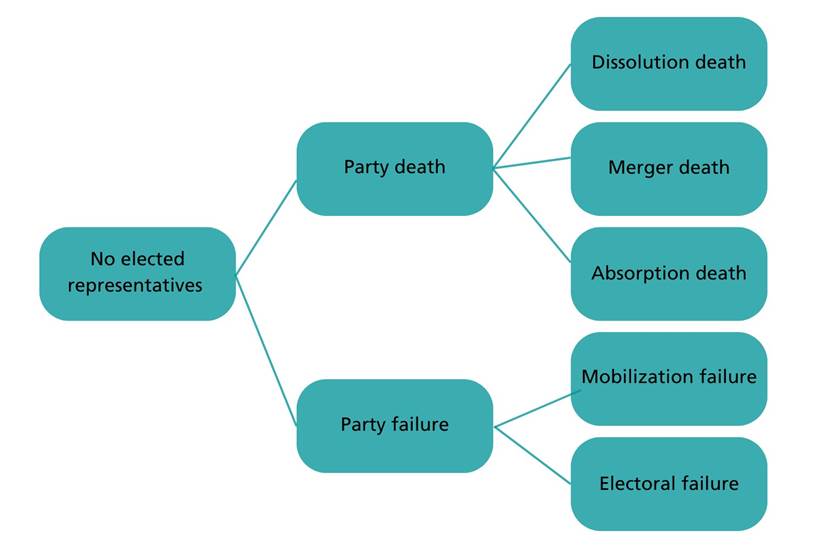
Figure 1: An oversight of unsuccessful parties: party death and party failure

In our article, we separate five possible reasons for political parties losing all representatives (Figure 1). In our framework, the first category is that of party death. In this category, the political party ceases to function as an independent, autonomous organisation. This category encompasses dissolution death (the party organisation no longer exists), merger death (the party has merged with another party), and absorption death (the party has been taken over by another party). The second category is that of party failure. In this category, the political party still functions as an independent, autonomous party organisation and is thus not ‘dead’. However, for other reasons, it no longer has elected representatives. This can be because of a mobilization failure (the party has ‘failed’ to present candidates for (re-)election and thus temporarily withdrawn from the election process) or electoral failure (the party participated in the election but failed to have any representatives elected).

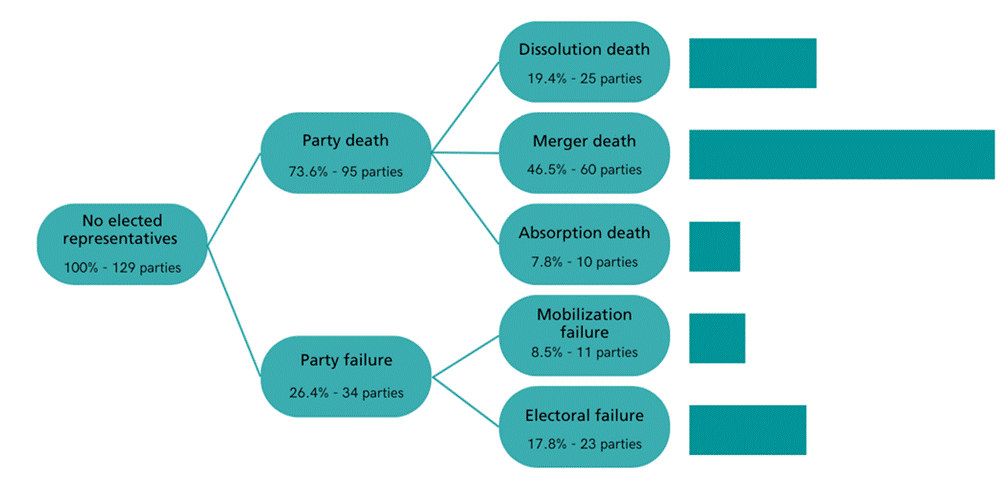
In the Netherlands, we found 129 local political parties that had representative elected in the local elections of 2014, but no longer in 2018 (and most also not in the elections of 2022). Using several data sources, including election results, party websites and media reports, we analysed what had happened to these parties (Figure 2).

Figure 2: Results for local parties with no elected representatives in 2018

Our data show that about three-quarters of all the parties that ceased to have elected representatives after the 2018 local elections had effectively ‘died’, meaning that they ceased to exist as an autonomous organisation. However, most of the parties placed in this category had merged with other parties and therefore continued as part of a new party organisation. This pattern is closely connected to a trend in Dutch local political practice: between 2014 and 2022 the number of Dutch municipalities decreased by about 15% and many local party mergers took place in municipalities that were amalgamating around the same time. The remaining quarter of local parties with no representatives experienced party failure, meaning that they either did not gain sufficient votes to elect a representative, or decided to temporarily not participate in elections. It is noteworthy that the vast majority of these parties can be considered effectively dissolved four years later, in 2022, supporting the view that party failures, consisting of electoral and mobilization failures, are a prelude to party death. Nevertheless, the posited causal relationship should be further investigated.

Regarding our theoretical framework, we would urge to keep separating party death from party failure. In the literature, there are many different definitions and overlaps between concepts. Party death refers to the end of the party organisation. Party failure relates to not participating in the elections or not winning enough votes to elect a representative.

Looking forward, we believe that our framework provides greater clarity for analysing the final stages of political parties at both local and national levels. The five subcategories encompass the different ways in which parties are unsuccessful, i.e. have no elected representatives from one election to the next. The model can identify the circumstances that explain why this is the case. In the Dutch case this was largely due to municipal mergers and therefore party mergers. Applying the model in different countries with different systems will most likely lead to different results. Applying the model to national politics will also be a further test of its relevance.

Find our full article here: https://research.tilburguniversity.edu/en/publications/reasons-political-parties-lose-their-representatives-combining-pa

Julien van Ostaaijen is a professor of Law & Safety at Avans University of Applied Sciences and an assistant professor in Public Administration at Tilburg University. His research interests include local institutions and parties, the relationship between society and politics, local safety, and good governance and countervailing power.

Rewiring Local Government for Citizen Engagement

Jason Lowther

The Institute of Local Government Studies (INLOGOV) has published a new report, Rewiring Local Government for Citizen Engagement, which sets out a compelling case for reimagining the relationship between local authorities and the communities they serve. At a time of structural reform, fiscal constraint and lower public trust, the report argues that citizen engagement must become fully embedded local governance, rather than a peripheral activity.

The report identifies three interrelated conditions that are essential for effective engagement. First, local authorities must convene inclusive democratic spaces that enable deliberation, dialogue and collective decision-making. These spaces, whether in the form of citizens’ assemblies, participatory budgeting or neighbourhood forums, can help to rebuild trust and foster more responsive policymaking.

Second, councils must invest in building community capacity. This involves supporting citizens, particularly those from groups whose views are often neglected, to participate meaningfully in public life. It also requires sustained investment in community infrastructure, such as local venues, networks and organisations, which provide the foundations for civic engagement.  The report recognises that 15 years of austerity since 2010 has significantly reduced the availability of community meeting places such as libraries, neighbourhood offices, youth and community centres, and cultural and leisure services.

Third, the report highlights the importance of co-producing public services. By involving service users in the design and delivery of services, councils can ensure that provision is more closely aligned with the lived experiences and priorities of local people. Co-production also fosters innovation and strengthens the legitimacy of public institutions.

The report draws on a wide body of academic research and practical experience, both in the UK and internationally. It shows that democratic innovations are already taking root in many councils, despite the challenges posed by austerity and institutional inertia. Examples include digital engagement platforms, youth-led initiatives, and the devolution of powers to neighbourhood and parish levels.

However, the report also acknowledges the barriers that councils need to address. Organisational cultures, limited resources, the need to develop new skills in officers and members, and legitimate concerns among elected members about the implications of participatory approaches can all inhibit progress. The report calls for leadership, reform and investment to embed engagement in the everyday practices of governance.

We pay particular attention on the vital role of councillors, who are well placed to act as facilitators and mediators between communities and institutions. Supporting councillors to develop these roles is essential if engagement is to be sustained and meaningful. The report also emphasises the need to engage young people and to make appropriate use of digital tools.

In conclusion, Rewiring Local Government for Citizen Engagement offers a clear and evidence-based framework for strengthening local democracy. It argues that by embedding citizen engagement in governance structures and practices, councils can foster trust, improve outcomes and build more inclusive and resilient communities.

We will be discussing our findings with councils, central government and related think tanks and sector organisations over coming months.

The full report is available here: