The abolition of NHS England 

Councillor Dr Ketan Sheth,

We all recognise that the current government inherited a deeply entrenched crisis in our NHS. Years of austerity, coupled with the immense strain of the Covid pandemic, have left our health service at breaking point. Across the country, patients are facing unacceptable delays — whether in A&E, for a GP appointment, or for much-needed elective procedures. The Health Secretary, Wes Streeting, has not shied away from the truth, acknowledging that the NHS is ‘broken’. But with this recognition comes a clear responsibility to act. The commitment to investment and reform was at the very heart of the Labour government’s manifesto, and it is now our duty to ensure these promises become reality.
The three fundamental shifts outlined by Wes — focusing on prevention rather than cure, strengthening community-based care over hospital reliance, and embracing digital innovation — are undeniably the right priorities. 

These are not new challenges; they are the very issues that those of us in local government and health services have been highlighting for years. With Tom Kibasi now leading the development of the NHS’s Ten-Year Plan, there is a real opportunity to turn ambition into action. But make no mistake — this will require more than just vision. It demands political will, cross-sector collaboration, and real investment to drive lasting change.

As a councillor with deep experience in health and social care, and as Chair of a London joint health scrutiny committee, I firmly believe that elected representatives — both national and local — must have clear oversight of how the NHS delivers for our residents. The NHS is funded by the taxpayer, and accountability for its spending —amounting to hundreds of billions —must be transparent. Striking the right balance between strategic oversight and operational efficiency is key. Reducing duplication and inefficiencies between national bodies is a sensible goal, but only if it genuinely results in better care, not just headline-grabbing restructuring.

Earlier this month, the government announced that, in order to focus resources on the frontline, NHS England would be abolished and funding to Integrated Care Boards (ICBs) would be cut by half. There is a logical argument for streamlining management functions where the Department of Health and NHS England overlap. Equally, we cannot ignore the vast NHS deficits that must be tackled if we are to clear the backlog left by the previous government. Cutting costs without compromising frontline care is an extraordinarily difficult balancing act, and success will hinge on empowering local decision-making rather than imposing one-size-fits-all solutions from Whitehall.

But now we must address both the handling and the substance of these decisions.

First, the handling. The people working in NHS England and ICBs are dedicated professionals, many of whom have spent their careers serving our health service. These are individuals with expertise, commitment, and families to support — not faceless bureaucrats. It is entirely possible to debate the structure of public services without resorting to derogatory language, labelling roles as ‘flabby’ or dismissing people as ‘blockers and checkers’. That is why it was reassuring to see Wes take to the airwaves to make a crucial clarification: the target is excessive bureaucracy, not the people who keep our NHS running.

On substance, the proposal to merge the functions of NHS England with the Department of Health is a bold and potentially transformative step — but only if executed properly. Addressing duplication in management is a legitimate goal, yet we must not underestimate the sheer complexity of NHS operations. The government must ensure that what replaces NHS England’s oversight role does not become another layer of top-down control. If local government is to have greater freedoms to shape healthcare services, these must be real and meaningful, not simply a rebranding exercise where old centralised structures persist under new names.

We must also keep our focus on tackling the stark health inequalities that persist in our communities. This means:

• Reducing waiting times for GP appointments and elective procedures.

• Strengthening hospital discharge pathways to ensure patients receive the care they need at home.

• Investing in public health initiatives to drive prevention and early intervention.

• Engaging meaningfully with local communities, in line with the NHS’s statutory duty to involve them.

• Managing winter pressures effectively and ensuring higher vaccination uptake.

While we await the publication of the Ten-Year Plan, which we hope will provide clarity on these pressing issues, one thing is certain: this government must not just explain why these changes are necessary, but prove to the public how they will lead to tangible improvements in their daily lives. The NHS is more than an institution; it is a national treasure, built on the principle that healthcare should be available to all, free at the point of use.

This moment is an opportunity — a chance to build an NHS that is fit for the future. It will take determination, investment, and an unwavering commitment to those who rely on it every day. Let’s not waste it.

Cllr Ketan Sheth chairs the North West London Joint Health Scrutiny Committee
Transport issues are the most common concern raised in residents’ petitions in London local government

Richard Berry

The e-petitions system introduced by the UK Parliament has gained considerable attention in recent years. This is often when a noisy cause claims hundreds of thousands of signatures and forces its way onto the parliamentary agenda. At the time of writing, for instance, there are live petitions for suspending all immigration, rejoining the European Union, reducing the state pension age and changing the parliamentary electoral system.

One might question the feasibility of these suggestions. They may indicate high levels of popular support for an idea, however they call for major shifts in government policy, significant investment of public funds or far-reaching legislative change. Governments would ordinarily have determined their stance on such ideas without any further prompting from petitioners, even significant numbers of them.

In contrast, local government should be fertile ground for petitioners. The subjects of petitions submitted to councils are often hyper-local issues and, in theory at least, much more realistic in their ambitions.

Catherine Bochel and Hugh Bochel have studied the use of petitions in English local government and described the benefits to both local authorities and their residents. In summary, they have found petitions can provide access to politics for citizens without requiring a significant amount of resource. A well-run petitions system can come to decisions that are seen as fair by the petitioners, even if they do not get their desired outcomes, and can provide an educative function. For councils, a petitions system can be a means of receiving ideas and information, which may inform future policy development and service provision.

The London Assembly Research Unit has recently conducted research into how petitions are used in local government in London. We found that 28 of the 32 London boroughs (87.5%) offer an e-petitions platform on their websites. In a couple of boroughs these are only accessible to registered users of the site – that is, local residents with an online account with the council – but in most cases they were accessible to any visitor to the site.

Looking at the calendar year 2023, we were able to obtain data on the number of submitted petitions for 26 boroughs. There was significant variation, with Barnet Council receiving 45 petitions and some not receiving any. The average per borough across the year was 11 petitions.

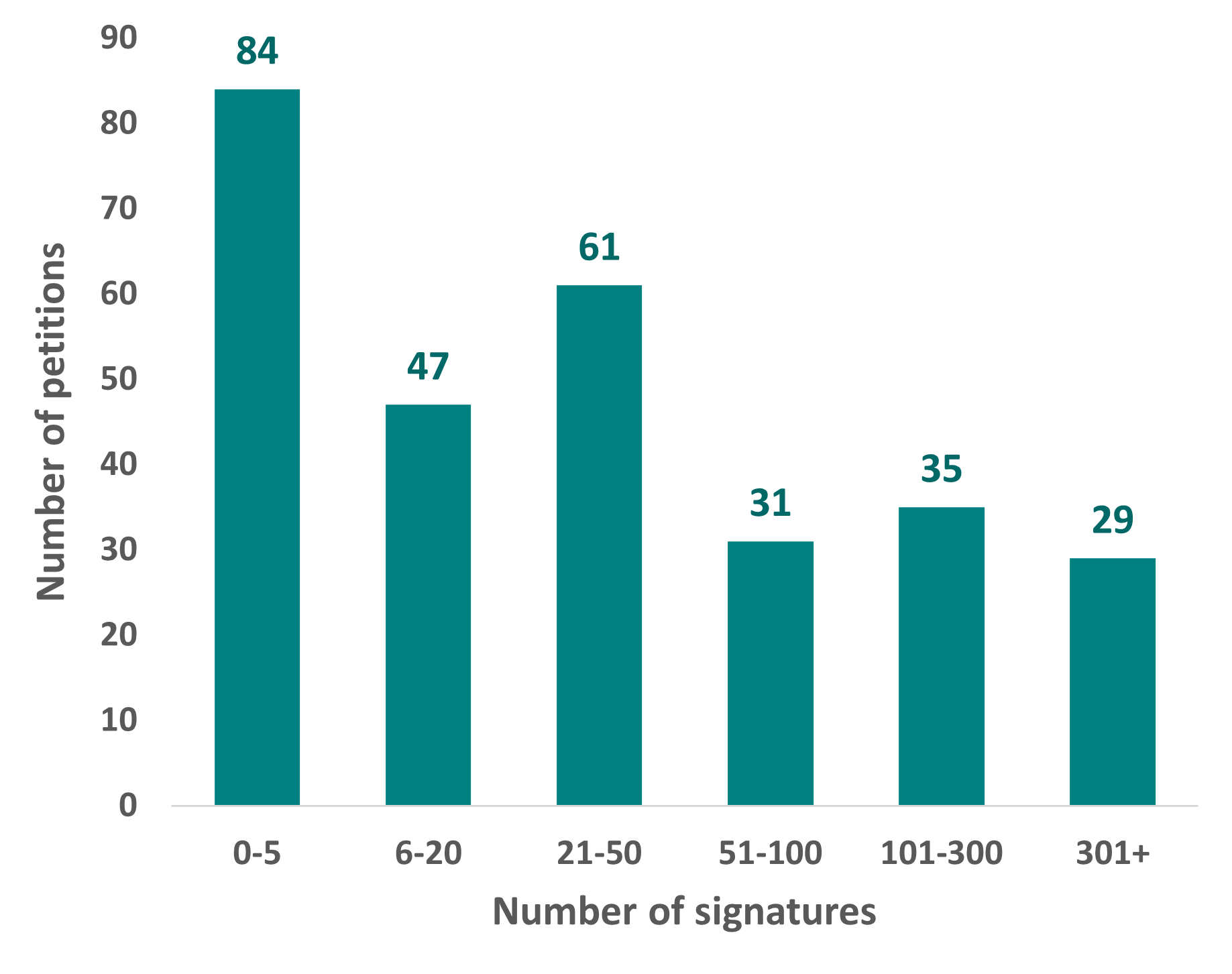
Chart 1 below presents information on the number of signatures received per petition. Most received relatively few signatures, with 26 being the median number of signatures. However, a few received very high numbers – 11 petitions across all boroughs received more than 1,000 signatures – bring the mean number of signatures per petition up to 187.

Chart 1: Number of signatures on e-petitions to London boroughs, 2023

Source: London Assembly Research Unit. Based on petitions data for 26 out of 32 boroughs

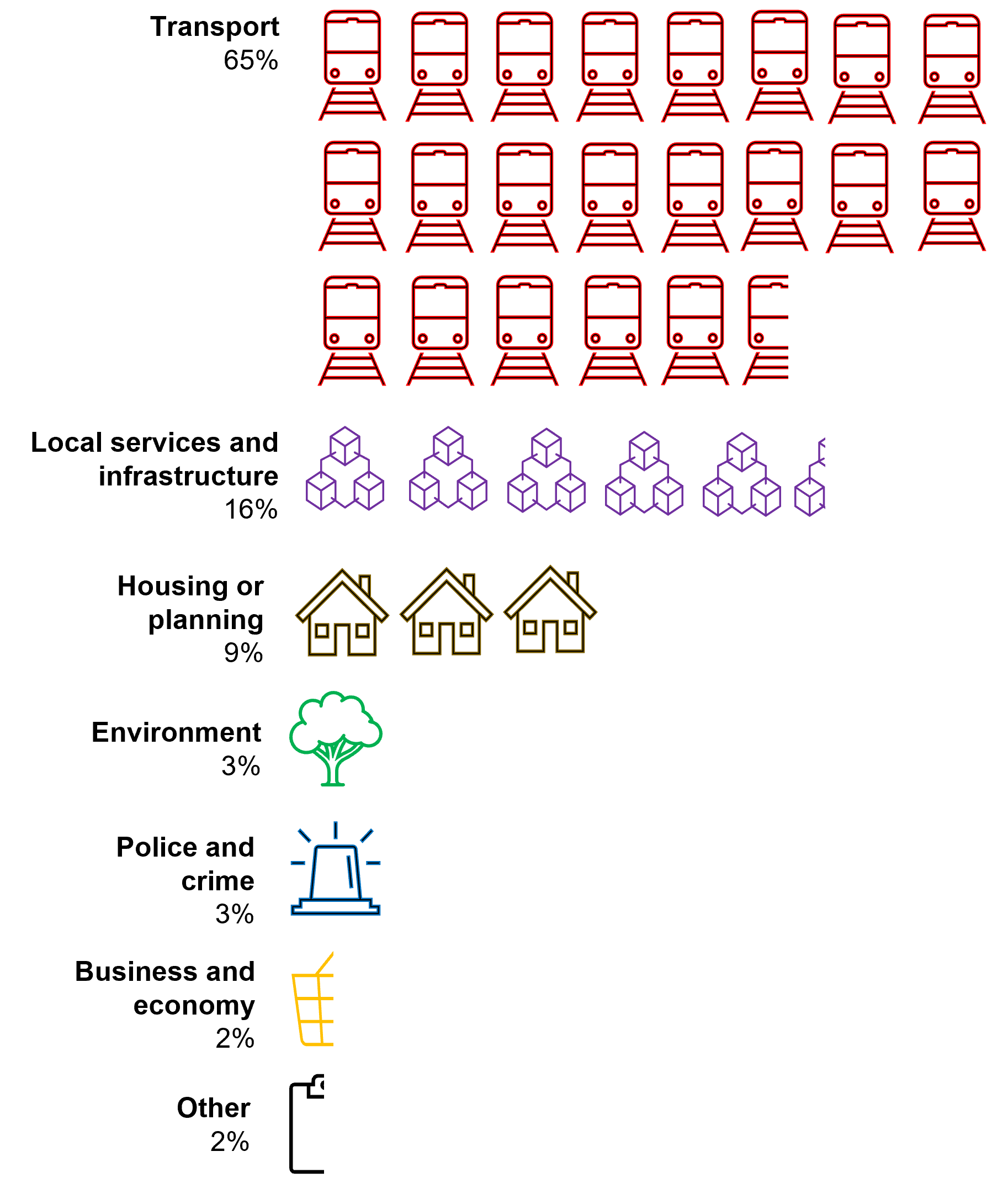
We also considered the topics of petitions submitted to boroughs. We found, somewhat surprisingly, that there was one dominant theme, transport, as shown in Chart 2.

In London, responsibility for most public transport and control of major roads is held by a city-wide strategic authority, Transport for London, overseen by the Mayor of London. Yet boroughs still control the majority of London’s roads, and we found this is where many petitions focused, as people sought changes to the streets where they live.

We see, for instance, that 71 residents of the London Borough of Ealing have called for the enforcement of the speed limit on one local road. 157 residents of the City of Westminster supported moving the location of an e-bike parking bay that had been blocking the pavement in one area. In the London Borough of Sutton, 52 residents signed a petition for the resurfacing one road in a state of disrepair.

Chart 2: Topic areas of e-petitions submitted to London boroughs, 2023

Source: London Assembly Research Unit. Based on petitions data for 26 out of 32 boroughs

The growth of online petitions systems has been the perhaps the most important development of recent times in this field. Another change that has coincided with the rise of e-petitions is that, from being the passive recipient of petitions generated externally, local authorities are now playing an active role in hosting the online platforms on which petitions are managed.

This was encouraged by the 2009 Local Democracy, Economic Development and Construction Act, which places a requirement on English local authorities to operate schemes for the handling of petitions from local residents. Although this requirement was repealed just two years later in the Localism Act 2011, systems had been introduced and in many cases have remained. In a very real sense, they are helping to facilitate campaigns focused on challenging councils’ own policies, which itself is a sign of a healthy democracy.

Richard Berry is the manager of the Research Unit at the London Assembly, which provides an impartial research and analysis service designed to inform Assembly scrutiny. The author would like to thank Kate First and William Weihermüller for conducting research cited in this article. All publications from the London Assembly Research Unit are available here.

Transforming Maternity Services in Brent

Councillor Dr Ketan Sheth

Each year here in Brent, we welcome almost 4,000 newborns into the world at Northwick Park Hospital’s maternity department. Each birth is the start of an exciting journey for new parents and families, who should all have confidence that they will receive safe, effective, compassionate maternity care that focuses on their individual needs.

Sadly, across the country, this has not always been the case. A quick online news search reveals that NHS maternity services have not always performed to an acceptable standard, with disparities in care especially for women from Black, Asian, and minority ethnic groups. The hard truth is that poor quality maternity care puts the safety and well-being of women and babies at risk.

An inspection by the Care Quality Commission in 2021 raised concerns about the quality and safety of maternity services at Northwick Park Hospital. I am delighted to say that in the years that have followed that inspection, Brent’s local government scrutiny committee has been working with the NHS leadership to ensure the service improves and staff have been working tirelessly with the National Maternity Safety Programme to turn things around for the 3,700 births there each year.

The maternity department recently celebrated opening its newly refurbished triage and birthing centres. Whilst this investment in new modern facilities is welcome, it is positive cultural change that is by far the biggest ingredient in the service transformation. There is a new senior management team and a commitment to listening to local women through the Northwick Park Maternity and Neonatal Voices Partnership, which is chaired by local mothers.

This has resulted in a raft of changes, including a special area for women who need to have an induced labour and a specialist midwife to support them. Obstetric nurses are on-hand to help women who have caesarean birth to recover quicker, and seven community midwifery teams have been set-up, three of which are in Brent. A new LifeStart trolley has also been introduced to look after newborn babies who need extra support, while keeping them close to their mothers. Antenatal care for women at risk of gestational diabetes has improved too.  

These substantial improvements, and many others besides, have led to the maternity team being taken off NHS England’s special measures. Indeed, the maternity service at Northwick Park Hospital was deemed the most improved of all trusts in a recent National Maternity Patient Survey

Transformation like this does not come about easily; it requires passion and the commitment from the local government and NHS working in partnership to continually deliver the best care possible for women, babies, and families. 

Tomorrow and every day, around ten babies will be born at Northwick Park, and each mother will have different needs. I wish them all the very best, safe in the knowledge they can expect personalised, safe, and compassionate care.  

Cllr Ketan Sheth chairs the North West London Joint Health Scrutiny Committee