Sarah Finn
Local Authorities in England have responsibility of ensuring there are sufficient school places to meet the demands of the population now and in the future. When new housing developments are proposed which result in a demand for additional school places, options include the expansion of an existing school, provision of a new school, or relocating an existing school to a new building on a new site.
The assessment of school relocation proposals is a complex process, impacted by financial constraints and silo-thinking within the public sector.
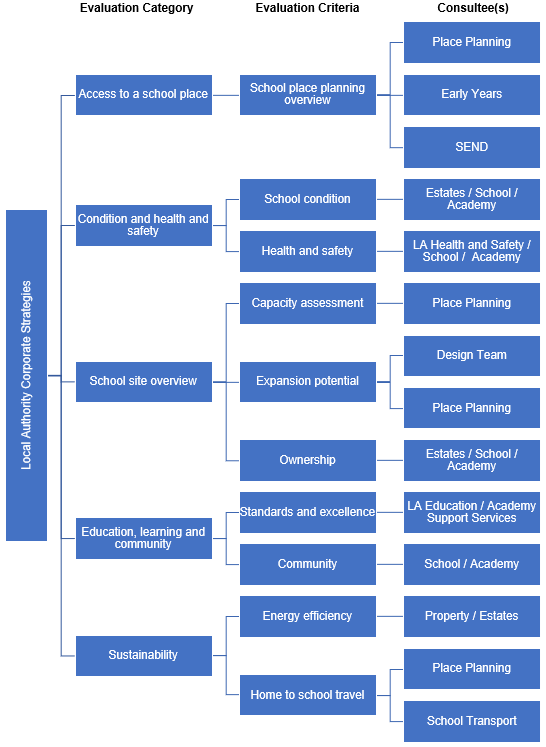
The project designed a School Relocation Assessment Tool (SRAT) which encourages officers to outline the financial impact of school relocation within the context of the council’s corporate strategies, and to consider short-term and long-term impacts of a variety of evaluation criteria in a holistic way, with weighting to support balanced decision-making. Critically, collaboration is a central factor of the tool.
Key points
• Where appropriately located land is available, some councils are starting to consider the option of relocating and expanding an existing school to a new site.
• Councils are currently only able to request developer contributions to fund the additional places required to mitigate the impact of the development, whereas re-provision of existing places must be met by council borrowing.
• The SRAT tool requires information to be gathered about multiple factors horizontally, across vertical silos within the Council to enable consideration of council priorities in a holistic way rather than being in competition with each other, thus mitigating the negative impacts of silo- thinking by making the assessment joined-up and strategic.
• The project identified several factors to evaluate when assessing school relocation opportunities, including home to school travel distances, community use, and school condition.
Background
Local Authorities in England have a statutory responsibility for education and have a duty to ensure there are sufficient school places to meet the needs of the population now and in the future. Traditionally, mitigating strategies adopted to provide additional pupil places generated by proposed new housing will involve either the provision of an entirely new school setting or an expansion to an existing provision. However, where appropriately located land is available, some councils are starting to consider a third option of relocating and expanding an existing school to a new site (school relocation).
The financial impact is particularly pertinent as councils are currently only able to request developer contributions to fund the additional places required to mitigate the impact of the development, whereas re-provision of existing places must be met by council borrowing.
What we knew already
Where strategic perspectives are not aligned within organisations there is a risk that obstacles to successful collaboration are created across administrative silos, where organisational parts of government [work] in isolation from each other. It’s been argued that reduced budgets have encouraged retreat into departmental silos, rather than collaboration.
Successful strategy relies on several overlapping strategic decisions being made in conjunction with one another, with financial constraints balanced against strategic priorities.
This research project involved both a systematic literature review and a group discussion with four senior council officers concerned with school standards, performance, and infrastructure.
What this research found
Financial and short/long term decision making
The current financial pressures faced by LAs encourages decision-makers to pursue the ‘least-cost’ option, without concern for externalities. The impact of school relocation should be considered within the context of wider council corporate strategies. A strategic perspective encourages LAs to take a longer-term approach to their decision-making.
The SRAT tool requires information to be gathered about multiple factors horizontally, across vertical silos within the Council to enable consideration of its priorities in a holistic way rather than being in competition with each other, thus mitigating the negative impacts of silo- thinking by making the assessment joined-up and strategic.
The project identified several factors to evaluate when assessing school relocation opportunities, including home to school travel distances, community use, and school condition.
School Relocation Assessment Tool (SRAT)
Conclusions
The aim of this research was to formulate an assessment criteria framework for school relocations. To achieve this, the project sought to understand how school relocation decision-making processes were impacted by financial constraints and silo-thinking, and to explore what criteria should be assessed when school relocations are considered.
The resultant SRAT has been successfully designed to encourage officers to outline the financial impact of school relocation within the context of a council’s corporate strategies, to consider short-term and long-term impacts of a variety of evaluation criteria in a holistic way with weighting to support balanced decision- making. Most significantly, it guides officers to collaborate with other teams across the council to ensure joined-up strategy is achieved.
During the research process, the researcher recognised that the literature around school relocation was lacking. The creation of a tool to assess both numerical and non-numerical evaluation factors of school relocations, drawing upon both practical and academic research, appears to have not previously been attempted until now. To build upon this research, different occupational viewpoints should be sought regarding the effectiveness of the tool to improve its validity, particularly from a financial perspective.
About the project
This research was a Master’s dissertation as part of the MSc in Public Management and Leadership, completed by Sarah Finn and supervised by Shailen Popat.
 INLOGOV Blog