Oops!  We lost two Mayors – let’s overthrow a sensible system

Chris Game

I assume it was the 2021 mayoral election results that finally clinched it. With the Conservatives winning just two of that year’s 13 mayoralties to Labour’s 11, it was time to enact the party’s 2019 manifesto pledge – “to continue to support the First-Past-The-Post (FPTP) system of voting, as it allows voters to kick out politicians who don’t deliver, both locally and nationally”.  Specifically, the Supplementary Vote (SV) system – despite also, like electoral systems generally, featuring the kicking-out of politicians – had to be replaced for mayoral and Police and Crime Commissioner (PCC) elections asap.

True, the counting of electors’ supplementary – second preference – votes had just enabled West Midlands Conservative Mayor, Andy Street, to be re-elected with the useful perk of a narrow overall majority of votes cast, along with the party’s rising star, Tees Valley’s Ben Houchen, who’d swept in with nearly 73% of first preference votes.

No supplementary second round necessary there, but nor should there have been, reformers reckoned, in Cambridgeshire & Peterborough, where the established Conservative Mayor, James Palmer, had been a victim of the dastardly SV ‘system’. He’d comfortably led Labour’s Nik Johnson after the count of first preference votes – by nearly 18,000 votes or 8%. Yet, by some foul trickery, or possibly because he simply wasn’t as broadly appealing his opponent, after the counting of relevant second preference votes, he’d fallen behind: 48.7% to new Mayor Johnson’s 51.3%.  Despite Government Ministers repeatedly claiming that “the candidate with the most votes” lost, he hadn’t. He’d won – he just wasn’t Conservative.

Anyway, Palmer threw what looked like a wobbly, promptly retired from politics, and SV elections for Mayors and PCCs would be retired with him, though not in time for last May’s Mayorals, which very nearly produced a Croydon re-run of that Cambs & Peterborough result. First count: Jason Perry (Con) 34.8%, Val Shawcross (Lab) 32.7%. Second count: Perry 50.4%, Shawcross 49.6% – the candidate with the leadership-resonant first name just edged it.

By then, though, the FPTP legislation was well under way. The next Mayoral elections – this May – would use FPTP, as will next May’s PCC elections. It seemed a good time for a review of the whole SV lifespan, facilitated by the invaluable statistical records of my polling specialist friend, David Cowling.

Quickish review: the Supplementary Vote is obviously not a proportional system, which would be tricky when electing single Mayors, Police & Crime Commissioners, etc.  Rather, it’s a simplified majoritarian system, enabling voters to rank their two most favoured candidates on the ballot paper in order of preference.

If no candidate gets over 50% of first preference votes on the first count, just the top two candidates continue to a run-off, thereby encouraging candidates from the outset to seek support beyond their core supporter base. The winner may still get less than half the total vote, but will need significantly wider support than under FPTP, and especially under FPTP with a lowish turnout.

Both, however – ultra-topical insert – are more democratic than this past weekend’s Spanish ‘mayoral’ elections, in which Barcelona Mayor Ada Colau, almost certainly the nation’s best-known mayor both at home and abroad, is seeking a third term of office … but as Leader of a two-party socialist coalition – for Spanish mayors aren’t even elected by ‘the people’, but indirectly by fellow councillors.

The name – Supplementary Vote – may have been new when it was ‘invented’ by an early 1990s Labour Working Party, but essentially similar ‘preferential’ systems had been quite widely used internationally for ages. France’s Presidential ‘double-ballot run-off’ was one example, but most obviously there was the Alternative Vote – the actual subject of Winston Churchill’s senseless but oft-recycled quote, about it rewarding “the most worthless votes given for the most worthless candidates” – although today’s Conservative critics have no difficulty unearthing and redirecting it to SV.

I’m old enough to recall lecturing about the SV’s UK ‘invention’ by a Labour Party working party in the early 1990s and the even then revered ‘psephologist’, the late Sir David Butler, getting uncharacteristically incensed about it – calling it “silly”!  But his sphere of matchless expertise was parliamentary elections, with turnouts at the time of consistently over 70%. Even they, though, have slipped a bit since, and well over a third of today’s MPs won less than 50% of their constituency vote, and that’s an awful lot of voters left feeling unrepresented.

Local (including mayoral) election turnouts, however, are proverbially in another ballpark – and this is probably the blog’s key point. Except when they coincide with parliamentary elections, they average around 40%, and that’s on good days. PCC turnouts, unsurprisingly, are significantly lower still – not one of the 39 areas in England and Wales managing even 51% in May 2021, and Durham and Wiltshire not quite achieving 17%.  All of which, under FPTP, will mean large percentages of the votes of the most civically conscientious and politically committed citizens being ‘wasted’ and, arguably even more importantly, the mandates of the elected mayors and PCCs correspondingly diminished.

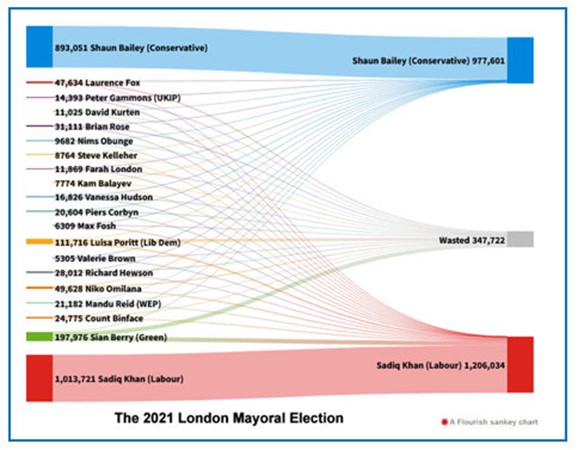
And then there’s the loss of the visual aids – for SV also produces what I only recently discovered are called ‘Sankey charts’, illustrating how the second-round count both produces a winner able to claim a statistical majority of positive votes and a dramatic reduction in the proportion of ‘wasted votes’ – on the part of voters choosing not to make use of their possible second choice. Good, isn’t it!
The Supplementary Vote, then, still favours the two main parties, but, returning to recent history and as shown in the following table, one in three of the 67 SV Mayoral elections going to second counts were won by Lib Dems, Independents and other parties. Labour won by far the most mayoral contests, but they also lost most in second counts. All of which contributes to SV hovering around mid-table in global democratic rankings of electoral systems – nothing to shout home about, except when compared with FPTP’s ranking as ‘least democratic’, apart from maybe Djibouti’s ‘Party Block Voting’.
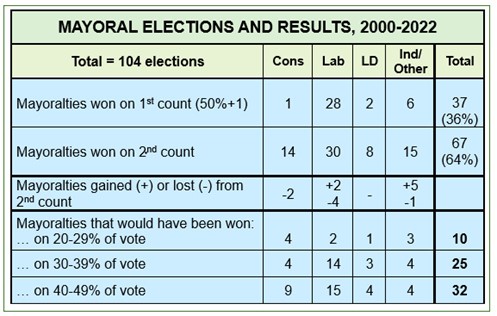
SV’s statistical merits apply in principle to any elections, but particularly to a set in which two-thirds of turnouts were under 50% and nearly a third under 40% (see table). First, it hugely reduces the number and proportion of so-called ‘wasted votes’ – those cast for neither of the leading two candidates – and secondly it ensures that the winning candidate can claim the majority backing not necessarily of all voters, but at least of those the system counted.

My presumptuous guess would be that West Midlands PCC Simon Foster likes knowing, and possibly even mentioning now and then, that he was elected with 53.7% of the vote, rather than 45.5%. And, while I don’t know any of these people, that Surrey PCC Lisa Townsend (one of 12 women PCCs, if you were wondering) definitely prefers her 58% to 33.5%.

Time to start closing, by checking out the arguments Ministers sought to make to justify their replacement of SV with FPTP – or, rather, plundering the critique the Constitution Unit’s Alan Renwick and Alejandro Castillo-Powell made at the time.

  1. That SV increases the number of spoilt ballots – possibly, very fractionally; but, if so, why not work on improving ballot paper design?
  2. It allows ‘loser candidates’ to win – stupid argument (see above); they won the election they were required to contest.
  3. It reduces the accountability voters have in expressing a clear choice – but increases it by saving them from calculating how best to cast their single vote ‘tactically’ to elect or defeat a particular candidate.
  4. “FPTP is the world’s most widely used electoral system.”  Tricky – needs its own separate blog; also a bit silly. Depends a bit on whether you mean number of countries or number of voters. India, Pakistan, Bangladesh and the US give FPTP a head start. More to the point, a 650-Member legislature isn’t the same as a single elected mayor or PCC.
  5. SV is an “anomaly … out of step’ with other elections in England.” True, it was decisively rejected in the 2011 referendum for the election of MPs, but these are the country’s only public elections to executive offices. In short, they’re completely different.  

None of which, of course, stands the remotest chance of influencing, never mind changing, anything … but it was quite enjoyable to ‘research’ and write!

Chris Game is an INLOGOV Associate, and Visiting Professor at Kwansei Gakuin University, Osaka, Japan.  He is joint-author (with Professor David Wilson) of the successive editions of Local Government in the United Kingdom, and a regular columnist for The Birmingham Post.

Picture credit: Theresa Thompson at www.flickr.com/photos/theresasthompson/
Reclaiming Participatory Governance: Social movements and the reinvention of democratic innovation

Sonia Bussu

Our world is experiencing multiple pressing crises; political elites’ inability or unwillingness to address them has contributed to diminishing trust in representative institutions. Democratic Innovations and participatory governance processes engaging citizens directly in politics and policymaking have been hailed as an antidote to elected representatives’ plummeting legitimacy. But they have also attracted much criticism, as they give much power to commissioning organisations, who design the process and choose who to invite, while there is limited follow-up on citizens’ recommendations.

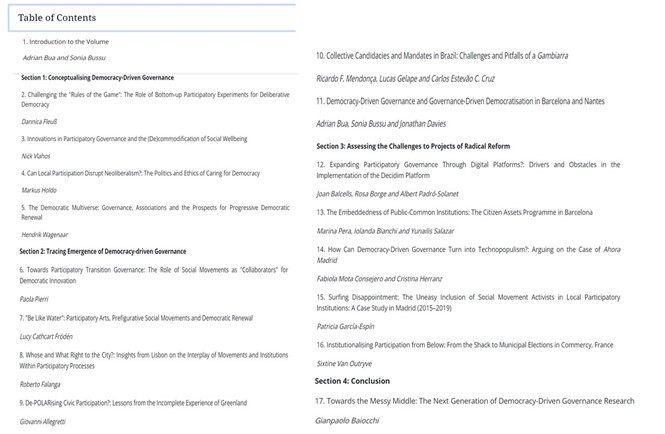
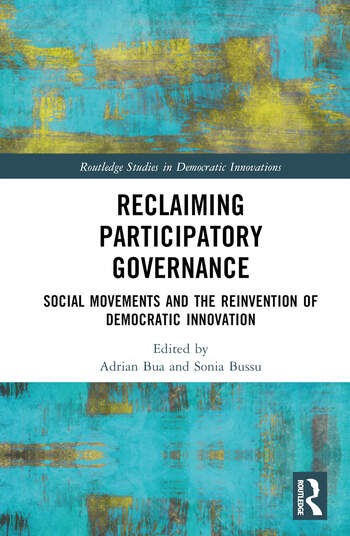
Reclaiming Participatory Governance, a volume I co-edited with Adrian Bua for Routledge’s Democratic Innovations series, provides an analysis of how social and grassroots movements are reclaiming and reinventing democratic innovations to strengthen the impact of citizen participation for social change. The book is articulated into three main sections to provide 1) theoretical and 2) empirical analyses of these processes, and to reflect on 3) challenges to the implementation of radical projects of social transformation. Through 17 chapters covering a range of cases, the volume captures the growing synergy between social movements’ mobilisations, the commons and participatory deliberative democracy, exploring how grassroots democratic action is mobilising to foster alternative forms of participatory politics and economics.

Throughout the book we apply democracy-driven governance as an analytical framework. We initially developed this concept to describe how social movements and grassroots groups who mobilised across Spain against austerity politics in the early 2010s used the deliberative and participatory toolbox, first to build movement parties’ platforms and later, after winning elections in many major cities, to transform local state institutions. Democracy-driven governance captures these social-movements-led forms of democratic innovations that aim to widen the scope of participatory governance from political institutions to the economy and wider society.

It is a counterpoint to Mark Warren’s governance-driven democratisation which refers to democratic innovations mostly initiated by public agencies, particularly at the local level. Governance-driven democratisation responds to specific policy issues and what Warren calls “pluralised ungovernability” (2014, 49). This refers to situations of high complexity that administrators are caught in as they navigate, on the one hand, dispersion of governing capacity, and on the other hand, high interdependence. The potential of Warren’s governance-driven democratisation resides in its pragmatic, problem-solving orientation, addressing problems of political leadership and public administration. However, by decoupling politics and economics and failing to attend to socio-economic factors, the practice of governance-driven democratisation has been quite tokenistic, falling short of making substantive positive change to the lives of citizens, in a context of widening inequalities.

Both governance-driven democratisation and democracy-driven governance exist in a dynamic relationship, which shouldn’t be understood as a mere bottom-up v. top-down heuristic. They both attempt to foster participatory governance or to include citizens in the work of public administration through “routinised participation”. They also interact with other participatory spaces, such as oppositional politics (protests) and the commons, where citizens create their everyday democracy by managing public goods through their own democratic decision-making rules and with limited interactions with state institutions.

The contributions to the volume look at how democracy-driven governance emerges across different socio-political and geographical contexts, and how it develops and navigates (or fails to) the constraints of day-to-day politics and public administration. Firstly, we wanted to test the analytical power of democracy-driven governance. By applying these concepts to a range of diverse cases, the chapters help flesh out the empirical characteristics of different forms of participatory governance. Secondly, we were interested in assessing how democracy-driven governance’s aspirations to social justice fare when applied to the real world. Can it strengthen the politics of the commons by making it visible and linking it to state institutions, as in the case of civic management and community-wealth building in Barcelona, or collective electoral mandates in Brazil? Can it facilitate processes of decommodification to help re-embed the economy in democracy and the wider society? Are these new approaches to politics and policymaking sustainable in the face of existing legal, business and public administration constraints?

The contributions trace practical challenges, from participation fatigue and activists’ disappointment with the slow pace of administrative work, to bureaucrats’ resistance or the challenges of reconciling democratic innovations, where citizens can participate as individuals, with assembly democracy, which strengthens organised civil society. One important aspect of democracy-driven governance concerns the digital commons, and the digital sphere will increasingly be the new battleground against the expansion of algorithmic capitalism.

The book provides many insights on the contested space to advance democracy, showing how social movements and citizen participation continue to play a crucial role in furthering the cause of critical theory: to challenge incumbency and demonstrate the possibility of other worlds.

The book launch is on 7th June 2023, at the University of Birmingham and on Zoom – register here.

Sonia Bussu is associate professor of Public Policy at INLOGOV. Her main research interests are participatory governance and participatory action research. Over the years, she has led research and published on participatory and deliberative processes, community engagement, coproduction of public services, and participatory research ethics.

Lessons from literature for local government

Professor Catherine Staite LLB, MBA, FRSA

No man is an island entire of itself: every man is a piece of the continent, a part of the main;

If a clod be washed away by the sea, Europe is the less, as well as if a promontory were,

As well as any manner of thy friends or of thine own were.

Any man’s death diminishes me because I am involved in mankind,

And therefore, never send to know for whom the bell tolls;

It tolls for thee.

John Donne

When every week seems to bring news of yet another major failure of governance in a local authority, some members and officers in other councils will be fearful that the same fate will befall their own council before too long, while others will be confident that all will be well for them.

When we look at the notable governance failures that have occurred in recent years, we see a very complex picture. Causes of failure are many and varied, ranging from the absence of the most basic controls to ambitious but risky money-making schemes. Some patterns are visible in all the complexity, including, failure to listen to officer advice, engaging in commercial activities without the requisite skills and knowledge, weak financial controls and opaque decision-making processes.

Councils need both strong rules, about finance and behaviour and strong public service values. Constant vigilance and honest collective self-reflection are vital to ensure that decision makers are independent, transparent, accountable, behave with integrity, have a sense of shared purpose and focus on outcomes. Ask yourself – are our informal and formal governance arrangements fit-for-purpose? If not, where might the weaknesses lie? Look at your structures. Are your Constitution, Codes of Conduct and Standing Orders up-to-date? Is your organizational structure robust? Are your s151 officer and Monitoring Officer on the senior management team and do they report directly to the Chief Executive? Then look at your systems. Are decision making processes clear? Can projects be started without the right sign-off? Can officers exceed their authority without consequences? Last, but by no means least, take a long hard look at organizational behaviour. How do leading politicians and officers respond to being challenged? Is bad behaviour rife but undiscussable?

It’s important to avoid complacency. Most of the members and officers leading and managing councils that have failed to uphold the best standards of good governance either thought what they were doing was fine, or that they could get away with it. Sometimes those who are part of an organization are the last to notice how the patterns of weak governance and bad behaviour, which have become so familiar that they cease to be noticed, will eventually lead to their downfall. Even when officers can see that their council is not going to able to balance its books or manage its risks, it can be difficult to speak up if members do not want to listen and it can be career limiting when a bullying culture prevails. Although statutory officers have statutory powers and duties, they are will not be protected from retaliation if they are perceived to be raining on the parade of colleagues and members who, because of ambition or political expediency, have lost sight of what good governance looks like. The statutory protections that attach to senior roles are not proof against bullying or actions amounting to constructive dismissal. The power imbalance between members and officers remains significant because while members may lose positions of power, or even their seats, officers risk losing their livelihoods and even their careers.

Those members and officers who consider themselves safe from failure may take some guilty pleasure from the failure of another council, especially if its run by another party. Councils have been encouraged to compete with each other for funding and kudos, so perhaps it’s natural to feel that the standing of better run councils goes up when the reputations of failing councils go right down. That’s a big mistake, for two very strong reasons; failure of one local authority reduces public confidence in local government as whole and it gives central government convincing reasons for not delegating resources and power to a local level. For all that we refer to ‘sovereign’ councils, no council is ‘an island, entire of itself’ and the failure of one diminishes all. When we open the LGC or MJ, to see for ‘whom the bell tolls’ we should hear the message that ‘it tolls for thee’.

Picture credit: Maggie Meng https://www.flickr.com/photos/snowfish2014/

Catherine is a researcher, consultant and coach who specialises in strengthening leadership, improving governance and supporting senior politicians and managers.  She is an independent consultant with Darlingburn, a small consultancy practice and is working with Grant Thornton on local government audit, specializing in governance. She was the Director of the Institute of Local Government Studies (INLOGOV) at the University of Birmingham from 2011 to 2017.