Pushing experts under a big red bus?

Picture source: https://paulcairney.wordpress.com/2020/07/08/covid-19-policy-in-the-uk-did-the-uk-government-follow-the-science-reflections-on-sage-meetings/
Jason Lowther


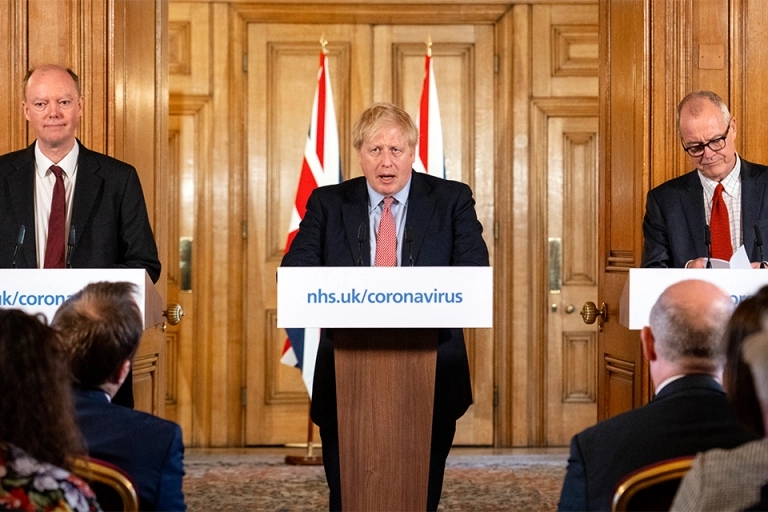
Politicians have a complex relationship with experts and the evidence the latter provide.  Back in May 2020, I reflected in the Municipal Journal on how Michael Gove’s statement in the Brexit campaign that ‘people in this country have had enough of experts’ had turned 180-degrees.  With the arrival of Covid, the PM told his 9th March 2020 press conference ‘we are doing everything we can to combat this outbreak, based on the very latest scientific and medical advice’ and this line was consistently reiterated by other ministers.  Thirty months on, Rishi Sunak (Chancellor in 2020) railed against the government’s main Science Advisory Group for Emergencies expert group (SAGE) saying ‘If you empower all these independent people, you’re screwed’. 

Sunak’s argument, presented in an interview with the right-leaning Spectator magazine, seems to be that the SAGE experts failed to consider any non-health impacts of Covid control measures (particularly lockdowns) and refused to show politicians their workings.  In the article he’s quoted as saying ’I was like: “Summarise for me the key assumptions, on one page, with a bunch of sensitivities and rationale for each one”, in the first year I could never get this’.  This doesn’t seem to match with the published SAGE ‘consensus statement’ on school closures issued in February 2020, which very clearly sets out its assumptions and explicitly states:

As well as the large economic and educational costs of school closures, including increased levels of workforce absence in the health and care system and elsewhere, school closures could have adverse consequences: As infections appear to be more severe in older people, putting children in the care of their grandparents may result in a higher number of severe cases. Once schools are reopened, the number of cases may increase again, with the overall attack rate not being reduced.
(SPI-M-O: Consensus view on the impact of mass school closures on 2019 Novel Coronavirus, Feb 2020)

Later, when facing the December 2021 Omicron variant, Sunak is said to have used his own alumni and private sector analyses to challenge SAGE advice for further lockdowns with the PM and in cabinet.  He argues that the scientific evidence failed to provide a balanced analysis of lockdown decisions, saying ‘I would just have had a more grown-up conversation with the country’.  Sunak also claimed that dissenting voices in SAGE discussions were edited out of the minutes, an assertion he supported by describing a Treasury official sitting in on the discussions and reporting disagreements and uncertainties back to him. 

SAGE scientists see this differently.  Former SAGE member Prof Ian Boyd from the University of St Andrews commented: ‘It is nonsense to suggest that Sage was insensitive to the issue of the long-term effects of lockdowns – a whole subgroup dedicated itself to trying to understand what this might look like. Sage was discussing the topic of excess deaths in detail in April 2020.  Those who attended Sage meetings were acutely aware of the trade-offs associated with implementing specific actions, such as closing schools. To the extent that it was possible with the information available at the time, these deals were included within the uncertainty expressed in the advice provided to politicians. It is simply unacceptable to rewrite history, by blaming scientists, to save a political class that has systematically failed to respond to the messages that scientists have been providing to them for many, many years’.

There are valid reasons to criticise elements of the advice system the government put in place during the pandemic.  The limitations of ‘a model in which a specialist committee produces consensus statements that spare policy makers any requirement to make choices on matters in which they have no competence’ have been demonstrated in analysis by Lawrence Freedman of the intelligence failings relating to the UK entry to war with Iraq as well as the Covid pandemic.   His analysis recommends a model with more opportunities for policy makers to engage with the experts as both the advice and the policy is developed.   The editor of the Lancet, Richard Horton, argued that expertise around public health and intensive medical care should have been in the SAGE discussions.  I argued in the MJ piece that having practical knowledge from local councils and emergency planners could help avoid recommendations that prove impossible to implement effectively, since esteemed experts can still make recommendations which are impossible to implement in practice.  But it’s simply wrong to suggest that SAGE ignored key evidence on non-health effects of Covid control measures or sought to silence dissenting views.  If the trade-offs and assumptions were not considered by the Cabinet, the blame for that lies not with the scientists but with the politicians.

This article appeared in the Local Area Research Intelligence Association newsletter on 27 Sept 2022

Jason Lowther is Director of the Institute for Local Government Studies (INLOGOV), University of Birmingham

T
“The Greatest Political Party on Earth” – Prime Ministerial hyperbole

Chris Game

Reader alert!  This blog’s sole excuse is its loose topicality. Its connection with local government, certainly, is tenuous in the extreme, and needs rationalising right away.

My chief role in INLOGOV, throughout most of my time as a full-time employee, was as Convenor of its undergraduate degree, latterly entitled the BSc in Public Policy, Government & Management. When we launched its predecessor in the early 1980s, ICT was in its youth, if not infancy. PowerPoint presentations, when they arrived, were seriously challenging, and one was constantly looking out for new IT developments that might illustrate current events and generally enhance the student learning experience.

The technology left me behind years ago, but the fascination with entertaining visual aids remained. Meanwhile, we quickly learnt that casually deployed, but now much more easily checkable, references and assertions, particularly superlatives, were a gift to the evolving technology. I was naturally aroused, therefore, by our new PM’s extraordinary phraseology in acknowledging her leadership victory: “Thank you for putting your faith in me to lead our great Conservative Party, the greatest political party on Earth.”

Never mind that she hadn’t had the faith of even half of that party’s modest-sized 170,437-member electorate.  Why the senseless GPPoE bit?  ‘Oldest PPoE’ might just have worked – by treating the C17th Tory Party’s demise in the 1830s and 1840s as an evolution, rather than dissolution, into the Conservative Party.

‘Great’, though – definitionally, etymologically – is chiefly and initially about large size. But accuracy, etymology, or even common sense clearly aren’t what Liz Truss is about, and I half-thought, therefore, of trying to make a blog out of it.

At that point, though, I hadn’t fully grasped, in addition, the extreme limitation of the Truss vocabulary, and there was suddenly more material to work with: the PM’s apparently considered evaluation, to her fellow MPs, of the late Queen as “one of the greatest leaders the world has ever known”.

Apart from the “one of”, no qualification or explication in sight. No “constitutional”, or “peacetime”, or even “modern-day”. Not “one of the world’s most recognisable faces”, possibly after Hitler. Or one of the most photographed. Not even one of the greatest women leaders, which would get rid of all those tricky men – Jesus Christ, Muhammad, Buddha, Confucius, Gandhi, Einstein, Mandela and the rest of the usual crew.

Actually, “one of the greatest women leaders” might at least have generated some informative debate. Elizabeth II’s chief competition would then have been merely Elizabeth I (obviously), Russia’s Catherine the Great, Austria’s Maria Theresa, and, with perhaps 30 seconds Googling, probably Ancient Egypt’s Pharoah Hatshepsut, and China’s C19th Empress Dowager Cixi.

If there really has to be a QEII superlative, there’s possibly “the most recognisable face in the world”. “Head of the world’s most effective democratic monarchy” could have done – interesting, and still a pretty big deal – but might have required a few seconds’ thought. And, pleasingly, that’s just what it got – even including a superlative. Not from Truss, but from local government, or, more specifically, LGIU Chief Executive, Jonathan Carr: “Her Majesty Queen Elizabeth II – our country’s greatest public servant”.

Sadly, though, it seems we’re simply going to have to get used to these ludicrous hyperboles as a Truss ‘thing’, though hopefully, PLEASE, not on a twice weekly basis. Meanwhile, back to her “greatest political party on Earth”, and, while there’s no knowing what, if anything much, she may have had in mind, it almost certainly wasn’t anything measurable or internationally comparable.

‘Great’, though, remains in the first instance a size adjective; so, as they say, needs must. Membership size of national parties is one of the many countable phenomena nowadays measured and compared – skilfully, entertainingly, and literally movingly by YouTube Ranking Charts. Other providers are available, but in my limited, amateurish judgement, these are the most comprehensive, user-friendly, and have the better background music tracks.

I’m a fan, and, were I still lecturing, the charts would be an early student recommendation. Not, sadly, in most cases for any immediate relevance to the world of local government, but for their sheer fun – and, by my reckoning, the products of often quite impressive research. 

The above link will get you to a whole catalogue of charts, usually headed by the ever popular ‘Top 10 Largest Armies in the World, 1816-2021’, which will serve as a brief illustration – yes, that’s 205 years of annual rankings, Napoleon to Putin.  Actually, Putin would be dead envious. In 1816 Russia’s 800,000 ‘Active Military Personnel’ easily outnumbered the world’s next four largest armies – the UK (255,000), Austrian Empire, France and Prussia – combined.

A century later in WWI we had 4.4 million troops, behind only the German Empire, Russia and France, and in WWII that increased to over 5 million – modest compared to the US and the Soviet Union (10 million+), but comparable to Nazi Germany and Japan, and, unsurprisingly, way ahead of France.

We finally dropped off the Top 10 chart altogether in 1963, as eventually did France in 1991. And today, if you were wondering … Russia’s I million+ troops rank them in a rather modest 5th place, behind China 2.1 mill., India 1.5 mill., the US 1.4 mill., and North Korea 1.3 mill.

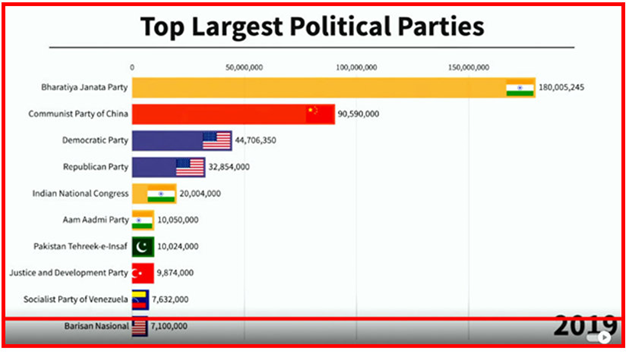
Apologies for that even further digression. Back to “the greatest political party on Earth” – by registered party membership. The principle is the same as for ‘Largest Armies’ – annually reported, with the totals, bar lengths and positions constantly changing, starting here in 1950, rather than 1816; checked and validated as much as possible, which explains the present-day absence of the Communist Party of the Soviet Union. Missing too is the UK Conservative Party – because, well, you can guess from all the other figures running into the several millions how far down the list its 172,437 would be.

To summarise: largest parties in 1950 were the US Democrats and Republicans (7.2 and 6.5 million members respectively), followed by the Communist Party of China (CCP) (6.5m) and the Indian National Congress. Not making the chart, but impressive in their way, the Conservatives’ membership would have been in the high 2 millions (including at least my father, not sure about mother) with Labour, excluding affiliated TU members, around 1 million.

Within two years the CCP had overtaken both US parties individually, and by the mid-1970s both combined. By 2019 it had 90,000 members, the two US parties 77,000 between them.  All three combined, however, had long since been massively overtaken by India’s Baratiya Janata Party (BJP), Narendra Modi’s Hindu nationalist party.

Founded in a 1970s multi-party merger, the BJP had grown gradually, topping 5 million members for the first time in 1993, compared to the Indian National Congress Party’s 13 million. By 2002, however, its then 15 million members had overtaken the Congress Party, following which it grew fast and steadily, reaching 38 million in 2006, overtaking the Chinese Communist Party’s 78 million in 2010, and in 2014, with 129 million members sweeping to national power under Modi, who remains PM today.  

And that, Prime Minister, is what the currently “Greatest Political Party on Earth” looks like.

Chris Game is an INLOGOV Associate, and Visiting Professor at Kwansei Gakuin University, Osaka, Japan.  He is joint-author (with Professor David Wilson) of the successive editions of Local Government in the United Kingdom, and a regular columnist for The Birmingham Post.

Schools and local authorities – where next?

Edwina Grant

Recently, politicians at Lancashire County Council have reflected on the national picture regarding the ambition of the Department for Education, contained in the White Paper on Education and the subsequent Schools Bill.  The Bill aims to move all schools to become academies and to allow councils to open a Local Authority-established Multi Academy Trust (MAT), although some would argue that this was technically possible before.

The government’s aim to ensure that by a notional target of 2030, 90% of pupils meet the expected standard in maths and reading at Key Stage 2, and that the national GCSE average grade in both English language and maths is increased from a 4.5 to 5.  It sets out its strategy of delivery: “ensuring excellent teachers, supporting teachers deliver high standards for all pupils, deploying targeted support for those who need it most, and ensuring a stronger school system”.

Key policies to achieve this include the ambition that there will be a fully Trust led system with a single regulatory approach, through growth of strong multi-academy trusts.  The Bill envisages the establishment of new multi-academy trusts (MATs), encouraging existing and new MATs to expand and allowing trusts to be established by local authorities.  The notional ambition is, that by 2030 all pupils will be taught in a strong MAT, or their school will be planning to join one.

The White Paper was released in March 2022 and subsequent Schools Bill was introduced to Parliament in May 2022.

At Lancashire County Council, we have a good relationship with our local authority-maintained schools, with single academy trusts (SATs) and with multi-academy trusts (MATs).  We have prioritised the core responsibilities for local authorities on promoting the children’s right to education in terms of admissions, challenging exclusions and supporting alternatives and working with our schools collaboratively on behalf of young people with special educational needs.  We became even closer as a result of the challenges of the Covid pandemic.  The Schools Bill, however, is a challenge for us, as at the time of writing, 560 of our 628 schools are local-authority maintained.

There are obviously options for us.  Firstly, to continue the status quo and to let the market take its course.  Secondly, to proactively manage the market by working closely with the new regional Department for Education teams to ensure that our local authority voice is heard as more schools are encouraged to join MATs and indeed, more MATs, as yet unknown to us, are encouraged to join our school landscape.  Thirdly, to express our ambition to establish a local authority maintained multi-academy trust.

After much deliberation, including briefings and discussions with all our councillors, and close consultation with the regional office for the Department for Education, we considered that options 2 and 3 should be explored further.  We are actively strengthening our existing relationships with MATs and trying to understand who the new players might be in our bordering geography of which, given the size of Lancashire, there will be many.  We have also submitted an expression of interest to establish a local authority established multi-academy trust specialising in special education.  We decided on the special education specialism as we have a high level of strength in that sector, and also an existing deep relationship on a pupil level with the children in those schools.

The outcome is yet to be decided but thinking about the next steps has brought us closer to key questions about our existing commercial activity with schools in our authority.  Will the new MATs who take on existing county schools still buy our services, and if they do, in what volume, given the financial pressures ahead?  How do we shape our local elected councillor involvement to ensure the democratic voice is heard, and how do we advise and support the multi-academy trusts so that they fully understand the community context of our local offer for the most vulnerable families and their children?

Time will tell, but this is potentially the most interesting change since the implementation of the 1988 Education Reform Act, which reduced the powers of local authorities over schools.  As I was an education officer in Lancashire at the time, I can attest that it took enormous amount of goodwill from both councillors and officers to realign our systems and our structures so that our schools could get the best of that significant change.  To think back on that time now, that schools previously did not have full control of their budgets, seems strange.  I hope that another 30 years on from now, we will be able to reflect as positively on the changes ahead of us.

References:

Edwina Grant OBE is Director of Education and Children’s Services for Lancashire County Council.