Petticoat Council – cheesy name, historic achievement

Chris Game

Nottingham Castle reopened to visitors recently, after a Covid-protracted three-year closure for what was anyway going to be a pretty extensive renovation. Even unrenovated, the castle has always been a good visit, not least for its exhibitions, which now include an enticingly named Rebellion Gallery, whose current Nottingham-focused displays, curated by University of Nottingham historian Dr Richard Gaunt, comprise the Civil War, the Luddite movement, and parliamentary reform with particular emphasis on women’s suffrage.

For reasons that will become clear, it was the last of these that particularly resonated with me – and one (poorly phone-photographed) bar chart in particular.
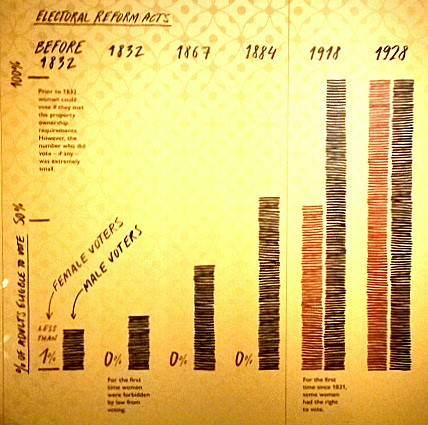
While its primary aim is presumably to emphasise the length of the continually frustrated campaign for women’s suffrage, it also showed how, near the start of that campaign, some women – those that “met the property ownership requirements” – actually lost their right to vote during the 1830s.

The otherwise franchise-extending 1832 Reform Act specified ‘male persons’ only, depriving at least small numbers of property-owning women of their parliamentary vote until 1918. And the 1835 Municipal Corporations Act excluded them from local elections – until 1869/70, when unmarried women ratepayers were granted the right to vote in first municipal council and then the new school board elections.

Between those dates, though, and with no confounding documentary evidence, it was widely believed, and taught, even in Patricia Hollis’ ‘bible’ – Ladies Elect: Women in English Local Government, 1865-1914 (Appendix B) – that women lost their voting rights completely, just like the 0%, 0%, 0% on the Nottingham bar chart.

Taught by me too, until a few years ago when I caught by chance a BBC Sounds broadcast describing the discovery of documentary evidence of at least some West Midlands women casting votes in local elections decades before those history books told us the 1869 Municipal Franchise Act legalised it.

The BBC programme described the recent discovery in Lichfield Record Office of an 1843 Poll Book. Compiled apparently for local Conservative Party campaigning purposes, it detailed all voters in that year’s St Chad’s Parish election of an Assistant Overseer of the Poor – the bloke (naturally) with responsibility for outdoor (cash) or indoor (workhouse) poor relief.

And of the 371 voters in that 1843 election …. 30 were women, including one, an evidently very well-heeled Grace Brown, with no fewer than four votes. It was a genuine, history-rewriting discovery – though not in fact the main point of this blog.

For that we must turn to the programme’s presenter: Sarah Richardson, nowadays Professor of History at Warwick University, and author of the then recently published The Political Worlds of Women: Gender and Politics in Nineteenth Century Britain.

Totally relevant, obviously, but Richardson’s even more pertinent role here must surely be one unmentioned in her University profile: longstanding Governor and currently Chair of Governors at Bishop’s Itchington Primary School.

Bishop’s Itchington is a South Warwickshire village/parish south-east of Royal Leamington Spa and about 18 miles from Coventry, which, as we’ll see, is more immediately relevant. It has a lengthy history too, its name combining references to the passing River Itchen and the Bishop of the afore-mentioned Lichfield Cathedral.

In many European countries, and unquestionably in France with its 35,000 communes, even its reduced present-day population of around 2,000 would make Bishop’s Itchington what we would call a principal local authority in its own right, with an elected mayor, a full range of local powers and responsibilities, and significant control of its own funding.

But in a middle England parish council, without even these basics, where, you might reasonably ask, is there the potential even for much passing interest, never mind drama?  To which the answer is: in its elected councillors, and, more precisely, those elected in 1949 to form what became the first female majority council in the UK.

It’s a hefty claim, but, in respect of a village/parish whose primary school Chair of Governors just happens to be a national authority on such matters, pretty authoritative.

Profesor Richardson herself summarises – this time on YouTube.  Edith Chapple-Hyam, Chair of the village Women’s Institute, was fed up with the all-male parish council’s lack of action on issues such as accessible electricity and running water, social housing, policing and speed restrictions, the sewage works, and public spaces, particularly for children.

In short, she and her WI members saw areas like Coventry being built up after the War and wanted a piece of the action.  So, when an election was announced, she and five WI committee members submitted their nominations.

Most of the sitting councillors assumed that, as no doubt regularly happened, the election would go uncontested and they would be re-elected by default.  Only one, therefore, bothered to submit his papers before nominations closed.

He was duly elected, but alongside all six women, who effectively – in both senses – took over.  And now, just the 72 years on, the Bishop’s Itchington story has been both informatively and highly entertainingly dramatised as a ‘folk musical’ and one of Coventry’s UK City of Culture 2021 events.

Entitled ‘Petticoat Council’, I saw it myself recently, and the mix of storytelling, song, dance and puppetry melded together by playwright Frankie Meredith – herself the great-niece of Ivy Payne, one of the six victorious councillors – is a delight, unquestionably worth catching if you ever get the chance.

My sole initial reservation had been the slightly cheesy title, for which I was prepared to blame the Americans, who had instantly labelled a very similar women’s power grab in Umatilla, Oregon back in 1916 a ‘Petticoat Revolution’.

But I was wrong. It apparently came from a local newspaper, reporting in 1952 how the men on the council were plotting to “overthrow petticoat rule”, as “the women have been getting too bossy”. Material for a sequel perhaps?

______________________

A version of this blog, with an accompanying photograph – of the councillors, not me – was published in the Birmingham Post on 15th July under the title The ‘Petticoat Council’ and a slice of Midland History

Photo

Chris Game is an INLOGOV Associate, and Visiting Professor at Kwansei Gakuin University, Osaka, Japan.  He is joint-author (with Professor David Wilson) of the successive editions of Local Government in the United Kingdom, and a regular columnist for The Birmingham Post.
Royal Consent – If only I’d known 40 years ago

Chris Game

Queen

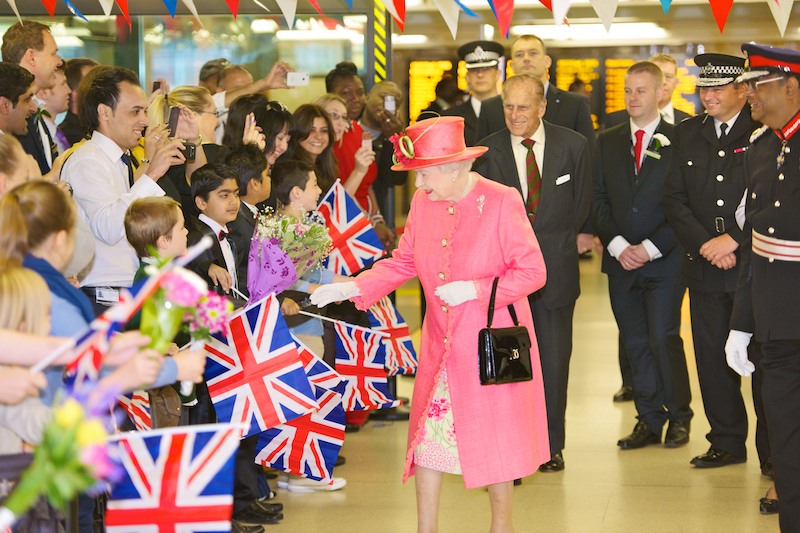
Photo credit: West Midlands Police – Royal Diamond Jubilee Visit

The Queen, I learned recently from my Murdoch Sunday newspaper, is “keen to hit her stride again” and indeed is already “ramping up for a very busy summer”.  Unsettling image, a ramping-up 95-year-old.  More personally, though, justification for not feeling too bad about airing a long-term grievance – for, as I’ll explain, I reckon she owes me.

This royal debt dates back to my pre-INLOGOV days, when, as mentioned in a name-dropping blog only quite recently, part of my 1970s was spent endeavouring to interest visiting American students from California’s Stanford University in the similarities and contrasts between their presidential government system and our constitutional monarchy.

Seminar exchanges would go something like this. You Brits call yourselves a constitutional monarchy, so you must have a constitution?  Yep – a set of the most important rules regulating relations between the different parts of the government and the British people.

But not written down?  Of course they’re written down, but in various forms: parliamentary statutes, judge-made laws, works by constitutional ‘authorities’, and what have become accepted conventions.

They’re just not ‘codified’, or fossilised, in an almost unamendable 1787 capital-C Constitutional document like yours – which, incidentally, says almost nothing useful about the US electoral system, political parties, or modern-day powers of its Supreme Court.

Britain’s uncodified, small-c constitution has enabled us, I’d suggest, to assimilate potentially huge changes without agonising for decades about whether and how to amend a capital-C Constitution.

Proof? The 19th Century metamorphosis during Queen Victoria’s reign from a real, if limited, executive monarchy to a virtually ceremonial one or effectively a republic: a state run by the people’s elected parliamentary representatives, but without a directly elected head of state.

[Literally parenthetically, I might add here that I genuinely can’t now recall how much of this stuff I actually believed and how much was pedagogical convenience. I don’t feel I’ve ever wholly supported the UK having an all-encompassing, written capital-C Constitution, as advocated recently for instance by the Lib Dems in their 2019 Manifesto (p.79), and for the Constitution Unit by QMU’s Prof. Douglas-Scott – not least because I’ve found it hard seriously to imagine it actually happening.

[I was, though, and think still am, in favour of something resembling what – in evidence to the (subsequently Conservative-abolished) Commons Select Committee on Political and Constitutional Reform – Profs George Jones and John Stewart termed a more limited “constitutional settlement governing relationships between central and local government”, giving the latter constitutional recognition as an elected institution].

Back, anyway, to the role, and powers, of that ‘virtually ceremonial’ constitutional monarchy, with which, like most Americans, Stanford students had an almost insatiable fascination.

They knew before arriving that their Berkshire Thameside campus, Cliveden House, had been the country home of the 18th Century Prince of Wales, and staged the first performance of the even then embarrassingly patriotic anthem, ‘Rule, Britannia!’.

They quickly learnt about the Queen owning all the river’s ‘unmarked mute’ swans, having her own Swan Warden, driving without a licence and number plate, and – from glossy US magazines in those pre-Google days – dozens more “incredible powers you didn’t know she has”.

So much truer than I realised!  My role then, however, involved emphasising how most of these incredible powers – even, I guessed, recruiting Swan Wardens – were symbolic, and in practice exercised by others.

Some were easy. Supreme Governor of the Church of England: Henry VIII was certainly hands-on, but nowadays it’s a combo of the PM and Church leaders. Head of the Armed Services: Ministers and the Defence Ministry do policy, armed forces most of the fighting.

Opening and closing Parliamentary sessions, the Queen’s Speech, the Government’s legislative programme, creating members of the Lords – again, all determined by Ministers. Appointing the PM – yes, but following election by their party.

My biggest explanatory problem was Royal Assent and Consent.  Royal Assent is straightforward: the Sovereign’s purely formal agreement that a Bill, passed by both Houses of Parliament, be enacted as law.  Last refused, as all textbooks dutifully record, in 1708.

But check those same textbooks for Royal, or even Queen’s, CONsent, and you’ll be lucky to find much more than the 5-line paragraph graciously offered under ‘The Queen and Parliament’ on the www.royal.uk website: “It is a long-established convention that The Queen is asked by Parliament to provide consent (which is different to assent) for the debating of bills which would affect the prerogative or interests of the Crown”.

Long established maybe, but minimally publicised, discussed and understood. And there’s more. Should the Royals (Charles has a Prince’s Consent too) even suspect that something in any draft Bill might adversely affect their extensive prerogative rights or ‘personal interests’, they can potentially stop it even getting debated, never mind becoming law, and usually without leaving even a written record.

That’s why I reckon they owe me personally – as well as, obviously, all UK citizens (sorry, I forgot: ‘subjects’). Because, while I was wittering to Stanford students about Swan Wardens, none of this seriously important stuff was public knowledge, in the sense of being debated, questioned, researched, quantified, or featuring in even ‘British Constitution’ textbooks.

Instead, there was/is effectively – in both senses – an Establishment connivance, between the leaderships of successive, supposedly democratically accountable Governments and the Royals, to keep all significant details of Royal Consent from us mere voters, taxpayers and university lecturers.

Only quite recently has even its scale become public knowledge, thanks particularly to The Guardian newspaper’s research moles. While I might have guessed at there being maybe two or three Royal Consents a year, it’s actually some ten times that.

The Guardian excavators have compiled a wondrous database of 1,062 parliamentary Bills (and rising) subjected since 1952 to the Queen’s or Prince’s Consent – or ‘royal vetting’, as they put it – from that year’s Clifton Suspension Bridge Bill (no idea why) to the 2020 EU Future Relationship Bill (I’d guess Sandringham and Windsor farming subsidies). All of which the Royals had first go at influencing in their own interests.

One serious purpose of this blog is to draw even some minimal additional attention to this fantastic research base and potential teaching aid – albeit decades too late for me personally.  In 1975, though, I know exactly what I’d have done: given groups of five students a year’s worth, say 25, and asked them to research what in each case they reckoned the Royal Consent hoped to gain.

[The original version of this blog was written for the Birmingham Post, July 1st, 2021, under the title ‘Secrets of Royal Consent that you’ll never hear of’]

Photo

Chris Game is an INLOGOV Associate, and Visiting Professor at Kwansei Gakuin University, Osaka, Japan.  He is joint-author (with Professor David Wilson) of the successive editions of Local Government in the United Kingdom, and a regular columnist for The Birmingham Post.
The surge of migration-related city networks around world: between militancy or co-optation

Thomas Lacroix


In December 2018, a delegation of mayors from various parts of the world attended in Marrakech the signature of the Global Compact for Safe, Orderly and Regular Migrations. Their presence was not random: the compact acknowledges local governments as a key level of implementation of its objectives. Cities were largely absent from the international discussions on migration only a decade ago. They are now regarded as a central player of global migration governance, along with states and civil society organisations. This influence is directly related to the surge in the number of migration-related city networks around the world. These networks are lesser-known than their leading mayoral figures such as Marvin Rees in Bristol, Eric Garcetti in Los Angeles, Luca Orlando in Palermo or Valérie Plante in Montreal. But, together, they form a web of interconnected cities advancing a progressive agenda for the welcoming and integration of immigrant populations. In a recently published article of Local Government Studies, I provide a picture of their extend, types and activities. This work draws on a database mustered through internet search between Spring 2019 and July 2020, compiling information on their members, date of creation, activities and funding. Three key findings emerge from this analysis.

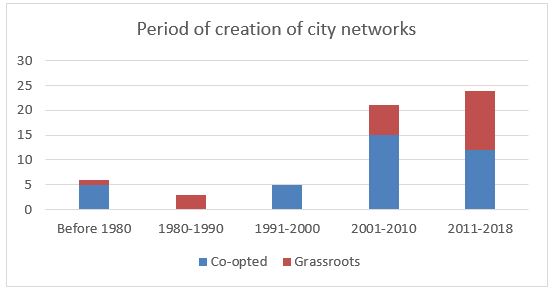
First, the surge of such groupings is a relatively recent phenomenon. If city networks are far from being a novelty, their concern for migration issues has been spreading since the early 2000s. Out of the 64 included in this database, 45 have been founded since 2000, and 24 since 2011. Three drivers account for this. In the first place, local authorities occupy a growing place in the agenda of international organisations. A larger share of development aid is geared towards cities (deemed as trustful and less prone to corruption than state administrations). In parallel, local authorities fill a void on issues such as climate change and migration where intergovernmental cooperation is in a deadlock. In consequence, inter- and supranational organisations support the creation of city networks on these strategic issues. In the second place, the wave of decentralisation reforms undergone by Southern and Northern cities since the early nineties have left local authorities with a broader range of responsibilities (including on integration issues), but no more financial resources. Municipalities turn towards alternative sources of financing: project-based funding bids, city to city partnerships, engagement with the private and third sectors. In the third place, the security approach to immigration in receiving countries has affected cities: the growing pressure and precariousness undergone by immigrants hinder their integration prospects. In reaction, many cities develop narratives challenging this security approach. They hail immigrants as economic actors of a vibrant cosmopolitan city or as human beings in need for welfare, education and health support. This engagement has propelled the multiplication of grassroots networks of like-minded cities in want of promoting an alternative management to immigrant populations.

From this follows a second finding, i.e. the distinction between co-opted and grassroots networks. The former, sponsored by external funding bodies, adhere to their agenda. This is true for the URBACT network which stems from the Urban Agenda of the European Union. The latter are spontaneous organisations formed by local authorities in want of sharing a space for common concerns. In the field of migration, this is illustrated by politicised networks opposing state policies: the sanctuary policies movement in the US, the ANVITA association in France, etc. Of course, these categories are porous. Eurocities is a grassroots European network created in the late eighties which is now largely funded by EU institutions. However, the initial conditions of their creation explain the divergent orientations of their activities. Both types foster exchange of experience and best practices, but co-opted organisations have more financial means to support projects while grassroot ones are more likely to engage in lobbying and awareness-raising activities.

 GlobalRégionalNationalTotal
Europe12151239
Amérique du Sud4117
Amérique du Nord 921
Océanie 213
Afrique5219
Asie1115

Third, this surge of migration-related city networks is a global but unevenly distributed phenomenon. 36 are them are located in Europe and North America. If we add to those the 12 world networks connected to these spaces, one counts three quarters of city networks including major immigration country localities among their members. The types and scales of these networks vary in different parts of the world. In Southern countries, they are almost exclusively organisations sponsored by international organisations: Sello migrante network, a group of cities developing welcoming policies for refugees in Latin America and supported by the High Commission for Refugees, is a case in point. In contrast, in North America, they are mostly grassroots networks gathering cities in reaction to policies targeting undocumented migrants: beyond the sanctuary cities movement, Welcoming America and City for Actions are but a few examples. Europe displays a mixed landscape, with co-opted networks supported by the EU or the Council of Europe for the promotion of local integration policies and more recent grassroots organisations reacting to restrictive migration policies.

Image Source: Alpha Stock Images – http://alphastockimages.com/
Original Author: Nick Youngson – link to – http://www.nyphotographic.com/

Thomas Lacroix is CNRS research director in geography affiliated to the Maison Française of Oxford. He works on local migration governance, city networks and the formation of the transnational state. He recently published with Amandine Desille “International Migrations and local Governance” (Palgrave, 2018)