Chris Game
Six months ago, while Donald Trump’s backers were issuing lawsuits to have vote-counting stopped in states threatening to swing from Republican to Democrat, Biden supporters marched with banners calling on officials to ‘Count Every Vote’. Examining the statistics of the recent London Mayoral election count, I can identify at least with their message.
Our elected Mayoral and Police & Crime Commissioner (PCC) elections have from the outset used the ‘preferential’ Supplementary Vote (SV) system, involving potentially a second round run-off between the two leading first-round candidates to ensure the winner is elected with an overall majority. It’s hardly brain-straining, and offers voters fractionally greater choice than ‘First-Past-The-Post’, with which – for barely disguised partisan reasons – the Home Secretary plans to replace it.
The SV ballot paper has two columns of boxes alongside candidates’ listed names: one cleverly labelled ‘Column A – 1st choice’; the other, yes, ‘Column B – 2nd choice’. Voters are instructed that:
You have 2 choices for Mayor.
Mark [X] your first choice in Column A.
Mark [X] a different second choice in Column B.
You must make a first choice or your vote won’t be counted.
Each vote must be for a different candidate.
I readily defer to Lewis Baston’s professional electoral expertise, but I do question his view that this rubric is “certainly among the more confusing that has been deployed in a British election”. Seriously less clear than, for instance, that in the previous five London Mayoral elections or two previous PCC elections? This year’s 20 Mayoral candidates obviously lengthened the ballot paper and made choice-making potentially trickier, but don’t blame the wording.
Something, however, certainly was responsible for, in the FIRST count alone, 87,214 ballot papers of the 42% of London electors sufficiently motivated either to physically turn out or return a postal ballot being NOT counted, for the single reason of “voting for too many candidates” in Column A – topping EASILY the totals of 16 of the 20 candidates.
A further nearly 27,000 ballots were rejected for other reasons – being left blank, voters revealing their identities, etc. – giving a first-count rejection total of over 114,000. That’s 4.3%, over double the previous (2004) record, and one in every 23 voters who had chosen to participate.
As it happens, this was fractionally under the national total of rejected/invalid votes for all reasons at the 2019 General Election – itself nearly 60% up on 2017, but still, by comparison, totalling ‘only’ 0.37%. It’s that 87,214, then, I found genuinely shocking – and that prompted this blog.
To emphasise, with apologies for repetition: first, these rejections have nothing to do with the verification of voters’ personal identifiers. This happens before ballots get anywhere near the count, resulting in generally some 4% being excluded, mostly for lack or indecipherability of signature and/or date of birth.
The 87,214, then, are solely verified ballots rejected from the FIRST count of the SV system that gives electors two possible votes and may comprise two separate, necessarily independent, counts. A further 384,000 ballot papers were excluded from that second count, mainly for Column B being left ‘unmarked’.
At which point it’s worth emphasising that, for Londoners, SV is neither new nor new-fangled. They’ve been using it since 2000, while over 60% of the world’s democracies seem somehow to cope with generally somewhat trickier systems of real proportional representation. At first sight, these rejection figures suggest many Londoners are not only what my mother would have called ‘slow on the uptake’, but getting slower. Or are there other explanations?
In 2012, Boris Johnson’s second win, nearly 22,000 ballots were rejected for interpreting ‘first preference’ in the plural – still a lot, but under 1%. In 2016, Sadiq Khan’s first win, it was over 32,000, and up to 1.2%, with total rejections close to 50,000 or 1.9%. A lot, and worrying – you might think – but still in a different league from this year’s single-cause 87,214.
The even more worrying thing, though, is that people – official people, like the Electoral Commission and London Assembly Elections Review Committee/Panel -have been worrying about and inquiring into this and other problematic features of these elections pretty well from the start.
As with everything London you have to start with its sheer size, in this case its electorate’s size. One consequence is the high proportion of postal voters – which means additional rejection opportunities (signature, date of birth, etc.).
Much bigger, though, is the counting itself, which for London mayoral elections has from the outset been electronic: e-counting, before England and Scotland were even officially piloting it. I, almost needless to say, have nil understanding of how the vital, techie bits of this work, but that doesn’t prevent ignorant suspicion – despite, or indeed reinforced by, seeing it in operation.
I don’t like any of it: the regularly changing IT companies used; the emptying of the familiar, battered ballot boxes into large, impersonal scanners that jam when ballot papers aren’t torn cleanly from their counterfoils; the whole concept of auto-adjudication, and the automatised rejection of ballot papers because the computer can’t figure out their ‘indeterminate’ markings; not seeing the rows of batched ballot papers piling, or not piling, up against the candidates’ named signs.
Above all, though, it’s that any rejection decision at the end of this untransparent process is made first by the ‘machine’ before being adjudicated and possibly overruled by the local Returning Officer (RO). Human being finally gets to challenge advanced technology!
My sense is that we’ve seen two potentially conflicting trends over the past couple of decades. Machines are being programmed to reject anything that doesn’t have the specified number of specified markings in the specified boxes. ROs, meanwhile, are being instructed NOT necessarily to reject ballots if, for example, the vote is “not marked in the proper place, marked other than by a cross, marked by more than one mark, if an intention to give a … vote for not more than one candidate clearly appears on the ballot paper” (my emphasis).
That last quote is from the Electoral Commission’s Doubtful Ballot Papers booklet for Police and Crime Commissioner and Mayoral elections – which also provides illustrations of acceptable and unacceptable votes. The apparent emphatic message: look at the whole ballot paper, at all the voter’s markings, and, if the voter’s intention can be unambiguously discerned, it counts.
Understandably, the numbers of ballot papers scrutinised in this way – nowadays in a “Covid-secure manner”, of course, and this year at just three London centres – are never published; possibly not even counted. But, if 87,214 were rejected in that first count alone, one can only imagine and guess, and it’s a mind-boggling number – and that’s without my having even yet mentioned the parallel elections for constituency and London-wide London Assembly Members.
Under that kind of pressure, with the media pestering you throughout the Saturday for the Mayoral result, which by that time clearly wasn’t going to go down to the proverbial wire, the temptation not to turn every scrutiny into an argument with “the machine” must, I imagine, be powerful indeed.
Anyway, mulling all this over, I was reminded of when I covered the 2015 General Election campaign for the international academic current affairs website, The Conversation. On Election Eve I described how we in the UK did vote-counting and adjudication, “the aim nowadays being to divine the voter’s intention wherever possible, rejecting only where it is completely unclear”.
I illustrated with the reported case from the recent European Parliament elections of a Western Isles ballot paper marked “wank, wank, good guy, wank” being accepted as an intended vote for the (SNP) “good guy” – little knowing that that very day a “detailed representation of a penis instead of a cross” would be similarly deemed valid.
Like the favoured MP himself, that particular case struck me as possibly ‘over-divining’ the voter’s intention, but it prompted me to look at some of the interpretations ROs would have been making this month in London. The Electoral Commission doesn’t have published views on the positive or negative messages of sketched genitalia, but it does provide over 50 examples of allowable and reject-worthy SV ballot papers, including my selected three from each group.
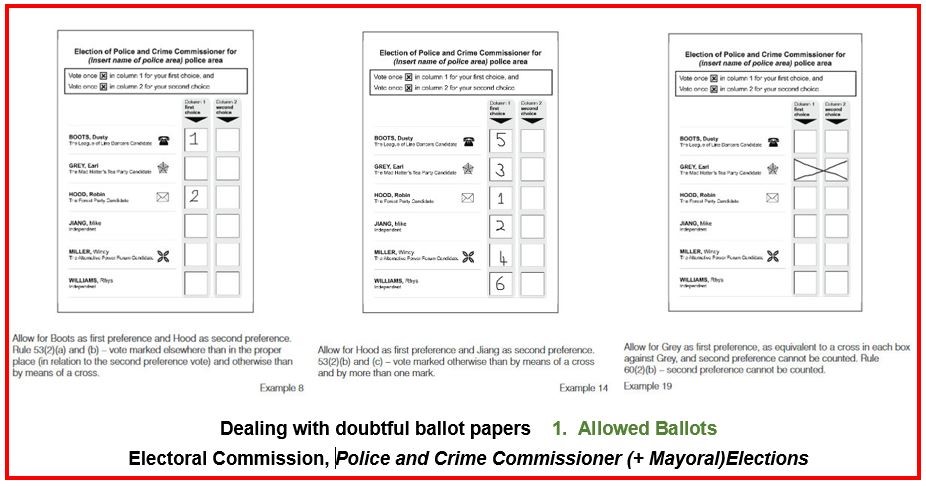
Obviously, none of the allowed ballots conform to the voter instructions quoted at the start. So, would the computer have rejected them? If so, would they have found their way to the RO – and, following scrutiny, all three been allowed back into the first count and Examples 8 and 14 into the second? Or were one or all part of the 87,214?
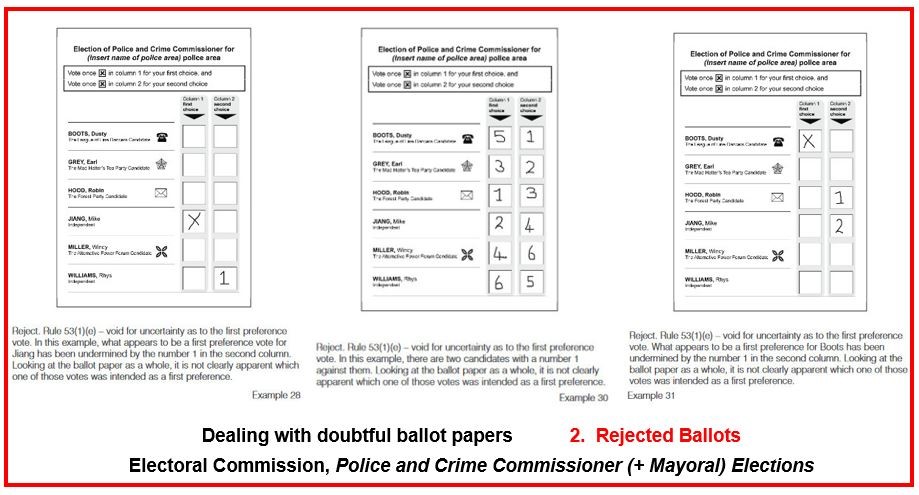
The ’Rejects’ are slightly trickier, because it requires acknowledgement of these Mayoral and PCC elections potentially comprising two completely separate counts. Yet examples 28 and 31 do precisely what the ballot paper instructs for inclusion in the first count, while 30 does precisely what was deemed allowable in Example 14. Without going into further detail, and taking account of the latitude granted in the ‘Allowed’ examples, a case could easily be argued for all three being eligible for inclusion in the second count.
As will be evident, much of the above is conjecture. I do, though, seriously feel we need to know more about that 87,214 and whether it comprised significant numbers of cases where the voter’s intention could have been divined.

Chris Game is an INLOGOV Associate, and Visiting Professor at Kwansei Gakuin University, Osaka, Japan. He is joint-author (with Professor David Wilson) of the successive editions of Local Government in the United Kingdom, and a regular columnist for The Birmingham Post.
 INLOGOV Blog