The colour (and gender) of power

Chris Game

As a blogger, I see myself as a kind of Middlesbrough in the Premier League: beigey. Not significant enough to attract the serious detestation of a Chelsea or Man United, but nor with the widespread likeability of a Bournemouth or Burnley. It means any feedback I receive is rarely obscene and generally supportive or constructive – an example being my recent blog on the West Midlands Combined Authority, whose initials, I’d suggested, could stand for “the (almost) Wholly Male Combined Authority”.

A respondent from Localise WM, a not-for-profit organisation that promotes local trading, tweeted that the initials “could alternatively stand for White and Male Combined Authority”.  And they were quite right. The figures are identical: one woman member and one (different) BAME member on the currently 33-member WMCA Board.

I had two main reasons for omitting any discussion in that blog of the minority ethnic dimension. First, space. I wanted to record not just the statistics of women’s under-representation in the elected Combined Authority world, but the efforts to improve that representation in, for example, Greater Manchester and Liverpool, prompted by local women’s campaign groups.

The second reason was that I was aware of a project on the point of publication that would almost certainly furnish the data to enable a more informed and better illustrated discussion. Not, as it happens, this week’s delayed launch of the Cabinet Office Race Disparity Unit, intended to monitor how public services discriminatorily treat people from different racial and ethnic backgrounds. I had in mind the Guardian newspaper’s international Inequality Project, a small but important part of which is ‘The Colour of Power’ (CoP) study undertaken by Operation Black Vote and the business management company, Green Park.

The CoP website suggests that “when we embarked on this journey, we did not know exactly what we would find”. Commendably open-minded, but my guess is they actually had a VERY good idea of what they’d find – that “in 2017, pathways to the very top jobs for Britain’s black and minority ethnic communities are almost non-existent” – and wanted to use an obvious but still highly effective means of quantifying and publicising it. The actual figures they recorded were that “for over 1,000 of the most senior posts in the UK, only 3.4% of occupants are BAME [30 men, 7 women], and less than 24% women”.

Shocking as such statistics ought to seem on their own, pictures are harder to ignore or refute – one reason why the row over the BBC presenters’ gender pay gap took off so instantly: we knew what most of them looked like. And it was why, following the similar 2016 #Oscarssowhite furore, the New York Times produced its famous ‘Faces of American Power’ feature, actually picturing the faces – and genders and colours – of the ‘Power People of America’.

That’s precisely how ‘Colour of Power’ have presented their data. There are 37 sets of pictures in all, from the CEOs of FTSE 100 companies, public bodies, advertising agencies and top charities to editors of women’s lifestyle mags and Premier League football managers – a selection of which, mainly from national and local government, I’ve summarised in my table.
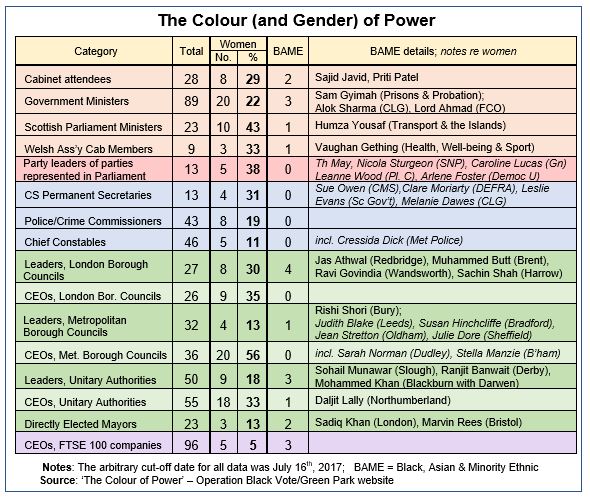
Colour%20of%20Power%20table.JPG

Knowing an albeit ludicrously dated authorial photograph would accompany this blog, and having recently celebrated my no-longer-titian beard’s 40th birthday, I did briefly contemplate adding a facial hair column to the table. But it turned into a version of the even older Peter Cook sketch, about it being only his lack of Latin that prevented his becoming a judge, rather than a coal miner.

It became apparent that my becoming not just a Supreme Court Judge, but a Chief Constable, Permanent Secretary, or CEO of a top bank, was effectively stymied from the outset by the beard. Easily my best chance of even proximity to power would have been, like Jeremy Corbyn, to become a party leader, with three of the eight male leaders unvictimized for their full facial hair.

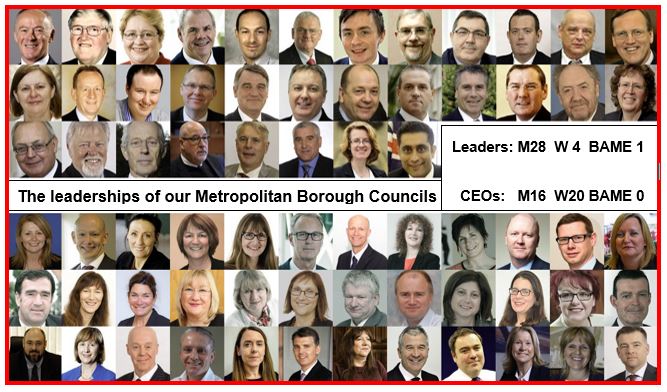
I did, though, want to illustrate CoP’s method and presentation, and I chose the politician and officer leaders of the councils which, outside London, have the highest numbers and proportions of BAME residents: the 36 metropolitan boroughs, with approaching 2 million or nearly 15%. I wasn’t expecting the councils’ members and officers to reflect these figures in any statistically significant way, but I did think they might come fractionally closer than, say, unitaries. So it was fortunate I didn’t put money on it.


Operation Black Vote, ‘The Colour of Power’, BAME political representation, International Inequality Project, Race Disparity Unit, women local authority CEOs
Met%20Borough%20leaders.JPG

A few of the leaders were apparently camera-shy, but the contrast between the M/F balance of leaders and CEOs – here particularly, but in councils of all types – was something else I hadn’t entirely anticipated. The clear majority of women CEOs in the mets, incidentally, was the only such figure apart from the MDs of media agencies and editors of women’s fashion and lifestyle magazines – and I did briefly consider using just the middle row, or even the phalanx of five just left of centre.

Which would have been a nice positive note on which to close, but in the circumstances also a false one. For the message of the CoP exercise – the almost complete absence of BAME faces, here and throughout the local government tables – is simply an embarrassment. Yet these are the people responsible, accountable even, for many of the services producing the disparities and ‘burning injustices’ that the PM and her Disparity Unit are pledged to eradicate. Quite an ask.

gameChris Game is a Visiting Lecturer at INLOGOV interested in the politics of local government; local elections, electoral reform and other electoral behaviour; party politics; political leadership and management; member-officer relations; central-local relations; use of consumer and opinion research in local government; the modernisation agenda and the implementation of executive local government.

Control freakery: Understanding who really gets to take control

Steve Rolfe

When Michael Gove reiterated the Brexiteers’ mantra of ‘taking back control’ at the recent Conservative Party Conference there was a strong sense of déjà vu about the whole performance. And not just because we’ve all heard the ‘taking back control’ message over and over again in the last 18 months. The repeated rhetoric of control also has strong echoes of an earlier Conservative policy idea – the notion of a ‘Control Shift’ at the heart of Localism and the Big Society. And the parallels go further. Just as campaigners have questioned what it might mean to ‘take back control’ after Brexit and who ends up in control, so my Local Government Studies paper, ‘Divergence in Community Participation Policy: Analysing Localism and Community Empowerment Using a Theory of Change Approach’ questions the policies which ostensibly aim to give power and control to communities.

Back in the early days of the Coalition government (remember those innocent pre-EU-referendum days?), the ideas of the ‘Big Society’ and shifting control to communities through Localism were big news, even if nobody could really work out what David Cameron meant by the Big Society. A whole raft of ‘new community rights’ were created, giving communities opportunities to challenge and take over public services, buy local assets, create their own Neighbourhood Plans and even develop local housing. Alongside this, the Localism Act aimed to ‘strengthen accountability’ of public sector organisations through directly elected mayors and Police and Crime Commissioners, plus referenda on ‘excessive’ council tax increases. At the same time, the Scottish Government were using similar language to set out their Community Empowerment agenda, giving communities rights to participate in service improvement and extending rights relating to control and ownership of land and assets. Both these policy frameworks are still in place, shaping community participation across England and Scotland, albeit that anything non-Brexit gets very little media attention these days.

On the surface, Localism and Community Empowerment seem to share many common features. Both see community voices as an important tool to improve public services, and community action as a means to fill some of the gaps between such services. Moreover, the language of ‘devolving power to communities’ sounds very similar on both sides of the border. However, as I try to argue in my paper, a more detailed look at the assumptions underlying Localism and Community Empowerment suggest that the UK and Scottish Governments have quite different ideas about how communities should participate and how they should relate to public sector agencies.

Crucially, the Scottish Government’s agenda emphasises a positive-sum conception of empowerment, where communities and public sector agencies each gain power by working together collaboratively. By contrast, most of the elements within Localism operate on a zero-sum basis, focusing on taking power away from the local state to give it to communities. Clearly there are risks in both approaches. In the Scottish partnership approach local authorities may simply hang on to power and refuse to collaborate – the evidence from decades of community work in Scotland provides many examples of intransigent bureaucrats, although also many tales of productive cooperation. In England, analysis of the policy detail suggests there are more complex and subtle risks involved. Hidden beneath the rhetoric of community rights are mechanisms which turn communities into ‘market-makers’, forcing local authorities to put services out to tender and challenging limits on house-building. Hence control is not so much shifted to communities, but rather handed to the free market and private businesses.

Interestingly, however, the more recent evidence about the use of Localism’s ‘new community rights’ suggests that communities are savvier than David Cameron perhaps expected. The Community Right to Challenge (the most blatantly market-focused element) has been hardly used in the six years since it was instituted. And whilst Neighbourhood Planning has proved very popular across England, most communities are attempting to use it to exert some control over the local housing market, rather than letting it rip.

So perhaps those fans of Brexit who continue to trumpet the idea of ‘taking back control’ may need to reflect a little on who is actually gaining control as we leave the EU. The evidence from community participation policy suggests not just that the rhetoric may be concealing the intended winners in the process of shifting control, but also that such processes are often unpredictable as multiple actors attempt to impose their own notions of control.


Steve%20Rolfe%20pic.jpgSteve Rolfe is a Research Fellow at the University of Stirling. His research interests include community participation and empowerment, social enterprise and housing. Before entering academia, he worked in local government for 15 years in a range of community development and policy roles.
Measuring Mandates – Let’s at least use the facts

Chris Game

Maybe it was a Monday morning thing.  But when last Monday’s Times – once, to foreigners at least, the ‘newspaper of record’ – recycled for the umpteenth time the claptrap about London Mayor, Sadiq Khan, having “the third biggest personal mandate of any directly elected politician in Europe”, my 16 months’ silent tolerance ran out.

The probably familiar story was that Mayor Khan, not being an ‘ordinary’ Labour Party member, had been barred from addressing ‘the people’s conference’. But then, presumably because he’s one of the relatively few Labour people who do actually run something – like Greater London – and decide stuff – like the fate of Uber – he was unbarred.

Unlike Mayor Andy Burnham, who also runs something – Greater Manchester – but who actually challenged Jeremy Corbyn for the party leadership, and has a willy – sorry, personal mandate – smaller than Corbyn’s, barely a quarter the size of Khan’s, and was easily side-lined to fringe meetings.

Because that’s what most of these things are fundamentally about in the male-dominated world of politics: if you’re a union leader, the size of your membership; if an MP, the size of your majority; if a council leader, the size of your electorate; and if a directly elected leader, the size of your mandate – all willy substitutes. Which is why it’s important to get the measurements right – unlike The Times, which, like at least some of our students, apparently uses Wikipedia as its bible of factual information.

The pity is that Sadiq Khan’s genuine statistical achievements are impressive enough not to need exaggerating. Largest personal mandate of any politician in UK history. First elected Muslim mayor of any major western capital.

To me, it was the precision of the Wiki/Times factoid that made it immediately suspicious – ‘third biggest’ personal mandate, of any directly elected European politician? It never even sounded right. After all, Europe’s a biggish place. Nearly 50 countries, even excluding the Vatican. At least 30 with populations over 3 million, where a personal vote bigger than Khan’s 1.3 million is at least conceivable.

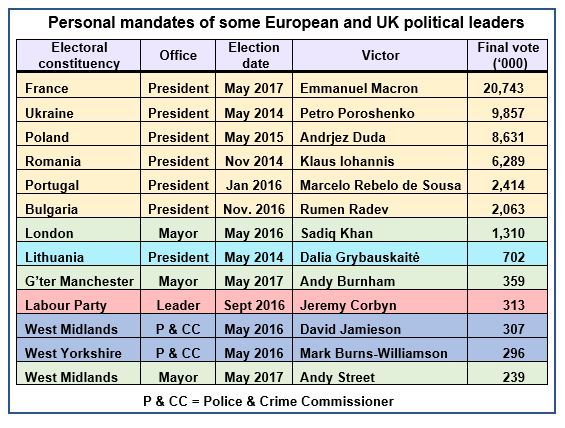
It seemed a bit like assuming Andy Street, because he’s elected mayor of the largest mayoral Combined Authority, has the biggest personal mandate of any political figure outside London – instead of, as shown in my table, only the second biggest in the West Midlands.

Politicians%27%20personal%20mandates%202.JPG

Anyway, back to the Khan claim, and a couple of early concessions. Let’s accept President Erdoğan’s Turkey, with the great majority of its population in Asia, and despite most holiday insurance classifications allowing it as European, counts as either Asia or Middle East. And Russia, though over three-quarters of its population live in Europe, as technically Eurasian. Otherwise, President Putin’s nearly 47 million votes in 2012 would present quite a hurdle.

But Ukraine, as every pub quizzer knows, is the largest country entirely in Europe.  Maybe not your established, Scandinavian-model democracy, but it is a kind of French-style semi-presidential republic, with a multi-party system. And its 2014 post-revolution presidential election – though excluding the annexed Crimea and certain other areas – was accepted by scrutineers both for its (broadly) democratic conduct and outcome: President Poroshenko’s decisive first-round victory.

France itself is one of Wiki’s top two, Emmanuel Macron comfortably topping 20 million personal votes in the second round of this May’s presidential elections. The other Wiki nominee, though, is Portugal’s President Rebelo de Sousa, which would be fine, were he not the only other nominee.

Like France, Portugal is one of the semi-presidential systems that constitute almost the governmental norm in modern-day Europe. They’re all different, particularly in their division of powers between the head of government and head of state. The key questions: is the president/head of state directly or indirectly elected, and, if directly, is s/he politically significant or essentially a ceremonial figurehead?

Portugal’s President was elected in a party political election and has real powers, from dismissing governments to vetoing laws and granting pardons. Wiki is quite right, therefore, to include it – but quite wrong to suggest that President Rebelo de Sousa is, apart from Macron, the only European politician with a bigger personal mandate than the London Mayor’s.

Wrong, partly because it appears not to understand the huge breadth of practice found in different ‘semi-presidential’ systems, and partly because its ‘Europe’ appears to stop at the Oder-Neisse Line, the former border between the German Democratic Republic and Poland. Even then, though, Poland, Romania and Bulgaria, like Ukraine, were European countries – their EU membership is a bit of a giveaway – and today, like France and Portugal, are semi-presidential republics whose Presidents are very far from symbolic.

If you’ve any doubt, just think back to the Polish bit of William and Kate’s embarrassing summer ‘Brexit tour’. Monday, they were shaking hands with President Duda at the Pres’s palace. Tuesday, he was assuring TV viewers that his Law & Justice Party’s plans to give government the power to appoint and dismiss judges were purely to increase judicial efficiency, and really nothing alarming. Wednesday, legislation was rushed through parliament allowing the government to dismiss at will any of the 83 Supreme Court judges.

Not exactly the kind of stuff a genuinely ceremonial Head of State like William’s grandma gets up to, so let’s hope the handshake was worth it when it comes to Poland’s vote on any Brexit deal – if indeed the EU Commission hasn’t by then suspended the country’s voting rights.

Apologies for the digression, but my point is simply that Presidents Duda, Iohannis, Radev and Poroshenko are no less “directly elected European politicians” than President Macron, which I reckon puts Mayor Sadiq Khan’s mandate down from 3rd to 7th in the list. Still ahead of that of any directly elected woman politician in Europe – Lithuania’s President Dalia Grybauskaitė – but then she hasn’t got one to feel the need to wave.

gameChris Game is a Visiting Lecturer at INLOGOV interested in the politics of local government; local elections, electoral reform and other electoral behaviour; party politics; political leadership and management; member-officer relations; central-local relations; use of consumer and opinion research in local government; the modernisation agenda and the implementation of executive local government.