Make elections work for you: check the polls, but follow the money

Chris Game

Spoiler alert: this is a blog about elections, but not local elections – mainly because it’s about election betting, and, with one conspicuous exception, which will be mentioned, our modern-day local election contests and candidates are rarely of sufficiently general interest to attract much serious fixed odds betting.

My prompt was the Conservatives’ recourse to their apparently hastily conceived Campaign Plan C – following the failures of A: negative, personal and increasingly counter-productive attacks on Ed Miliband; and B: daily, unexplained and increasingly implausible financial treats for everyone from NHS patients and rail users to volunteers and better-off housing association tenants.

Plan C involves drawing on – or alarmingly, in the latter case, ‘weaponising’ – the proven, if contrasting, electioneering skills of famous grey man, soapbox campaigner and former PM, John Major, and safe seat candidate and London Mayor, Boris Johnson.

Let’s start with Johnson, the opening paragraph’s ‘conspicuous exception’. You can currently get odds of 33/1 both on his being the next London mayor and next Deputy Prime Minister, and a very short 1/50 on his becoming MP for Uxbridge and South Ruislip – which in itself gives a small hint of the huge growth in recent years of so-called novelty betting in general and political betting in particular.

We wagered over £1 million on Prince George’s arrival in 2013 and could well top that this time. Current shortest odds are on a blonde female, eventually named Alice, born on April 25, with 50/1 on triplets and 1000/1 on the hapless infant being named Boris. But royal births are peanuts compared to political betting. Bookies reckon we laid out £30 million on the 2010 election, £50 million on the Scottish independence referendum, and predict this election will be the first UK non-sports betting event to break £100 million.

With William Hill’s taking bets online of £200,000 and over the counter of £50,000 on a hung parliament – at 2/9 and 1/8 respectively – it suggests some clearly see it as an easy earner, and they could be right. The odds on these big bets may be short – £50,000 at 1/8 would win just £1 for every £8 staked, or £6,250 plus the returned stake. But that doesn’t necessarily make them unattractive compared, say, to the 8/1 (£8 for £1 staked) you could get on an improbable coalition involving the Scottish Nationalists.

The attractiveness of particularly these short odds bets obviously depends on whether you think the bookies can predict the results of election races as skilfully as they can horse races and football matches. Put another way, and the main topic of this blog: who are generally more reliable – pollsters or punters?

Step up, John Major, the country’s most electorally successful living Conservative, thanks to his historic triumph in the 1992 General Election. Averaged out, the then four main final polls put Labour ahead on 39%, the Conservatives on 38%, and projected a comprehensively hung parliament. Next day, Labour managed just 35%, while the Conservatives won nearly 43% and a Commons majority of 21 seats. Major became the only UK party leader ever to win 14 million votes – nearly a third more than Cameron in 2010 – a hung parliament was postponed for another 18 years, and ‘shy Tories’ had arrived as a pollster’s nightmare. For a young and still mistrusted polling industry it was a humiliating setback.

It has, as the current campaign daily demonstrates, recovered, grown, and evolved methodologically almost beyond recognition. At the same time, particularly with the proliferation of smaller parties, both polling and seat prediction have become considerably more hazardous. All political pollsters, however, are parts of large commercial companies. Screw up, and their other clients immediately know, so generally they’re highly rigorous and pretty good – provided you judge them reasonably.

They’re not predictors or forecasters. They take time-specific opinion snapshots, with different interrogatory cameras – some using online panels, some random digit phone dialling – of what they hope are politically as well as demographically representative samples of the whole electorate. But because they’re samples, mostly of between 1,000 and 2,000, not much more than 19 times in 20 will any single response be within 3 per cent (plus or minus) of what it would be, had the whole population been surveyed.

This means two things: first, roughly every 20th finding or poll will be outside that +/- 3 per cent margin of error; second, that ‘rogue poll’ will invariably attract more media attention than the rest put together.

That’s almost certainly what happened in the last fortnight of the Scottish referendum campaign. Of nearly 40 polls published between June and the September 18 polling day, only two put the Yes vote ahead. The coverage given to particularly the first of these polls was enough, though, to prompt all three major party leaders to panic in concert, rush up to Scotland, and make desperate vows and commitments they’re still regretting.

It doesn’t, though, explain why the averaged five final polls put the No vote on 49.2%, with a lead of just 4.2% – when the actual result was 55.3% to 44.7%, and a No lead of 10.6%. Poor methodology, very late change, shy No voters, whatever – the pollsters got it wrong.

And they got it as badly wrong – or, in fairness, their Israeli counterparts did – in this year’s perhaps most publicised elections: those in March to the Israeli Knesset, called early by Prime Minister and Likud Party leader, Benjamin Netanyahu.  The averaged seat projections of the final seven polls published before Israel’s five-day pre-election poll ban gave Likud 22 seats and its main opposition, Isaac Herzog’s two-party Zionist Union 26 – prompting newspaper headlines like the Daily Telegraph’s ‘Bye-bye for Bibi?’.

The three exit polls suggested that the four-point gap had been closed in the final few days’ campaigning, but none came anywhere near the actual result of a six-seat lead (30-24) to Likud/Netanyahu. In what is a 120-seat legislature, with 10 parties having at least five seats, forming a government is tricky, but, in these matters anyway, Israelis are more patient than we are, and the permitted 42 days have been extended to allow Netanyahu until May 6 to name his.

Those ‘Bye Bye, Bibi’ headlines, however, weren’t the only ones. Gambling sites and the more refined ‘prediction markets’ were giving Netanyahu “an 81% chance of being re-elected”, and offering the equivalent of fractional odds of 1/6 on his winning and 4/1on losing.

It could have been a replay of the Scottish referendum. Over that final ten days, while English politicians and pollsters were over-reacting, the betting odds, overwhelmingly predicting No throughout the campaign, hardly wobbled: around 7/2 against Yes, and 1/4 for No. Indeed, one firm paid out a six-figure sum on a No bet three days before polling day.

These cases of the betting industry having a better sense (no apologies; pun deliberate!) of what’s actually happening aren’t the exceptions that prove the rule; they are the rule – a rule, moreover, that’s logically to be expected. Pollsters ask about our voting intentions and opinions, whereas bookies and bettors focus only on results and outcomes. Above all, though, they back their judgement with their money. So watch the polls carefully, as the bookies do, but if in doubt, then, as Americans might say, follow the frogskins (greenbacks for the alliteratively inclined).

At the time of writing – Wednesday 22nd – there have been 11 new polls since last Thursday’s BBC1Opposition Leaders’ debate. Five put the Conservatives ahead in percentage votes, five Labour, and one had them tied on 34 per cent.  There have also been seven poll-based seat forecasts: five showing the Conservatives ahead, two Labour.

No division among the bookies, though. The best seat-number odds being offered on Labour by any of Oddschecker’s 24 bookmakers were 21/10, while the best on the Conservatives were 1/2. Next PM, though, is very different: Miliband was 3/4 and shortening; Cameron 11/8 and drifting – rather like his party’s campaign.

Chris Game - pic

Chris Game is a Visiting Lecturer at INLOGOV interested in the politics of local government; local elections, electoral reform and other electoral behaviour; party politics; political leadership and management; member-officer relations; central-local relations; use of consumer and opinion research in local government; the modernisation agenda and the implementation of executive local government.

An invitation to the 7th annual postgraduate colloquium

The School of Government and Society plays host to the 7th Annual Postgraduate Colloquium, being held in room 429 of Muirhead Tower on Wednesday 29th April between 9am-4pm. This event provides postgraduate researchers from across several departments the opportunity to showcase their research and present their latest findings.

Readers of this blog are invited to attend, especially those currently undertaking post-graduate research or who are thinking of doing so in the future, whether at Birmingham or elsewhere.

We have a full day of panels lined up with papers from PhD researchers from across the School, more details of which can be found on the website:

http://www.birmingham.ac.uk/schools/government-society/events/2015/04-29-annual-postgraduate-colloquium.aspx

A free lunch will be provided on the day and a drinks reception will follow for all colloquium delegates and presenters from 5.30 onward.

Please confirm your attendance on our Facebook event page: https://www.facebook.com/events/350231068509806/

We look forward to seeing you all there and if you have any questions in the mean time please get in contact with Max Lempriere at [email protected]

Council Tax Support – anatomy of a Pickles’ localism triumph

Chris Game

Shortly before the dissolution of Parliament, Communities & Local Government Secretary Eric Pickles issued an apparently self-penned eulogy of his ministerial record, entitled on the Government’s own website, in characteristic, cod Churchillian, style: Local Government: Delivering for England. It makes an interesting document, as would be hoped of one requiring two separate links.

First, I want to emphasise that it’s a genuinely useful exercise. It’s already easier than probably ever before to find out what the government thinks its policy is, at any particular time, both generally and by department and topic. Currently it has 224 of them. The DCLG has 24, including four each on local government and housing, and a rather extraordinary 215 “contain ‘local self-government’”.  There’s at least a Masters dissertation, surely: which nine Coalition policies failed to tick the ‘local self-government’ box?

Pickles’ eulogy, though, is quite different: a consummate politician’s listing of 60+ bullet-pointed triumphs and achievements, the like of which I at least can’t recall having for any previous administration.  The gov.uk version even gives us a proxy measure of the difference – in the dozens of instances of ‘[political content removed]’. And there’s another dissertation: the insight provided by the redacted and unredacted versions into civil service interpretation of ‘political content’ in the run-up to a General Election.

None of this, however, provides more than the opening key to the main subject of this blog. Somewhere between Pickles’ 50th and 60th bullet points – shortly before “supporting the Royal Wedding, Diamond Jubilee and VE Day by cutting Whitehall and municipal red tape on holding street parties, and introducing new laws to cut ‘elf and safety’ red tape on community events” – was “localising Council Tax Support (CTS), so councils are rewarded for getting people off the dole and welfare dependency and back into work, £1 billion has been cut from previous Council Tax Benefit (CTB) funding, and councils themselves bear the responsibility of increasing the living costs of some of their poorest residents.”

OK, I’d better come clean.  The ‘elf and safety’ bit is totally genuine – straight from the Pickles jar, as it were – but I’m afraid the last couple of clauses, after ‘back into work’, are mine, though, I would claim, entirely accurate and in a way slightly admiring.

For the CTB changes were Pickles’ self-styled muscular localism at its most politically skilful – a devolution of an important responsibility, impossible for councils to refuse, yet accompanied by conditions and constraints that meant any flak would go to them and any credit to the Conservative part of the Coalition.

The publication in the middle of the election campaign of the New Policy Institute’s third annual CTS monitoring report provides a timely opportunity to review one of the Coalition’s key and most controversial social policies, whose approaching launch was covered at the time in these columns.

The essence of the 2012 Welfare Reform Act was to replace, from April 2013, the means-tested Council Tax Benefit, paid for by the Department for Work and Pensions but administered to nearly 6 million recipients by local authorities, by Council Tax Support schemes individually determined and operated by the authorities themselves, and funded through business rates retention. It sounded like a laudable transfer of responsibilities from Whitehall to town hall – until you came to the attached strings.

First, with the professed aim of strengthening councils’ incentives to get people back into work, the amount the Government would pay local authorities for their new schemes would be 10% less than for CTB – creating for my own authority of Birmingham, for example, a funding gap of nearly £11 million.

Second, it ruled that pensioners receiving CTB must, and other particularly vulnerable groups should, be protected against any reduction in support – meaning in Birmingham that 54,000 pensioners were protected, while 83,000 working-age recipients were left shouldering potentially the whole savings burden.

It was only here, then, that the localism bit actually kicked in, with councils having the discretion, within a very tight deadline, to devise their own schemes to achieve these savings – and collect the taxes from their tens of thousands of new and aggrieved taxpayers.

In practice, this discretion amounted to three unenviable choices: spreading the cut in funding equally across virtually all CTB recipients apart from pensioners; giving the rebate to certain groups only; or continuing with the full rebate, and filling the gap either through raising council tax or finding savings elsewhere, on top of the savings already being demanded by the Government.

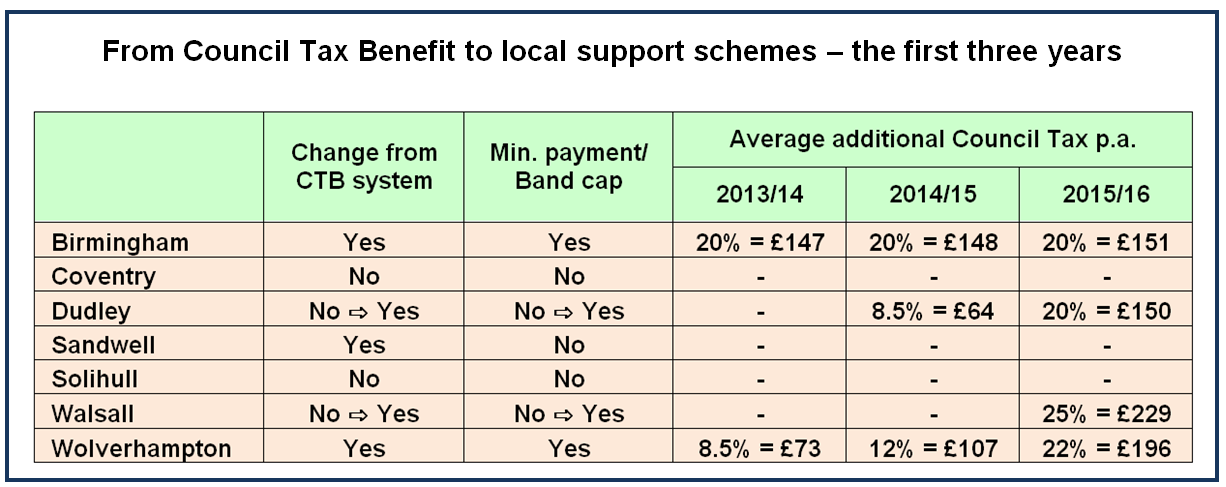
It would have been odd for a policy wholly designed to produce local difference not to do so, and there was and continues to be significant variation, in the metropolitan West Midlands as across the country. The practices adopted by the seven West Midlands metropolitan boroughs, though not statistically reflective of the national picture, can usefully illustrate it.

Game 9th April blog table

At that first time of asking in 2013, nearly 18% of the 326 English councils decided to continue with the same CTB-level rebate and somehow find the money, including four of the West Midlands seven.

70% of councils nationally and in the West Mids Birmingham and Wolverhampton – the two with the largest affected caseloads – introduced ‘minimum payment’ schemes, requiring everyone to pay at least some council tax, regardless of income. In Birmingham, therefore, it meant that almost all working-age people paid at least 20% of their council tax, representing an average annual payment of £147 or just under an extra £3 per week.

The remaining authorities, including Sandwell in our table, rejected ‘minimum payment’ but introduced other changes. Sandwell’s adjustments over the three years have included changing the income taper – the amount by which support is withdrawn as income increases; lowering the maximum savings limit over which one is no longer eligible for benefit; and reducing the second adult rebate – the benefit homeowners not on a low income receive if they share their home with someone (non-partner) on low income.

The main trends identified by the New Policy Institute over the now three years of CTS’ operation are the drop by nearly a third in the number of authorities still retaining all features of CTB, and the increase in percentage minimum payments – both seen in the West Midlands table. Nationally, 2.3 million low income families will pay on average £167 more in council tax in 2015/16 than they did under CTB, and 11% of those 2.3 million have also been affected by the ‘Bedroom Tax’ or ‘removal of the spare room subsidy’.

As for local councils, as is usually the case, they’ve generally coped – possibly too effectively for their own good. Some council tax collection rates have fallen fractionally, but nowhere (to my knowledge) as drastically as some predicted at the time. New council schemes to reduce worklessness are springing up all the time, but it’s difficult to identify which, if any, of these is incentivised by the CTB changes.

Something, though, is quantifiable.  Roughly £1 billion has been transferred from central government’s welfare bill to the shoulders of local government – and is being borne variously by increased bills for council tax support claimants, reductions in the claimant count, increased council tax bills for all, and reductions in other council budgets.  But then that’s muscular localism for you.

Chris Game - pic

Chris Game is a Visiting Lecturer at INLOGOV interested in the politics of local government; local elections, electoral reform and other electoral behaviour; party politics; political leadership and management; member-officer relations; central-local relations; use of consumer and opinion research in local government; the modernisation agenda and the implementation of executive local government.

An earlier version of the blog was published by The Chamberlain Files.